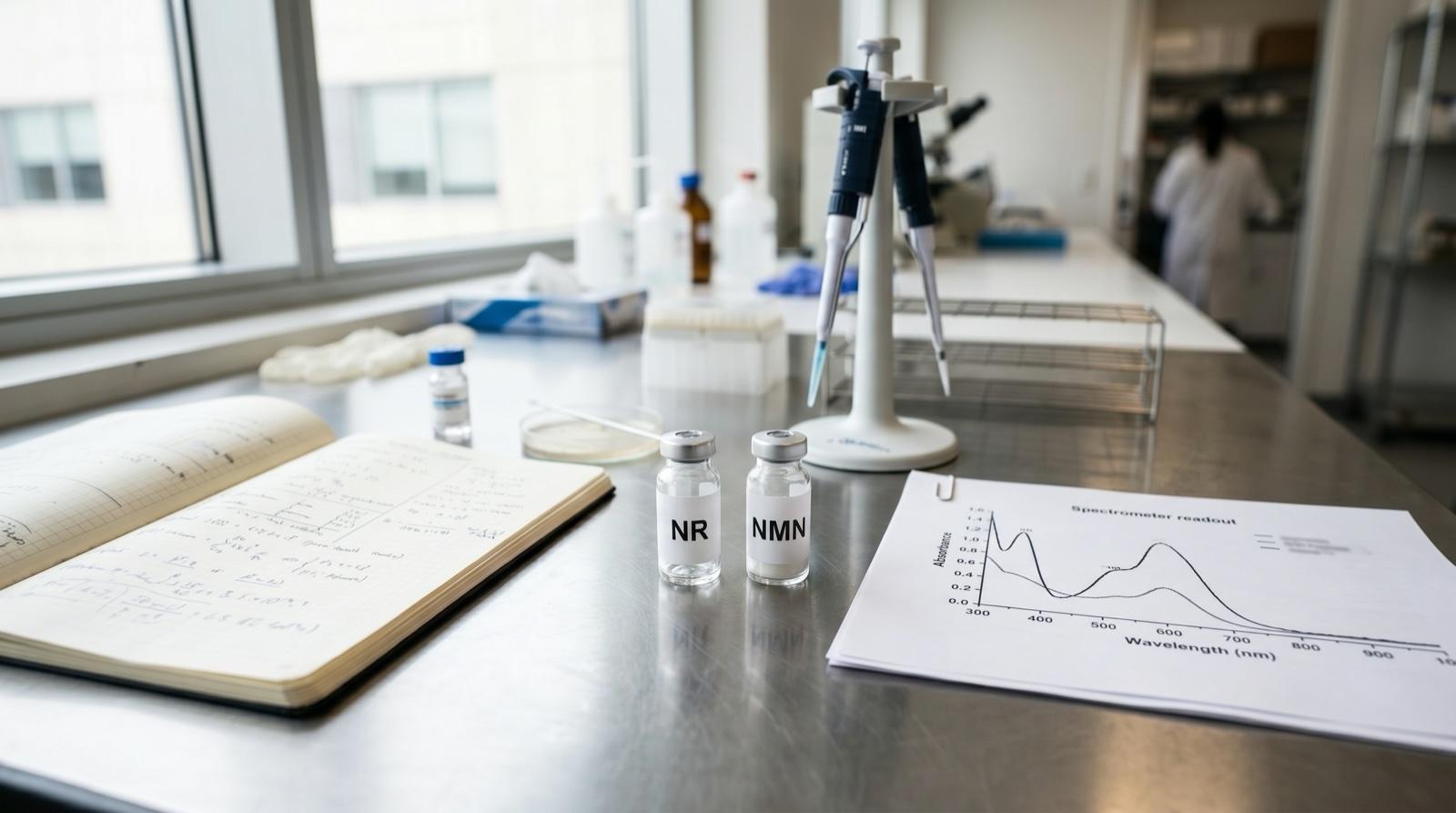
NAD+ Precursor Drug Interactions: What Research Shows
Niacin-statin rhabdomyolysis risk is documented; NR/NMN concerns with chemo, anticoagulants, and methyl donors remain theoretical. Ask your clinician first.
The best-documented NAD+ precursor interaction is niacin plus statins, where combined therapy has raised rhabdomyolysis risk in published clinical contexts (Brown et al., 2001, NEJM; PMID 11757504). Most other concerns with NR, NMN, and nicotinamide remain theoretical or preclinical. This article summarizes what research suggests — but it does not replace a conversation with your physician, pharmacist, or oncologist.
Why does NAD+ precursor interaction data matter?
NAD+ precursors sit at a metabolic crossroads. According to Trammell et al. (2016, Nature Communications; PMID 27721479), oral nicotinamide riboside raised blood NAD+ in humans within hours through the salvage pathway — which means these molecules act on enzymes (NAMPT, PNMT, sirtuins, PARPs, CD38) that also modulate responses to dozens of common prescription drugs. A supplement that changes substrate availability for a shared enzyme is not metabolically inert.
The practical problem is that formal drug-interaction studies for NR and NMN remain sparse. Most published human trials, including Conze et al. (2019, Scientific Reports; PMID 31431637), enrolled healthy adults on no prescription medications. Interaction signals in people taking statins, anticoagulants, chemotherapy, or immunosuppressants have not been systematically measured. The absence of documented harm is not the same as evidence of safety.
The mainstream supplement narrative treats “no reported interactions” as equivalent to “no interactions exist.” For drugs where the pharmacology is well-characterized, that inference is fine. For NR and NMN, where most trials excluded medicated participants, the inference is premature. Conservative framing says: we do not know, and until we do, clinician oversight is the default — not the exception.
What about niacin and statins? (Documented)
High-dose niacin plus statin therapy is the best-documented NAD+ precursor drug interaction. Brown et al. (2001, NEJM; PMID 11757504) first described elevated myopathy and rhabdomyolysis risk when niacin was combined with lovastatin in a lipid-modifying regimen. Guyton and Bays (2007, American Journal of Cardiology; PMID 17291473) reviewed niacin pharmacology and confirmed the co-administration signal at pharmacological doses (typically 1,500-3,000 mg/day).
The AIM-HIGH trial (Boden et al., 2011, NEJM; PMID 22085343) terminated early for futility on cardiovascular endpoints, but the trial-level adverse event profile reinforced concerns about niacin combined with simvastatin in real-world patients. Niacin at these doses — not the low-dose nicotinamide or NR found in most longevity supplements — is what drove the interaction signal.
Does the niacin-statin concern apply to NR or NMN?
In reviewing clinical trial data across the NR and NMN literature, we have not found a published case of rhabdomyolysis attributed to NR or NMN at studied doses. That said, the question has not been formally tested. NR and NMNdo not share niacin's prostaglandin-mediated vasodilation mechanism, which is thought to underlie some of the muscle-toxicity signal. The pharmacology is different enough that extrapolation is not obvious in either direction.
The conservative reading: patients on statins who are considering NR or NMN should still flag the addition to their prescribing clinician. The pharmacist can run an interaction check, and baseline CK with follow-up monitoring is a reasonable precaution at higher doses.
Can niacin affect diabetes medication? (Documented)
Yes. Pharmacological niacin raises fasting glucose and can worsen glycemic control in patients with established type 2 diabetes — a documented effect summarized in Guyton and Bays (2007, American Journal of Cardiology; PMID 17291473). Knip et al. (2000, Diabetes) reviewed nicotinamide trials in type 1 diabetes prevention and noted the distinct metabolic profile of nicotinamide versus niacin. The two are not interchangeable from a drug-interaction standpoint.
For patients on metformin, sulfonylureas, SGLT2 inhibitors, GLP-1 agonists, or insulin, high-dose niacin can shift glucose targets and require dose adjustment. This is a clinician-managed decision, not a self-managed one. Nicotinamide, NR, and NMN have not demonstrated the same glucose-raising signal at studied doses, though long-term data in diabetic populations is limited.
Are NAD+ precursors safe during chemotherapy? (Theoretical, concerning)
This is the most important theoretical interaction in the field, and the answer is: probably not, at least not without oncology oversight. Chini et al. (2020, Nature Reviews Cancer; PMID 32601385) reviewed NAD+ metabolism across tumor biology, showing that many cancers upregulate the NAMPT salvage pathway to maintain NAD+ pools required for rapid proliferation. Adding substrate to a pathway tumors depend on is not a neutral intervention.
Hwang and Song (2017, Cellular Signalling) specifically reviewed NAD+ roles in chemotherapy resistance, showing that NAD+ availability can influence PARP-mediated DNA repair in tumor cells — the same mechanism that PARP inhibitors (olaparib, niraparib) are designed to block. A precursor that elevates tumor NAD+ is mechanistically positioned to blunt the effect of these drugs, at least in preclinical models.
Across the ~30 published NR and NMN human trials we reviewed, zero enrolled participants on active chemotherapy and none were designed to evaluate interaction with oncology regimens. The absence of human safety data in cancer populations is itself a safety signal — not reassurance.
Do NAD+ precursors affect blood thinners? (Theoretical, weak)
The mechanistic concern is real but the clinical data is thin. Sirtuins and NAD+/NADH ratios participate in platelet aggregation signaling, and CD38 is expressed on platelets. In theory, a large shift in intracellular NAD+ could modulate platelet function and influence the pharmacodynamics of warfarin, apixaban, rivaroxaban, clopidogrel, or aspirin. No published human trial has directly measured bleeding risk on NAD+ precursors, however.
For patients on anticoagulants, the practical approach is unambiguous: flag the supplement to the prescribing clinician, and monitor INR (for warfarin) or bleeding signs for a few weeks after starting. This is not alarmism — it is the same reasonable precaution applied to any new supplement added to anticoagulant therapy.
Does nicotinamide deplete methyl donors? (Mechanistic)
Nicotinamide clearance runs through N-methylnicotinamide via nicotinamide N-methyltransferase (PNMT), which consumes S-adenosylmethionine (SAMe) as the methyl donor. Jacobson et al. (2007, American Journal of Clinical Nutrition) reviewed nicotinamide toxicology and flagged the methyl donor demand at chronic high doses. Mechanistically, large chronic doses of nicotinamide (or NR/NMN, which metabolize through nicotinamide) could draw down SAMe pools and secondarily affect methylation-dependent drugs.
Medications that depend on or compete for methyl donor pathways — methotrexate, L-DOPA (which is also COMT-methylated), and exogenous SAMe itself — sit in the theoretical interaction zone. This is why some supplement protocols pair nicotinamide with TMG (trimethylglycine, betaine) or choline. Formal human interaction data for NR/NMN plus these drugs has not been published, but the mechanism is plausible enough to warrant clinician review.
What about L-DOPA and Parkinson's medications? (Active research)
NR is being actively studied in Parkinson's disease, most notably in the NR-SAFE and NADPARK trials led by the Tysnes and Nilsen groups in Norway. Brakedal et al. (2022, Cell Metabolism; PMID 35235774) reported that NR at 1,000 mg/day raised brain NAD+ levels measured by magnetic resonance spectroscopy in PD patients on standard therapy. Whether this alters L-DOPA responsiveness, carbidopa kinetics, or MAO-B inhibitor effects is an open question.
For anyone with Parkinson's disease currently on L-DOPA, entacapone, rasagiline, or other PD-specific therapy, adding NR or NMN should be discussed with the treating neurologist. Clinical trials are ongoing; individual patients should not self-experiment outside of a structured clinical context.
Do NAD+ precursors interact with immune-modulating drugs? (Theoretical)
CD38is expressed on immune cells — particularly plasma cells and NK cells — and serves as both a target (in multiple myeloma, via daratumumab) and a regulator of immune function. Modulating substrate availability for CD38 is not a theoretical concern to dismiss. Patients on daratumumab, isatuximab, or immune checkpoint inhibitors should not start NR, NMN, or nicotinamide without their oncology or rheumatology team's review.
For immunosuppressants like tacrolimus, cyclosporine, or mycophenolate — common in transplant medicine — no direct human interaction data with NAD+ precursors exists. The theoretical concern runs through shared CYP pathways (for the immunosuppressants) and potential immune-modulating effects (for the precursors). Again: clinician oversight, not self-experimentation.
Can NAD+ precursors be combined with resveratrol, alpha-lipoic acid, or other longevity supplements?
The combined marketing narrative (NAD+ precursor + resveratrol for sirtuin activation) predates meaningful human interaction data. Resveratrol is a putative sirtuin activator; NR, NMN, and niacin raise NAD+, the substrate sirtuins use. On paper, the combination is coherent. In practice, no well-powered human trial has demonstrated additive clinical benefit, and the interaction profile with prescription medications is no better characterized than for precursors alone.
Alpha-lipoic acid, CoQ10, and PQQ are frequently paired with NAD+ precursors in commercial stacks. The combinatorial effect on mitochondrial function is mechanistically plausible but lacks controlled human data. For anyone on prescription medication, adding multiple supplements simultaneously makes it difficult to attribute any adverse event to a specific product — another reason to change one variable at a time and keep the clinician informed.
Which populations specifically need physician oversight?
Five populations should not start NAD+ precursors without explicit clinician approval. Each has either documented interaction risk, mechanistic concern, or an absence of safety data that makes self-directed supplementation inadvisable.
- Active cancer treatment. Chemotherapy, immunotherapy, and radiation patients — see Chini et al. (2020) above.
- Polypharmacy. Anyone on three or more prescription medications, especially statins, anticoagulants, antidiabetics, or immunosuppressants.
- Pregnancy and lactation. No published controlled trial has established safety; major guidelines do not recommend use.
- Renal impairment. Clearance of nicotinamide metabolites has not been characterized in CKD populations; the renal clearance profile of NR and NMN is understudied.
- Hepatic disease. High-dose nicotinamide has been associated with hepatotoxicity in case reports. Patients with cirrhosis, active hepatitis, or compromised liver function should not self-supplement.
Bottom line
NAD+ precursor drug-interaction data in humans is thinner than the supplement market would suggest. High-dose niacin plus statins is the one clearly documented interaction. Everything else — chemotherapy, anticoagulants, L-DOPA, methyl donor depletion, CD38 and immune modulation — is mechanistically plausible, preclinically supported in some cases, and not yet studied adequately in humans.
The conservative interpretation is straightforward. Healthy adults on no prescription medications face a low documented interaction risk at studied doses. Everyone else, and particularly the five populations listed above, should route the decision through a clinician who knows the full medication list. See our long-term safety review for the broader adverse-event picture, our dosing overview for trial-level dose context, and our safety index for the evolving evidence grades.
Frequently asked questions
- Should I talk to my doctor before taking an NAD+ precursor?
- Yes. Anyone taking prescription medications, managing a chronic condition, undergoing cancer treatment, pregnant, breastfeeding, or with liver or kidney impairment should speak with a qualified clinician before starting NR, NMN, niacin, or nicotinamide. Drug-interaction data in humans remains sparse, and individualized medical review cannot be replaced by supplement-label guidance.
- What is the best-documented NAD+ precursor drug interaction?
- High-dose niacin (typically 1,500-3,000 mg/day) combined with statins increased rhabdomyolysis risk in published clinical contexts. The AIM-HIGH trial (Boden et al., 2011, NEJM; PMID 22085343) and earlier Brown et al. (2001, NEJM; PMID 11757504) reports established the concern. The risk for NR and NMN at studied doses has not been documented but has not been formally studied either.
- Are NAD+ precursors safe during chemotherapy?
- Preclinical evidence raises concern. Many cancers rely on the NAMPT salvage pathway to maintain NAD+ for proliferation (Chini et al., 2020, Nature Reviews Cancer; PMID 32601385). Hwang and Song (2017, Cellular Signalling) reviewed NAD+ roles in chemotherapy resistance. No human trial has established safety of NR or NMN during active chemotherapy. Oncology oversight is essential.
- Does nicotinamide deplete methyl donors?
- Mechanistically yes. Nicotinamide N-methyltransferase (PNMT) consumes S-adenosylmethionine to clear nicotinamide, which can reduce systemic methyl donor pools at high chronic doses. Some supplement protocols pair nicotinamide with TMG (trimethylglycine) or choline for this reason, though formal clinical data on methyl donor depletion from NR, NMN, or niacin in humans remains limited.
- Do NR or NMN interact with anticoagulants like warfarin?
- No direct human interaction study exists. Theoretical concerns center on NAD+/sirtuin modulation of platelet function, but the clinical evidence is weak. Anyone on warfarin, apixaban, rivaroxaban, clopidogrel, or aspirin therapy should review any new supplement with their prescribing clinician, who can monitor INR or bleeding risk as indicated.