NR vs NMN: What Head-to-Head Research Actually Shows
A neutral comparison of NR and NMN — salvage-pathway entry, bioavailability, the Slc12a8 debate, human trials, and side effects. No head-to-head RCT exists yet.
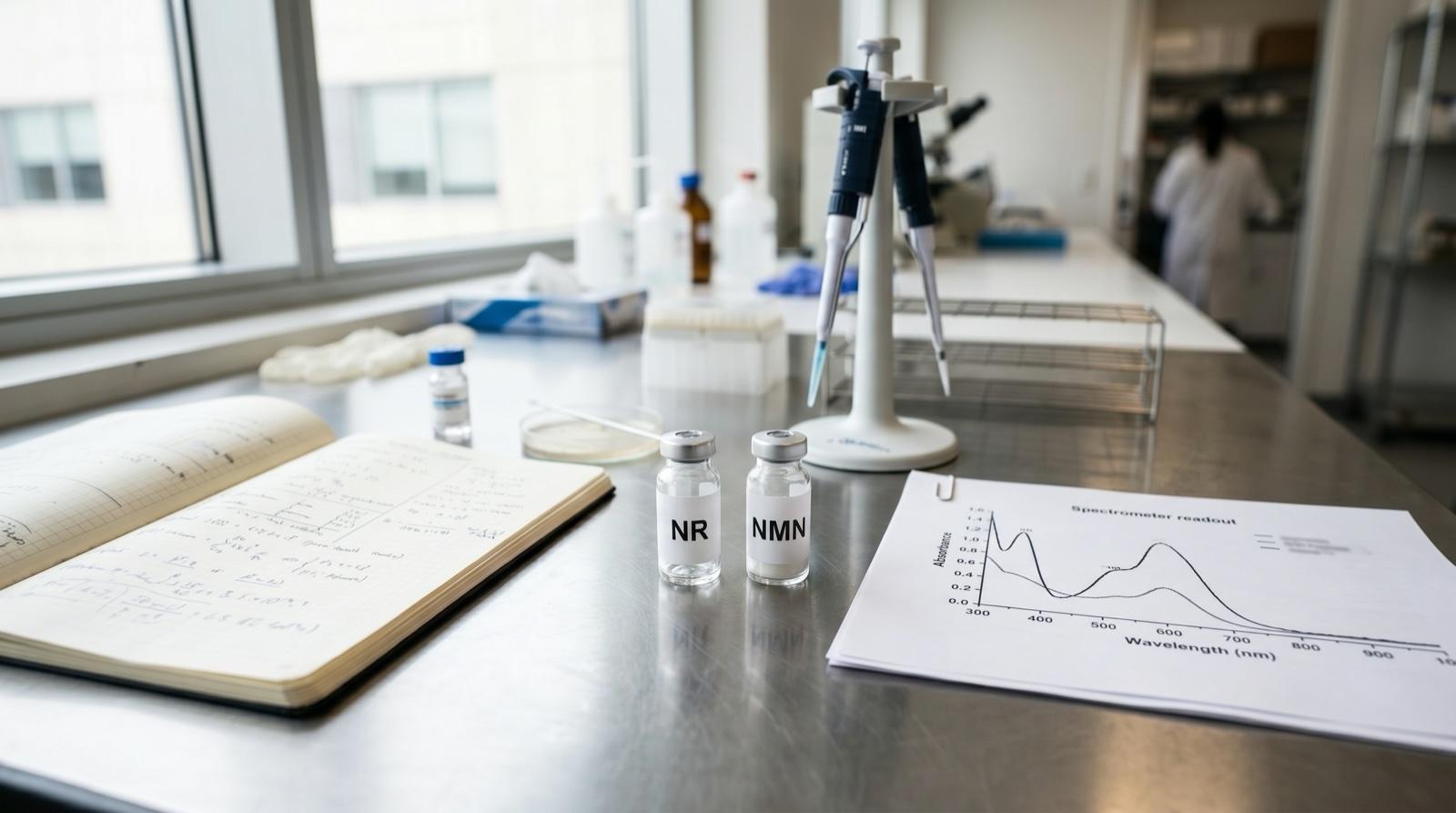
NR and NMN are two related vitamin B3 derivatives that both raise blood NAD+ in placebo-controlled human trials. They enter the salvage pathway one enzymatic step apart, and no head-to-head randomized trial has directly compared them at equivalent doses. The research supports neither a winner nor a loser — it supports two viable precursors with overlapping but distinct evidence bases.
What are NR and NMN, chemically?
NR (nicotinamide riboside) and NMN (nicotinamide mononucleotide) are both intermediates in the NAD+ salvage pathway. NR is a riboside — a sugar attached to nicotinamide. NMN is the same molecule with a single added phosphate group (molecular formula C11H15N2O8P versus NR's C11H16N2O5).
Bieganowski and Brenner first characterized NR as a distinct NAD+ precursor in 2004 (Cell, PMID: 15137942), identifying the NRK1 and NRK2 kinases that phosphorylate NR into NMN. Belenky's subsequent work mapped the broader pyridine-nucleoside metabolism that places NR upstream of NMN in mammalian cells.
The chemistry matters for one reason: inside a cell, NR must be phosphorylated to NMN before it can be adenylated to NAD+. NMN is already at that step. This single-step difference is the entire basis for the commercial claim that NMN is “closer” to NAD+. It is — by one phosphorylation.
NR vs NMN: side-by-side comparison
The table below condenses the parameters discussed in this article. Every entry reflects published human or characterized data, not commercial claims. Where the honest answer is uncertainty, the table says so.
| Parameter | NR (nicotinamide riboside) | NMN (nicotinamide mononucleotide) |
|---|---|---|
| Molecular formula | C11H16N2O5 | C11H15N2O8P (NR plus one phosphate) |
| Salvage-pathway entry | Phosphorylated by NRK1/2 to NMN, then to NAD+ | One step closer; adenylated by NMNAT to NAD+ |
| Published placebo-controlled human trials | More (multiple RCTs, mostly short-duration) | Fewer but accelerating |
| Documented blood NAD+ elevation | ~1.5-2.7x at 1 g/day (Trammell 2016, Martens 2018) | ~30-40% at 250 mg/day (Yoshino 2021) |
| Human tissue-level NAD+ data | Yes — skeletal muscle (Elhassan 2019) | None published in humans to date |
| Dedicated intestinal transporter | Slc12a8 NMN transporter claim (Grozio 2019) is contested and unconfirmed in humans | |
| US regulatory status | FDA GRAS since 2015 (NDIN 822) | Excluded from supplement status pending NDIN review (2022) |
| Causes niacin-style flushing | No | No |
| Relative consumer cost per mg | Lower | Typically higher |
| Head-to-head RCT vs the other | None published at equivalent molar doses | |
How do they enter the salvage pathway?
Both compounds feed the salvage pathway, but at different entry points. NR is phosphorylated by NRK1 or NRK2 (nicotinamide riboside kinases) into NMN inside the cell. NMN is then adenylated by NMNAT1-3 into NAD+. NMN, taken orally, either enters cells as NMN or — more commonly, according to several groups — is first dephosphorylated to NR in the gut lumen before cellular uptake.
This gut-lumen conversion is the crux of why the Slc12a8 debate matters. If NMN is mostly degraded to NR before absorption, the two precursors converge on the same biochemistry after the intestinal barrier. If a meaningful fraction of NMN crosses the gut wall intact via a dedicated transporter, NMN has a pharmacokinetic route NR does not.
What is the Slc12a8 controversy?
Grozio et al. published in Nature Metabolism in 2019 that Slc12a8 is a dedicated NMN transporter in mouse small intestine, showing rapid NMN uptake into cells expressing the transporter and disrupted uptake after Slc12a8 knockdown. This became the pharmacological keystone for NMN marketing. Our summary of the Grozio paper documents the original claim.
Schmidt and Brenner published a methodological critique in 2019 arguing that the kinetics Grozio reported were not consistent with direct NMN transport and that Nam-pathway reassembly could not be ruled out by the experimental design. The critique did not refute Slc12a8's existence — it challenged the interpretation that Slc12a8 is the dominant NMN uptake route in vivo. No subsequent paper has definitively resolved the disagreement in humans.
The practical interpretation is honest uncertainty (evidence grade: contested — original claim in mice, methodological critique published, no human confirmation). A dedicated NMN transporter may exist and contribute meaningfully to uptake, or it may be a minor route relative to NR-reassembly. Both possibilities are compatible with the observed blood NAD+ elevation from oral NMN.
What does the published NR trial evidence show?
NR leads in the number of published placebo-controlled human trials (evidence grade: moderate — multiple RCTs, mostly short-duration, modest sample sizes). Airhart et al. (2017, PLOS ONE) published the first pharmacokinetic characterization of sustained NR dosing in humans, demonstrating dose-dependent NAD+ elevation without adverse signals. Trammell et al. (2016, Nat Commun, PMID: 27721479) showed blood NAD+ roughly 2.7-fold higher after 1 g oral NR.
Martens et al. (2018, Nat Commun, PMID: 29599478) extended the evidence to chronic dosing — 1 g/day NR for six weeks in healthy middle-aged adults — reporting sustained 60% blood NAD+ elevation and a modest reduction in systolic blood pressure. Dollerup et al. (2018, AJCN, PMID: 29992272) reported a 12-week trial of 2 g/day NR in obese, insulin-resistant men that raised NAD+ metabolome markers but did not significantly improve insulin sensitivity — an important negative result for the metabolic hypothesis.
What does the published NMN trial evidence show?
NMN's human evidence base is younger but accelerating. Yoshino et al. (2021, Science, PMID: 33888596) remains the cleanest mechanistic result — a 10-week placebo-controlled trial of 250 mg/day NMN in postmenopausal women with prediabetes that showed improved muscle insulin sensitivity (evidence grade: moderate — single high-quality RCT, n=25, specific population). Our Yoshino trial summary covers the effect size and limitations.
What is missing from the comparison?
A head-to-head placebo-controlled trial comparing NR and NMN at equivalent molar doses in the same population does not exist in the peer-reviewed literature as of this writing. Every claim that one is superior to the other relies on indirect comparison across trials with different populations, doses, durations, and endpoints. Indirect comparison is a weak form of evidence for precursor choice.
What does bioavailability data actually show?
Both compounds are orally bioavailable at doses where blood NAD+ elevation is measurable. The precise fraction absorbed differs by assay and by whether you measure the parent compound or downstream NAD+ metabolome. Trammell 2016 documented NR's Tmax at 1-2 hours and a plasma NAD+ response peaking at roughly 2.7 hours.
NMN pharmacokinetics in humans are less published than NR's, partly because the analytical methods to distinguish intact NMN from its metabolites in blood are demanding. Sublingual NMN formulations are marketed on the premise of bypassing gut conversion, but rigorous bioavailability comparison studies across sublingual and oral-capsule routes remain thin. Our primer on tissue NAD+ decline covers the broader context of what blood NAD+ elevation does and does not tell you.
Tissue-level data is scarce for both. Elhassan et al. (2019, PMID: 31412242) showed NR at 1 g/day raised skeletal muscle NAD+ in aged men over 21 days — the cleanest tissue-level human result for any precursor. No equivalent tissue-biopsy trial exists for NMN in humans at the time of this writing. This asymmetry deserves note: tissue elevation is the endpoint that matters clinically, and only NR has been directly measured.
Do NR and NMN have different safety profiles?
Published safety data for both precursors is favorable at studied doses (evidence grade: moderate — short- to medium-duration trials, healthy or specific clinical populations). Conze et al. (2019, Sci Rep, PMID: 31316207) reported an 8-week NR trial at doses up to 2,000 mg/day without significant adverse events or clinically meaningful changes in safety laboratory parameters. Our Conze safety trial summary covers the ceiling doses.
NMN trials — Yoshino 2021 at 250 mg/day for 10 weeks, Yamaguchi 2022 at up to 900 mg/day for 60 days — reported similarly clean safety profiles with no serious adverse events. Neither NR nor NMN produces the cutaneous flushing associated with pharmacologic niacin doses, a common point of differentiation from the Preiss-Handler pathway entry.
Long-term safety — multi-year daily dosing in diverse populations — has not been established for either compound. This is the honest boundary of the current evidence. Rodent data from Mills et al. (2016, Cell Metab, PMID: 28068222), which administered NMN for 12 months in mice, did not flag organ toxicity, but mice are not humans and 12 months is not a decade. Long-term safety questions are covered in our safety and drug interactions overview.
Methyl donor considerations
Both NR and NMN ultimately generate nicotinamide as a downstream metabolite. Nam is methylated to 1-methylnicotinamide (MNA) by nicotinamide N-methyltransferase (NNMT) using SAM as the methyl donor. Sustained high-dose supplementation theoretically draws down methyl pools. Whether this matters in practice at studied doses is an open question — no trial has reported clinically meaningful homocysteine or SAM deficits from NR or NMN at typical supplement doses. TMG co-administration is common in protocols but is not supported by strong human evidence.
What does the regulatory and cost picture look like?
NR received FDA GRAS status in 2015 (NDIN 822) and is the active ingredient in Tru Niagen, the most widely studied commercial NR product. NMN's regulatory trajectory in the United States took a sharp turn in 2022 when the FDA concluded that NMN was excluded from dietary supplement classification pending a New Dietary Ingredient Notification review, because it had been investigated as a drug. The situation remains unresolved at the federal level.
Cost per gram varies widely but, as of recent commercial data, NMN is typically priced higher per milligram than NR at consumer scale — partly reflecting raw material cost and partly the smaller number of large manufacturers. Neither compound has reached pricing parity with commodity nicotinamide or niacin.
Bottom line on the head-to-head question
The comparison NR versus NMN is, today, a comparison between two compounds that both raise blood NAD+ reliably, both have acceptable short-term safety profiles, and neither has been directly compared against the other in a properly powered human trial. Tissue-level evidence is stronger for NR by virtue of Elhassan 2019; mechanistic metabolic benefit evidence is stronger for NMN by virtue of Yoshino 2021. Neither asymmetry supports a blanket recommendation.
For anyone evaluating the two, the useful framing is not “which is better” but “what question are you trying to answer.” Blood NAD+ elevation is well-documented for both. Tissue NAD+ elevation is documented in humans only for NR. A specific metabolic endpoint (muscle insulin sensitivity in prediabetic postmenopausal women) is documented only for NMN. Everything else is indirect extrapolation. Our precursor comparison matrix lays the parameters side-by-side without a verdict.
The commercial landscape around both compounds is polarized and heavily marketed. The peer-reviewed landscape is narrower, cleaner, and more honest about uncertainty. The distance between those two landscapes is where most consumer confusion sits.
Frequently asked questions
- Is NR or NMN better for raising NAD+?
- No head-to-head randomized trial in humans has compared NR and NMN at equivalent molar doses. Both raise blood NAD+ reliably in placebo-controlled trials: NR by roughly 1.5 to 2.7-fold at 1 g/day (Martens 2018, Trammell 2016) and NMN by approximately 30-40% at 250 mg/day (Yoshino 2021). Direct superiority claims are not supported.
- What is the Slc12a8 controversy?
- Grozio et al. (2019, Nature Metabolism) claimed NMN is transported directly across intestinal cells by Slc12a8. Schmidt and Brenner (2019) published a critique arguing their methodology could not distinguish NMN uptake from Nam-pathway reassembly. The existence of a dedicated NMN transporter in humans remains unresolved.
- Do NR and NMN have different side effects?
- Published trials for both report similar tolerability profiles. Conze et al. (2019) documented NR at up to 2,000 mg/day for eight weeks without significant adverse events. NMN trials at 250-900 mg/day (Yoshino 2021, Yamaguchi 2022) reported no serious adverse events. Neither produces the flushing associated with niacin.
- Does NMN convert to NR before absorption?
- A portion of oral NMN is dephosphorylated to NR in the gut lumen by intestinal alkaline phosphatase, then reassembled inside cells. How much bypasses this conversion via Slc12a8 in humans is disputed. The pharmacological outcome — elevated blood NAD+ — is observed for both compounds regardless.
- Why are the two priced so differently?
- NR is protected by a patent licensed to ChromaDex (Tru Niagen) and granted FDA GRAS status in 2015. NMN was classified in 2022 by the FDA as excluded from dietary supplement status pending an NDIN review, shifting its commercial trajectory. Ingredient cost per gram, scale, and regulatory posture all differ.