NAD+ Decline With Age: Why Tissue Levels Drop 50% by 70
Tissue NAD+ falls ~50% between age 20 and 70. Rising CD38, declining NAMPT, and PARP activation explain why — and what research says about restoration.
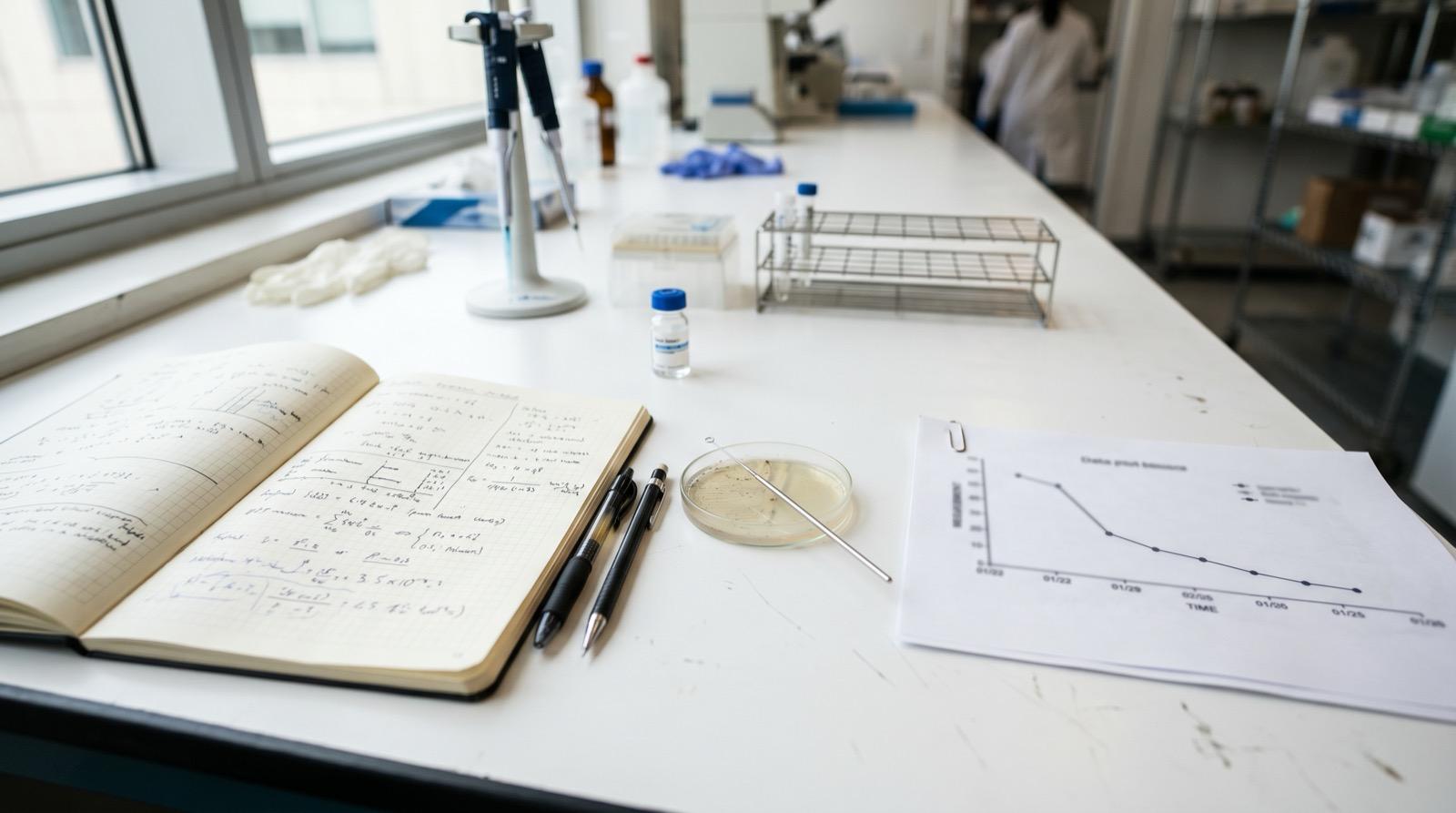
Tissue NAD+ concentrations drop by roughly 50% between age 20 and 70 in every organ researchers have measured. The decline is not a vague “cellular aging” phenomenon — three specific enzymes explain most of it, and that specificity is what makes NAD+ one of the few longevity targets with a clear mechanistic picture.
What the numbers actually say
The widely cited claim that NAD+ “drops 50% by age 70” comes from a composite of tissue-level measurements across multiple compartments. The cleanest single dataset is the Massudi et al. (2012) analysis of human skin NAD+ concentrations from donors aged 20 to 87 — a roughly 57% reduction across the lifespan, with the steepest decline in the 30-50 year window.
Skeletal muscle measurements from Zhu et al. (2015) show a similar trajectory: a 30-50% reduction in NAD+ between young (30-35) and middle-aged (60-65) cohorts, with larger drops in sedentary subjects than in endurance-trained controls. Whole-blood NAD+ measurements (more recent, easier to collect at scale) confirm the pattern but with wider individual variation — genetics, diet, sleep, and inflammation all move the needle.
How does CD38 drive NAD+ loss?
CD38 is a cell-surface glycohydrolase that cleaves NAD+ into nicotinamide and ADP-ribose. In young tissues, CD38 expression is low and NAD+ consumption by this enzyme is minor. With age and chronic inflammation, CD38 expression rises sharply — typically 2-3x between young and aged tissue samples.
Camacho-Pereira et al. (2016) knocked out CD38 in aged mice and found that NAD+ levels in liver, skeletal muscle, and adipose tissue returned to approximately young-adult levels. The knockout mice also showed improved mitochondrial function and resistance to diet-induced metabolic dysfunction. This is the strongest single piece of evidence that CD38 is the dominant driver of age-related NAD+ decline in mammals.
The implication is direct: if CD38 activity is the leak, plugging the leak is more efficient than pouring more water in the top. Selective CD38 inhibitors (78c, apigenin, luteolin) are an active drug development area specifically because supplementation alone fights an uphill battle against a rising degradation rate.
Why does NAMPT salvage activity fall with age?
On the supply side of the NAD+ balance equation, NAMPT (nicotinamide phosphoribosyltransferase) is the rate-limiting enzyme of the salvage pathway that regenerates NAD+ from nicotinamide. NAMPT expression and activity decline measurably with age — Yoshida et al. (2019) reported a 30% reduction in hepatic NAMPT protein in aged mice, with corresponding reductions in NMN availability.
NAMPT is also secreted into the bloodstream as eNAMPT, where it circulates as an adipokine with systemic effects. Aged adipose tissue produces less eNAMPT, and restoring eNAMPT via adipose-specific overexpression in mice extended healthspan and physical function in Yoshida's trial. This dual role — rate-limiting enzyme locally, signaling adipokine systemically — makes NAMPT decline a compound problem, not a simple enzymatic bottleneck.
How does PARP activation drain NAD+ with age?
The third contributor is chronic demand. PARP enzymes — particularly PARP1 — use NAD+ as their sole substrate to signal DNA damage and recruit repair factors. Under healthy conditions, PARP activity is brief and transient. With accumulated DNA damage from decades of oxidative stress, UV exposure, and errant replication, PARP activity becomes chronic rather than episodic.
Bai et al. (2011) demonstrated that PARP1 knockout in mice increases tissue NAD+ and improves mitochondrial metabolism — suggesting PARP activity in healthy adult tissues is already consuming a meaningful fraction of the NAD+ pool, and that number only grows with age.
Can you actually restore tissue NAD+?
This is where the research gets less tidy. Blood NAD+ elevation with oral precursors is well-established: Martens et al. (2018) showed 60% elevation in healthy middle-aged adults with 1 g/day NR for six weeks. Yoshino et al. (2021) demonstrated the cleanest human mechanistic result with NMN at 250 mg/day for ten weeks. But blood elevation is a biomarker, not a proven tissue outcome.
The cleanest tissue-level human data is Elhassan et al. (2019), which took skeletal muscle biopsies from aged men before and after 21 days of NR at 1 g/day. Muscle NAD+ rose meaningfully, and mitochondrial gene expression shifted. This remains one of very few trials to directly measure tissue response in humans — most inference about “restoration” still relies on blood measurements plus animal-model extrapolation.
Which precursor, if you supplement?
The three precursors with meaningful human data — NR, NMN, and niacin — each raise blood NAD+ through different biochemical routes. NR and NMN feed the salvage pathway; niacin enters via the Preiss-Handler pathway. Our precursor comparison matrix lays out the pharmacokinetics and regulatory status side-by-side.
None of these precursors directly addresses the CD38 leak. If the dominant driver of decline is accelerated hydrolysis rather than reduced supply, oral precursors are running up a down escalator. This is why CD38 inhibitors — still preclinical or early-human — are arguably the more interesting pharmacological target than more precursor SKUs.
Bottom line
NAD+ decline with age is not a single process. It is the sum of a hydrolysis leak (CD38), a supply-side bottleneck (NAMPT), and chronic demand pressure (PARP). Each has a different intervention logic. Supplementing precursors addresses the supply side; the leak and the demand side remain active research areas with no approved intervention yet.
The practical implication for anyone evaluating supplementation: blood elevation is measurable and reliable across published trials, but the jump from elevated blood NAD+ to meaningful longevity outcomes requires reasoning that the current data does not yet support. Conservative framing respects what we know and what we don't.
Frequently asked questions
- At what age does NAD+ start declining?
- Detectable NAD+ decline begins in the late 20s to early 30s and accelerates through the 40s and 50s. Tissue-specific measurements in skin, muscle, and blood show roughly 10-15% reductions per decade, with the steepest drops occurring alongside menopause in women and andropause in men.
- Is NAD+ decline reversible?
- Multiple human trials show NAD+ precursors (NR, NMN, niacin) raise blood NAD+ by 30-60% at studied doses. Whether this translates to tissue-level restoration and measurable health outcomes remains under active investigation — blood elevation is a biomarker, not a proven benefit.
- What causes NAD+ to decline with age?
- Three mechanisms dominate: rising CD38 expression (an NAD+-hydrolyzing enzyme that increases 2-3x with age and inflammation), declining NAMPT activity in the salvage pathway, and chronic PARP activation from accumulated DNA damage drawing down intracellular NAD+ pools.
- Does supplementation actually raise tissue NAD+?
- Elhassan et al. (2019) showed 1 g/day NR for 21 days raised skeletal muscle NAD+ in aged men. Systemic blood elevation is well-established across precursors, but tissue-level effects vary by organ and have been measured in only a handful of trials.
Related posts
Mechanisms
NAD+ and PARP1: How DNA Damage Repair Drains the NAD+ Pool (and the DBC1 Brake on Aging)
19 min read

Mechanisms
NAD+ vs NADH: The Redox Pair, the Ratio, and Why It Matters for Aging
16 min read
Mechanisms
Sirtuins and NAD+: How SIRT1-SIRT7 Translate NAD+ Levels Into Longevity Signaling
17 min read