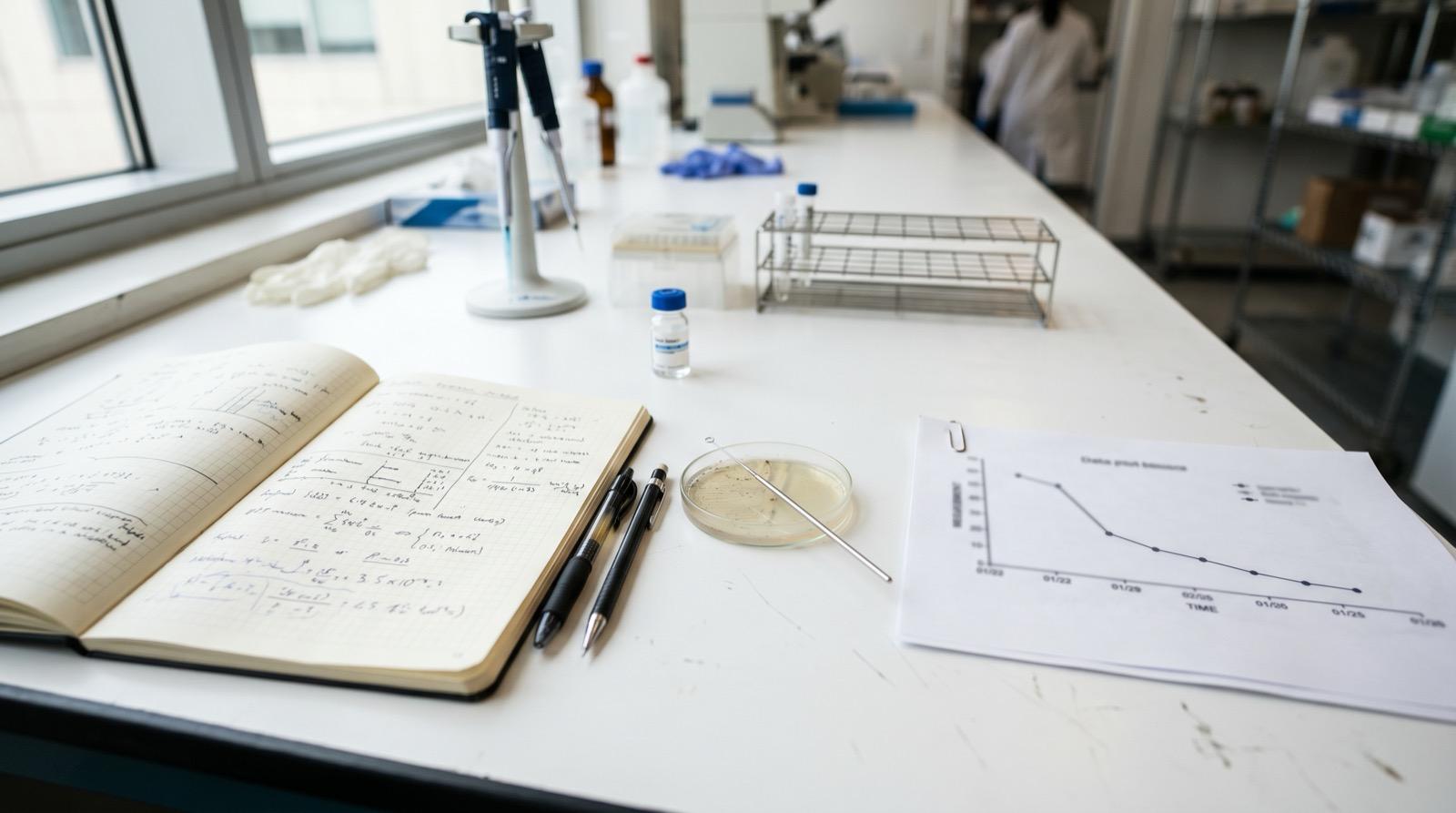
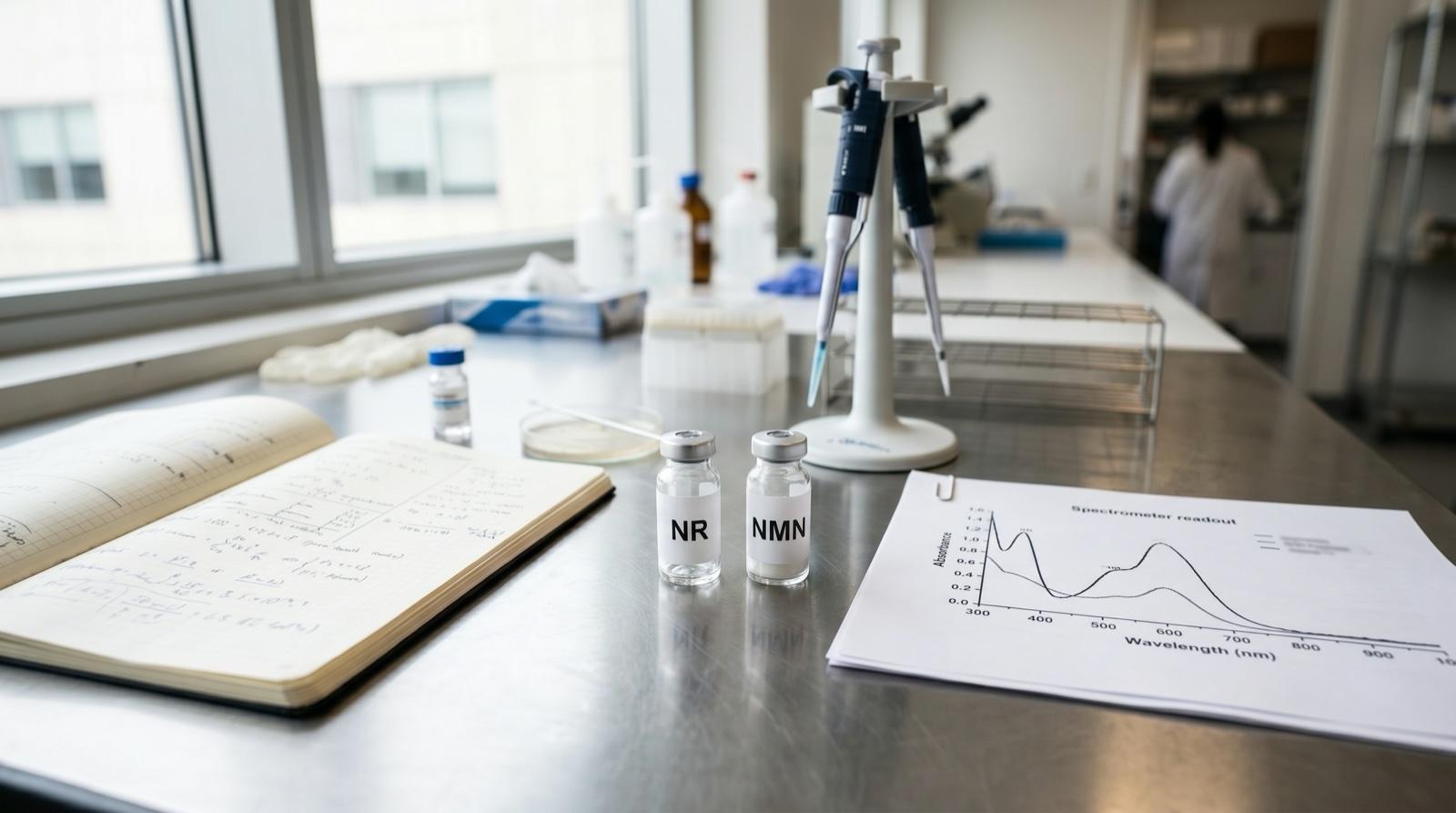
How NAD+ Declines with Age: The Mechanistic Picture
Tissue NAD+ falls roughly 50% between age 20 and 70. CD38 upregulation, NAMPT decline, and chronic PARP activation explain most of the depletion — here is how.
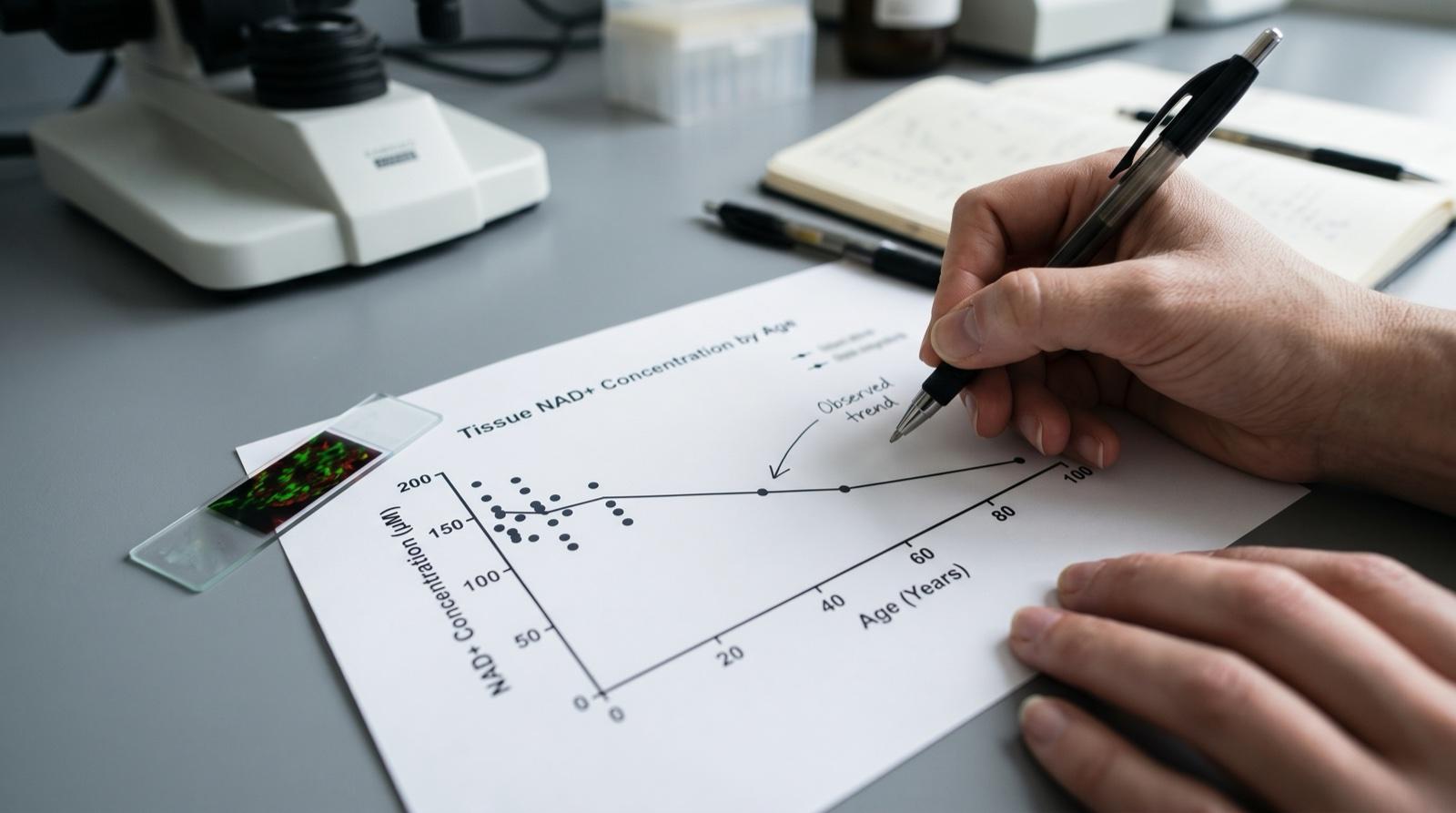
NAD+ tissue concentrations fall roughly 50% between age 20 and 70. The decline is not a single process but a compound of three well-characterized shifts: CD38 upregulation, NAMPT salvage-pathway weakening, and chronic PARP activation from accumulated DNA damage. Each has a distinct mechanism and a different intervention logic.
How much does NAD+ actually decline?
Direct human tissue measurements place NAD+ loss at roughly 50% across the adult lifespan. The most cited single dataset is Massudi et al. (2012, PLOS ONE, PMID: 22848760), which measured skin biopsies from donors aged 20 to 87 and documented a ~57% reduction in protein-normalized NAD+. The steepest decline clustered between the third and sixth decades.
Skeletal muscle shows a comparable trajectory. Independent cohorts report 30 to 50 percent reductions between young (aged 30) and older (aged 65) subjects. Whole-blood assays, which are easier to collect at scale, confirm the direction but with wide inter-individual variance driven by inflammation, sleep patterns, and exercise status. Clement et al. (2019, Nature Communications) profiled the full NAD+ metabolome in human plasma and found not only lower total NAD+ but a shift in metabolite ratios consistent with accelerated consumption.
Why tissues decline at different rates
The decline is not uniform. Brain NAD+ drops more gradually in cortex than in white matter. Muscle NAD+ falls faster in sedentary than endurance-trained subjects. Liver NAD+ is buffered by a high baseline NAMPT pool. Skin — highly exposed to UV — shows the steepest curve. This tissue-specificity maps onto the three mechanistic drivers described below: where CD38 is expressed most, where DNA damage accumulates fastest, and where NAMPT supply can or cannot compensate.
Why does CD38 rise with age?
CD38 is the dominant NAD+-consuming enzyme in aged tissue. It is a membrane-bound glycohydrolase that cleaves NAD+ into nicotinamide and ADP-ribose with extremely high catalytic efficiency. In young tissues, CD38 expression is low and its contribution to overall NAD+ turnover is minor. With chronic inflammation and senescent-cell accumulation, CD38 protein levels rise two- to threefold.
The definitive experiment is Camacho-Pereira et al. (2016, Cell Metabolism, PMID: 27304511). The investigators knocked out CD38 in aged mice and measured NAD+ in liver, skeletal muscle, and adipose tissue. All three tissues returned to approximately young-adult NAD+ concentrations. Mitochondrial function improved in parallel, as did resistance to diet-induced metabolic dysfunction. No precursor supplementation was required — removing the hydrolase alone restored the pool.
Senescent cells are a major CD38 source. Chini et al. (2020) showed that senescent-cell conditioned media upregulated CD38 on neighboring macrophages, creating a paracrine loop in which age-associated inflammation begets more NAD+ hydrolysis. This is why CD38 rises sharpest in tissues with high senescent burden — adipose, liver, and skeletal muscle.
What happens to NAMPT in aging tissue?
NAMPT — nicotinamide phosphoribosyltransferase — is the rate-limiting enzyme of the NAD+ salvage pathway. It converts nicotinamide (Nam) back to nicotinamide mononucleotide (NMN), which NMNAT enzymes then adenylate into NAD+. Because salvage handles the majority of intracellular NAD+ regeneration in mammals, NAMPT activity is the throughput bottleneck for the whole pool.
Yoshino et al. (2011, Cell Metabolism) documented NAMPT expression declines in multiple mouse tissues with age, and subsequent human work confirmed the pattern in adipose and muscle. Stromsdorfer et al. (2016, Cell Reports) showed that adipose-specific NAMPT deletion accelerates systemic NAD+ decline, because adipose secretes extracellular NAMPT (eNAMPT) as an adipokine with systemic signaling consequences.
Circulating eNAMPT as an aging signal
Adipose tissue releases eNAMPT into the bloodstream bound to extracellular vesicles. Aged adipose secretes less eNAMPT, and the decline correlates with reduced systemic NAD+ biosynthesis. Yoshida et al. (2019) extended this work by overexpressing adipose eNAMPT in mice, which raised hypothalamic NAD+ and extended median lifespan. The finding matters because it reframes NAMPT not as a local enzymatic bottleneck but as a systemic signaling axis with distributed effects on brain, muscle, and metabolic tissues.
Why does PARP activity drain NAD+ with age?
PARP1 uses NAD+ as its sole substrate to tag damaged DNA with poly-ADP-ribose chains, recruiting repair machinery to strand breaks and oxidative base damage. Under healthy conditions PARP activity is transient — the enzyme activates, repairs, and stands down. With decades of accumulated DNA damage, PARP activity becomes chronic rather than episodic, drawing continuously on the nuclear NAD+ pool.
Fang et al. (2014, Cell, PMID: 24813611) demonstrated the axis explicitly. In a Cockayne syndrome model of accelerated aging, persistent PARP1 hyperactivation depleted nuclear NAD+, collapsed SIRT1 activity, and triggered a pseudohypoxic transcriptional state in mitochondria. NAD+ repletion reversed the pseudohypoxia. The study is one of the cleanest demonstrations that PARP-driven NAD+ drain has downstream consequences well beyond its nominal DNA-repair role.
Earlier work by Bai et al. (2011) showed PARP1 knockout mice had higher tissue NAD+ and improved mitochondrial biogenesis — evidence that PARP activity in normal adult tissue is already consuming a meaningful fraction of the NAD+ pool before any accelerated-aging manipulation. The consumption rate scales with damage burden, which scales with age.
How does SIRT3 loss propagate NAD+ decline?
Sirtuins are the downstream casualty of falling NAD+. SIRT3 is the main mitochondrial sirtuin, and it deacetylates enzymes of the electron transport chain, antioxidant defense, and fatty-acid oxidation. When mitochondrial NAD+ falls below SIRT3's effective Km, its deacetylation activity drops and ETC components accumulate hyperacetylated — a state associated with reduced oxidative phosphorylation efficiency and increased ROS.
Gomes et al. (2013, Cell, PMID: 24360282) connected this back to the nucleus. Falling nuclear NAD+ reduced SIRT1 activity, which in turn permitted HIF-1α stabilization even under normoxia — a “pseudohypoxic” state that suppresses mitochondrial biogenesis and forces cells toward glycolytic metabolism. The paper is important because it described a communication breakdown between nuclear and mitochondrial compartments driven specifically by NAD+ depletion. NR supplementation in aged mice partially reversed the phenotype.
What is the circadian-NAMPT feedback loop, and why does it break?
NAD+ is under circadian control. Ramsey et al. (2009) showed NAMPT transcription oscillates over a 24-hour cycle driven by the CLOCK / BMAL1 transcription factors. NAMPT protein peaks in the evening, raising NAD+ and activating SIRT1, which then deacetylates and represses BMAL1 itself — a feedback loop where NAD+ is both a circadian output and a circadian input.
This loop dampens with age. Circadian amplitude flattens, NAMPT oscillation loses peak height, and SIRT1 feedback weakens. The practical consequence is that the normal evening rise in NAD+ — which supports overnight mitochondrial repair and metabolic switching — becomes blunted. Sleep disruption in older adults is both a cause and a consequence of this loop's decay, making circadian hygiene one of the few behavioral levers with plausible mechanistic effect on NAD+ homeostasis.
What is established, and what is still hypothesized?
The decline itself is established. Tissue NAD+ falls with age, the rate of fall varies by tissue, and the dominant consumers (CD38, PARP) and suppliers (NAMPT) are well-characterized at biochemical resolution. Covarrubias et al. (2021, Nature Reviews Molecular Cell Biology, PMID: 33353981) — reviewed in full at our research index — is the most thorough synthesis of the current mechanistic picture.
What remains hypothesized is the causal direction in human aging phenotypes. Does falling NAD+ cause the hallmarks of aging (mitochondrial dysfunction, genomic instability, inflammation), or does it accompany them as a parallel consequence of upstream damage? Preclinical data in mice — Zhang et al. (2016, Science, PMID: 27127236) extended median lifespan ~5% with NR supplementation, and multiple NMN studies improved metabolic markers — support a causal role at the model-organism level. The jump to humans has not been made at comparable rigor.
The trial gap
Human trials to date have measured blood NAD+ elevation (reliably achieved), muscle NAD+ elevation in a small number of studies (see Elhassan et al., 2019), and downstream biomarkers such as blood pressure and insulin sensitivity. None has yet measured lifespan or validated cause-of-death endpoints. Aging biomarkers (epigenetic clocks, proteomic aging scores) are being tested but lack the decade-scale follow-up to settle the question. The current honest framing: NAD+ decline is a validated biological marker of aging; whether restoring it restores youth remains open.
Why does this mechanistic detail matter?
Because the three drivers point to three different interventions. Precursor supplementation (NR, NMN, niacin) addresses supply but does not slow degradation. CD38 inhibition addresses the leak but is still preclinical for humans. PARP modulation is a double-edged intervention — inhibiting PARP could preserve NAD+ but at the cost of reduced DNA repair capacity. No single intervention handles the full picture.
The precursor comparison matrix lays out pharmacokinetics and regulatory status for each supplementable molecule. The sirtuins and longevity pages explore the downstream consequences in more detail. For anyone tracking the field, the sensible posture is to watch the CD38-inhibitor trials alongside precursor data — the mechanistic picture implies the combination may matter more than either alone.
Bottom line
NAD+ decline with age is a compound of rising consumption (CD38, PARP) and falling supply (NAMPT salvage), distributed unevenly across tissues and compartments. The decline itself is well established in human data. Its precise causal contribution to aging phenotypes is still under investigation, and current human evidence for lifespan or healthspan extension through NAD+ restoration is emerging rather than conclusive.
The cleanest way to hold the current state of the field: the decline is real, the mechanisms are largely understood, the preclinical repletion data is strong, and the human outcome data is thin. Any confident claim beyond that outruns the evidence. For a plain-language intro to NAD+ itself, see the NAD+ precursor page; for the current supplementation landscape, the NR vs NMN comparison covers what the head-to-head research does and does not show. For the evidence-grading framework behind every claim on this site, see our methodology.
Frequently asked questions
- How much does NAD+ decline with age in humans?
- Direct tissue measurements show roughly a 50% reduction in NAD+ concentration between age 20 and 70. Massudi et al. (2012, PLOS ONE, PMID: 22848760) quantified a ~57% drop in human skin biopsies across this span. Blood NAD+ declines at approximately 10 to 15 percent per decade in cross-sectional cohorts, with larger drops reported in aged muscle.
- Is CD38 really the main reason NAD+ drops with age?
- CD38 is the single largest identified consumer of NAD+ in aged tissue. Camacho-Pereira et al. (2016, Cell Metabolism, PMID: 27304511) showed CD38 knockout restored liver, muscle, and adipose NAD+ to near young-adult levels in aged mice. Other enzymes contribute, but CD38 upregulation explains the majority of measurable decline.
- What role does PARP play in NAD+ decline?
- PARP1 uses NAD+ to signal DNA damage. With accumulated genomic damage, PARP activation becomes chronic rather than transient. Fang et al. (2014, Cell, PMID: 24813611) demonstrated that persistent PARP1 activation in aging depletes nuclear NAD+ pools, impairing SIRT1-dependent mitochondrial maintenance and contributing to pseudohypoxic gene expression.
- Does NAMPT decline cause the NAD+ drop too?
- NAMPT decline reduces salvage-pathway throughput. Yoshino et al. (2011, Cell Metabolism) reported age-dependent NAMPT reductions in multiple mouse tissues, and Stromsdorfer et al. (2016, Cell Reports) showed adipose-specific NAMPT loss accelerates systemic NAD+ decline. The effect compounds with rising CD38 hydrolysis — less supply, more consumption.
- Does restoring NAD+ reverse aging?
- No. Current human evidence shows NAD+ precursors raise blood NAD+ reliably, but meaningful healthspan or lifespan outcomes in people remain unproven. Zhang et al. (2016, Science, PMID: 27127236) showed NR extended lifespan in mice by 5 percent, yet translating preclinical effects to human longevity is speculative. The decline is established; its causal role in aging phenotypes is still under investigation.