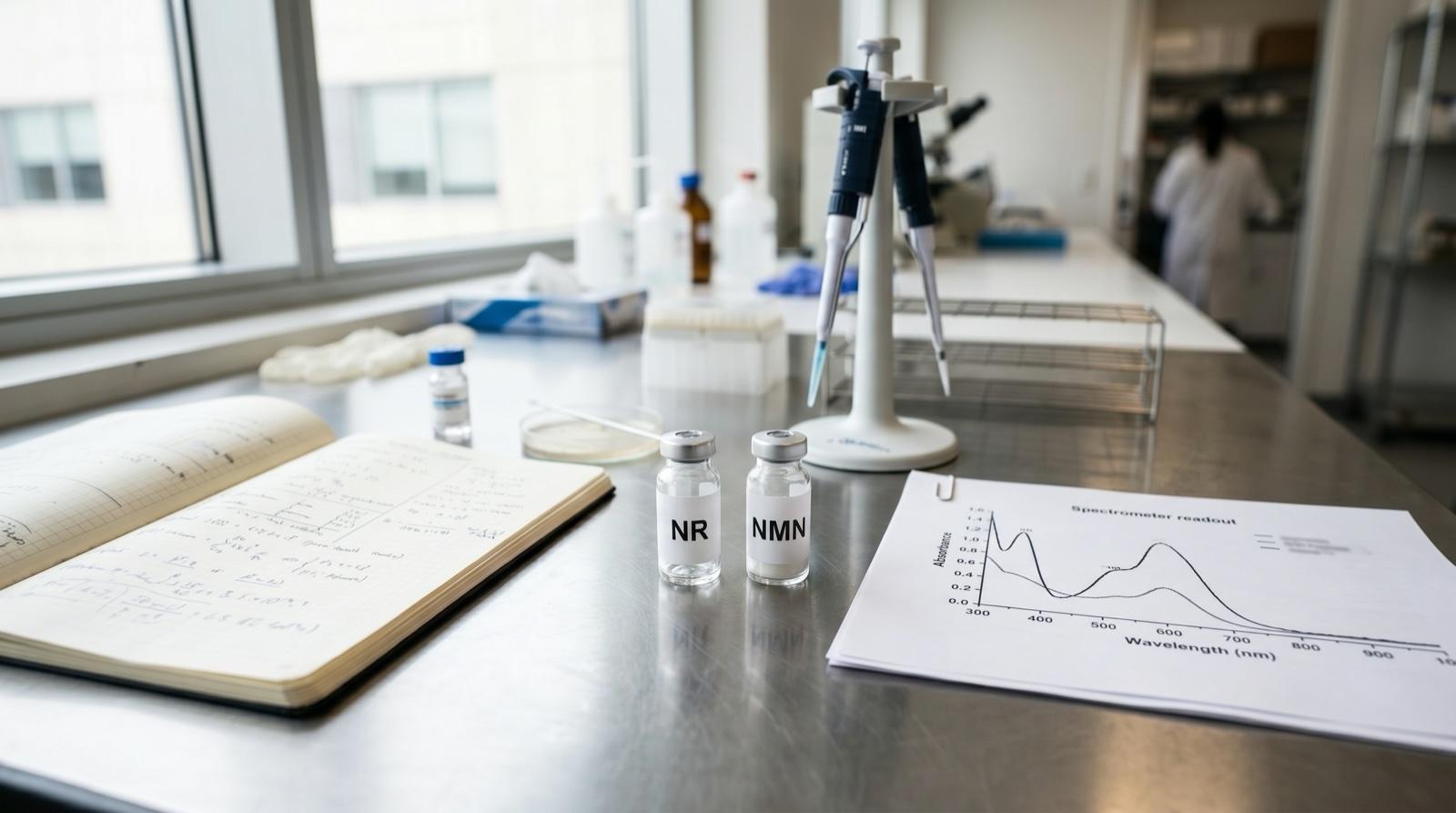
NAD+ Precursor Dosing in Human Trials: What the Evidence Shows
Published NAD+ precursor trials used NR at 100-2000 mg/day, NMN at 250-1200 mg/day, and niacin at 50-2000 mg/day. Here's what the human data actually shows.
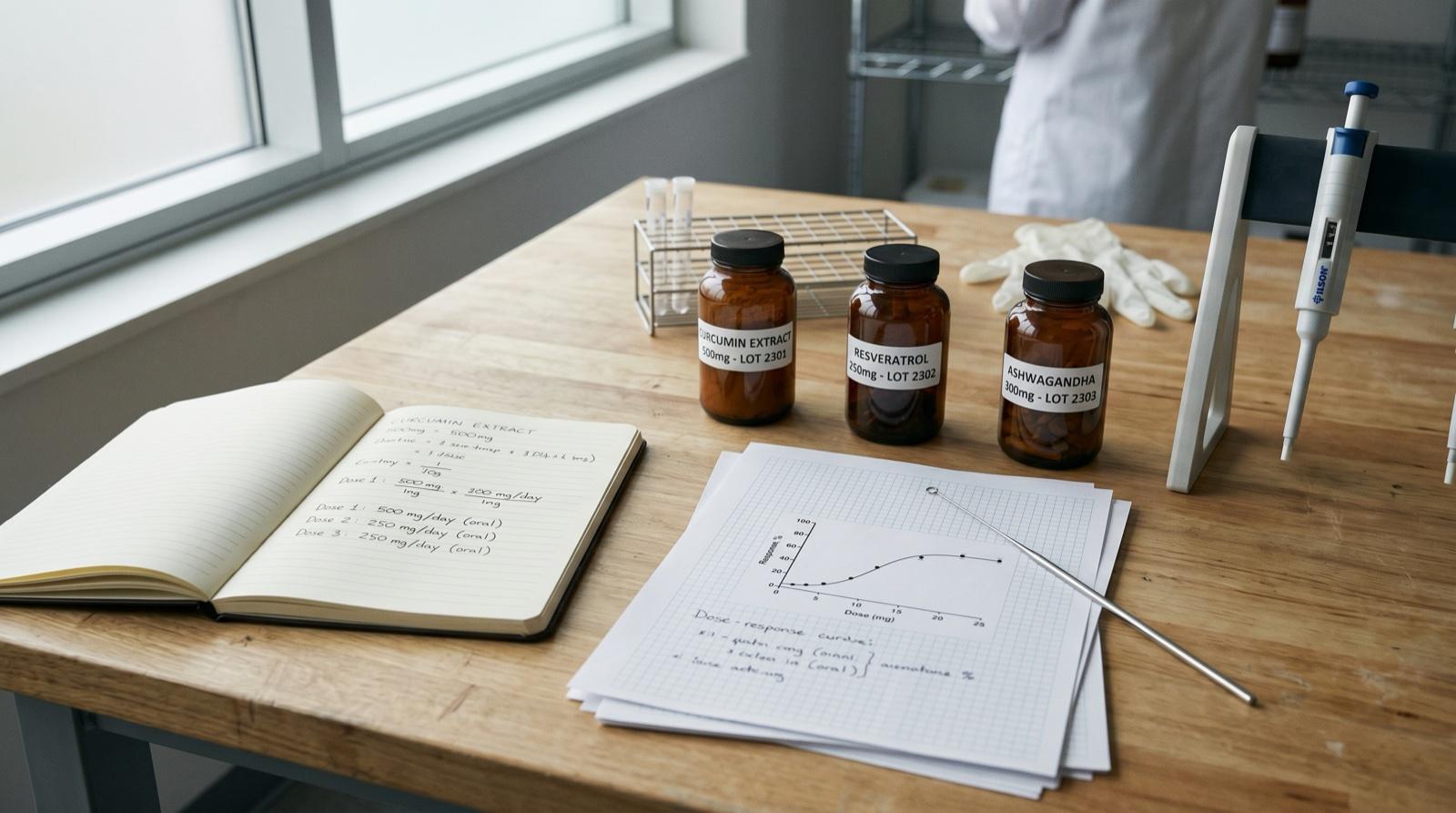
Published NAD+ precursor trials have used widely different doses: nicotinamide riboside at 100-2000 mg/day, nicotinamide mononucleotide at 125-1200 mg/day, and niacin from 50 mg (nutritional) to 2000 mg (lipid-lowering). No human trial has established an optimal dose for any clinical endpoint, and no longevity outcome trial exists at any dose.
What dose range has NR been studied at?
Clinical trials of nicotinamide riboside have used daily doses spanning a 20-fold range. The lowest published oral dose was 100 mg in early pharmacokinetic work (Conze et al., 2019, Scientific Reports). The highest sustained regimen in a randomized trial was 2000 mg/day (2 x 1000 mg) in obese men over 12 weeks (Dollerup et al., 2018, American Journal of Clinical Nutrition; PMID 29992272).
Most efficacy trials have clustered near 500-1000 mg/day. Martens et al. (2018, Nature Communications; PMID 29599478) used 1000 mg/day for six weeks in healthy middle-aged adults and reported an approximately 60% elevation in whole-blood NAD+. Elhassan et al. (2019, Cell Reports) administered 1000 mg/day for 21 days and measured skeletal-muscle NAD+ biopsies in aged men — one of the few trials to directly sample tissue rather than blood.
Trammell et al. (2016, Nature Communications) established the single-dose pharmacokinetic profile in healthy adults: oral NR elevates blood NAD+ within hours, with a dose-dependent AUC from 100 mg up through 1000 mg. Airhart et al. (2017, PLOS ONE) extended this with 100, 300, and 1000 mg dose escalation and reported tolerability but a plateauing NAD+ response at the higher doses.
What dose range has NMN been studied at?
Human NMN trials cover 125-1200 mg/day. The often-cited Yoshino et al. (2021, Science; PMID 33888596) used 250 mg/day for 10 weeks in prediabetic, overweight or obese postmenopausal women and measured improvements in muscle insulin sensitivity. Irie et al. (2020, Endocrine Journal) reported single oral doses up to 500 mg as safe in healthy men, with no clinically relevant adverse effects over the acute study window.
At the upper end, Huang et al. (2022, GeroScience) tested MIB-626 — MetroBiotech’s crystalline beta-NMN — at 1000 mg once or twice daily (1000 mg and 2000 mg/day total) in middle-aged and older adults. The trial documented dose-dependent elevation of blood NAD+ and NAD+-related metabolites without dose-limiting toxicity over 14 days. Katayoshi et al. (2023; PMID 36797326) administered 250 mg/day for 12 weeks in healthy adults aged 45-65 and reported tolerability plus modest metabolic biomarker shifts.
Shorter-duration dose-finding work has used 100-500 mg single doses to map pharmacokinetics. The collective picture: NMN doses above 250 mg/day raise blood NAD+, but trial durations are mostly 8-12 weeks and the long-term dose-response curve in humans is not established.
How do niacin and nicotinamide doses compare?
Niacin(nicotinic acid) has two distinct dose contexts. At nutritional intakes (14-18 mg/day, the US RDA) it corrects deficiency. At pharmacological doses — typically 500-2000 mg/day extended-release — it was a first-line lipid-lowering agent for decades (Guyton & Bays, 2007, American Journal of Cardiology). Niraula et al. (2022, Nature Medicine) demonstrated that 750-1000 mg/day oral niacin over four months raised muscle NAD+ and improved strength in a small cohort of mitochondrial myopathy patients.
Nicotinamide (the amide form) has been used in clinical trials at doses ranging from 500 mg/day (skin-cancer prevention — Chen et al., 2015, New England Journal of Medicine) up to 3000 mg/day in chronic kidney disease phosphate trials. At high doses, nicotinamide inhibits sirtuins via feedback — a paradox often raised as a reason to prefer NR or NMN if the therapeutic goal is sirtuin activation.
Does blood NAD+ elevation reflect tissue NAD+?
Whole-blood and peripheral-blood-mononuclear-cell (PBMC) NAD+ are the dominant biomarkers in human trials because they’re cheap and non-invasive. Tissue-level measurements require biopsies. Only a few NR and NMN trials have directly sampled muscle, and fewer still have sampled brain, liver, or adipose — the organs most relevant to metabolic and neurodegenerative endpoints.
Elhassan et al. (2019) is the cleanest tissue-level human dataset: 1000 mg/day NR for 21 days in aged men raised skeletal-muscle NAD+ and shifted mitochondrial gene expression. Niraula et al. (2022) is the other. The practical implication: blood NAD+ is a reliable dose-response marker, but “my blood NAD+ doubled” does not mechanically translate to “my brain NAD+ doubled.” Tissue distribution, BBB penetrance, and compound-specific pharmacokinetics all intervene.
This sampling-site gap is one reason different delivery routes have been explored. Oral capsules dominate the literature (see our oral capsule overview), but sublingual and other routes have been proposed for first-pass-metabolism considerations. Comparative human pharmacokinetic data across routes remains limited.
Split dosing vs single dose: what does the pharmacokinetics say?
Single-dose NR pharmacokinetics (Trammell 2016; Airhart 2017) show plasma NAD+ metabolites peaking roughly 4-8 hours after oral administration, with a return toward baseline by 24 hours. Based on this half-life, several trials split the daily dose — Dollerup 2018 used 2 x 1000 mg, and Huang 2022 compared 1000 mg once daily with 1000 mg twice daily.
Huang’s twice-daily arm produced higher steady-state NAD+ elevation than the equivalent single-dose-per-day arm in most participants, consistent with the intuition that split dosing smooths the peak-trough cycle. Dollerup’s 2 x 1000 mg regimen was tolerated without dose-limiting effects over 12 weeks. Still, no head-to-head trial has compared split vs single dose with a clinical endpoint — only biomarker endpoints.
Is morning or evening dosing better?
The short answer: the human data is thin. NAD+ is a substrate for SIRT1, which regulates the circadian clock through BMAL1 and CLOCK in a feedback loop. Animal work (Ramsey et al., 2009, Science) shows that NAD+ levels themselves oscillate across the day. Some researchers have argued NMN and NR should be dosed in the morning to align with the natural NAD+ peak; others argue against supplementing at night because of potential interference with melatonin-linked pathways.
No randomized human trial has directly compared morning vs evening administration for a clinical endpoint. Most published trials administered doses in the morning or split (morning + midday) without explicit circadian-timing hypotheses. The circadian question is biologically plausible but clinically unanswered — another reason to treat any “optimal timing” recommendation with skepticism.
Do different populations need different doses?
Published trials have enrolled heterogeneous populations, and the doses chosen often reflect the condition. Healthy middle-aged and older adults: most NR efficacy trials used 500-1000 mg/day (Martens 2018; Elhassan 2019). Metabolic conditions: Dollerup 2018 used 2000 mg/day in obese men; Yoshino 2021 used 250 mg/day NMN in prediabetic women. Neurodegenerative and mitochondrial conditions: Niraula 2022 used 750-1000 mg/day niacin in mitochondrial myopathy.
Ataxia-telangiectasia, Parkinson’s, and ALS trials have used NR at 1000-3000 mg/day — higher than healthy-adult protocols, reflecting the goal of pushing NAD+ into compromised tissue against active consumption. See the broader landscape in our clinical trials index.
Body weight scaling has not been systematically applied in most trials. Doses are typically fixed rather than mg/kg. Pediatric data is essentially absent — almost every published trial enrolled adults 18+. Pregnancy and lactation are standard exclusion criteria.
Why isn’t there an “optimal dose” established yet?
Three reasons. First, no trial has tested a longevity or all-cause mortality endpoint. Trial durations are typically 8-12 weeks, and endpoints are biomarkers (blood NAD+, insulin sensitivity, blood pressure) rather than long-term health outcomes. Second, tissue sampling is rare, so we can’t build a clean tissue dose-response curve. Third, individual variation — genetic differences in CD38 expression, NAMPT activity, and precursor metabolism — means the same mg/day produces different internal exposure across participants.
The FDA has not approved any NAD+ precursor for a disease indication. That means no compound has cleared the dose-ranging studies typical of a drug approval pathway. The dosing in the literature is a landscape of research protocols, not an endorsed therapeutic dose. The long-term safety data is similarly early, with most trials lasting under six months.
Bottom line
The honest summary of the human dosing literature: NR has been studied at 100-2000 mg/day, with 500-1000 mg/day the typical efficacy range. NMN has been studied at 125-1200 mg/day, with 250 mg/day the dose that produced the cleanest mechanistic result in a peer-reviewed journal (Yoshino 2021). Niacin and nicotinamide have dose-context issues — the same milligram number means very different things depending on the endpoint.
Blood NAD+ elevation is reproducible across precursors and doses, but it plateaus. Tissue elevation is measured in only a handful of trials. No trial has tested a longevity endpoint. Any recommendation framed as “take X mg/day” extends beyond what the peer-reviewed evidence currently supports. Our comparison of NR vs NMN covers the compound-level tradeoffs, and the precursor comparison matrix lays out the dose ranges side-by-side.
Frequently asked questions
- What dose of NR has been used in human clinical trials?
- Published NR trials have used doses from 100 mg/day (Conze et al., 2019, Scientific Reports) up to 2000 mg/day (Dollerup et al., 2018, American Journal of Clinical Nutrition; PMID 29992272). Most efficacy studies have landed near 500-1000 mg/day. Dose-response curves show blood NAD+ elevation approaching a plateau around 500-600 mg/day in healthy adults.
- What dose of NMN has been used in human clinical trials?
- Published NMN trials have used 125 to 1200 mg/day. Yoshino et al. (2021, Science; PMID 33888596) used 250 mg/day in prediabetic women for 10 weeks. Huang et al. (2022, GeroScience) tested MIB-626 at 1000 mg once or twice daily. Katayoshi et al. (2023; PMID 36797326) ran 250 mg/day for 12 weeks in healthy adults.
- Does more NAD+ precursor equal more benefit?
- No. Airhart et al. (2017, PLOS ONE) and Trammell et al. (2016, Nature Communications) both observed dose-dependent NAD+ elevation, but most human trials report a flattening response above roughly 500-600 mg/day for NR. No human trial has demonstrated that higher blood NAD+ translates to better clinical endpoints, and no longevity outcome trial exists at any dose.
- Should NAD+ precursors be taken morning or evening?
- The human circadian timing data is thin. NAD+ participates in SIRT1-dependent circadian regulation, and animal work suggests timing matters, but no randomized human trial has directly compared morning versus evening dosing for a clinical endpoint. Most published trials administered doses in the morning or split across the day without explicit circadian design.
- Is the dosing in published trials a recommendation for personal use?
- No. The doses cited in peer-reviewed studies describe research protocols, not personal medical advice. Individual response varies with age, body weight, genetics, medications, and underlying conditions. Anyone considering supplementation should consult a qualified clinician, especially if taking prescription medications or managing a medical condition.