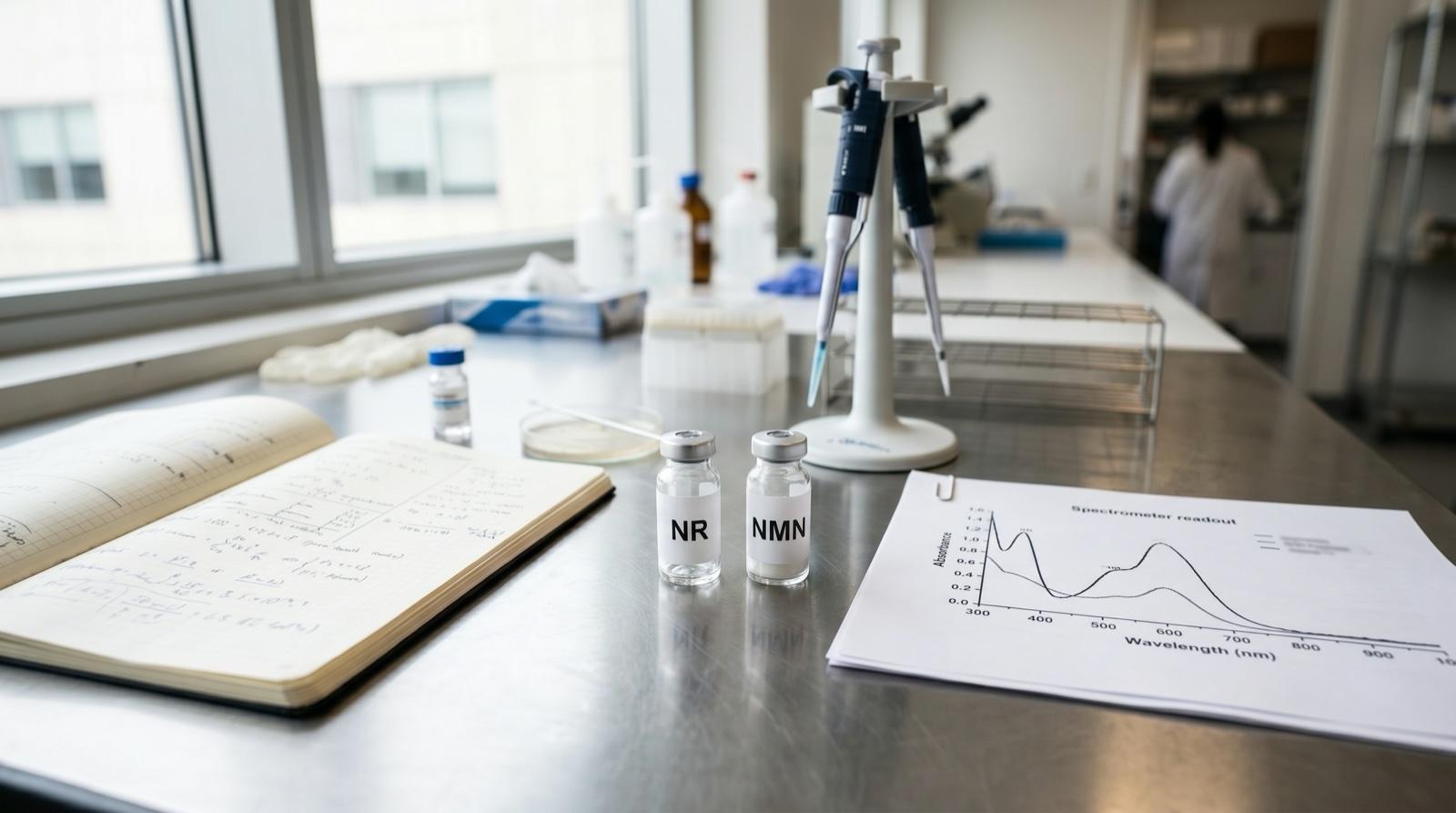
Long-Term NAD+ Precursor Safety: What We Know and Don't
The longest published NR and NMN human trials run 8-12 weeks with no serious adverse events at studied doses. Decade-scale safety data does not yet exist.
The longest published randomized trials of nicotinamide riboside (NR) and nicotinamide mononucleotide (NMN) run 8 to 12 weeks. At the doses studied, serious adverse events are not reported. Decade-scale safety data — the kind that would answer whether daily use over 10 or 30 years is safe — does not yet exist for either compound.
What does short-term safety data actually show?
Across the published randomized controlled trials of NR and NMN that ran 6 to 12 weeks, no study reported a serious adverse event attributable to the investigational compound. Martens et al. (2018, Nature Communications, PMID: 29599478) administered 1,000 mg/day of NR to healthy middle-aged adults for 6 weeks and documented a tolerability profile comparable to placebo.
Conze, Brenner, and Kruger (2019, Scientific Reports) extended this to 8 weeks at doses up to 2,000 mg/day. They reported no serious adverse events and no clinically meaningful changes in complete blood count, comprehensive metabolic panel, or lipid markers. Dellinger et al. (2017, NPJ Aging and Mechanisms of Disease) reported similar tolerability in an 8-week NR study using a combined NR-pterostilbene formulation.
NMN has a shorter human track record. Irie et al. (2020, Endocrine Journal) conducted the first single-dose human NMN study and reported no acute adverse events after oral administration. Yoshino et al. (2021, Science, PMID: 33888596) administered 250 mg/day for 10 weeks to postmenopausal prediabetic women and reported no serious adverse events and no abnormal shifts in safety chemistry. Kim et al. (2022, Nutrients) reviewed the aggregate NMN safety literature and reached the same conclusion: at studied doses and durations, no safety signals have surfaced.
What do researchers actually mean by “long-term”?
In the NAD+ literature, “long-term” is a relative term. When a trial protocol calls itself long-term, it typically means 8 to 12 weeks — long enough to see steady-state blood NAD+ elevation and short-term biomarker shifts. In pharmacology more broadly, long-term safety evidence usually requires years of exposure across thousands of patients.
The reference point many people have for “long-term safety” is niacin (nicotinic acid). Niacin has been in widespread clinical use since the 1950s, with decades of pooled safety data summarized by Guyton and Bays (2007) covering cardiovascular trial cohorts. That depth of evidence is what a true long-term safety profile looks like. NR and NMN are nowhere close to that standard — not because they have failed safety tests, but because the tests have not been conducted.
Which adverse events have actually been reported?
In trial-level adverse event tables, the most frequently reported symptoms across both NR and NMN studies are mild gastrointestinal discomfort (nausea, loose stools, abdominal cramping), headache, and transient fatigue. These are typically reported in a small minority of participants, often at rates statistically indistinguishable from placebo arms.
Conze et al. (2019) specifically documented that any reported side effects in the NR group resolved without intervention and did not require discontinuation. The published safety record for NR at 2,000 mg/day for 8 weeks is among the cleaner datasets in the field. Kim et al. (2022) make the same point for NMN: the most common events are mild GI, rare, and not dose-limiting at studied ranges.
What is missing from these reports is the kind of rare or delayed event that only surfaces in larger or longer studies — hepatotoxicity in a 1-in-5,000 patient, cardiovascular signal over 10 years of daily use, or cumulative effects on metabolic regulation. These gaps are not evidence of harm. They are evidence of what has not been measured.
Is methyl donor depletion a real concern?
One of the most discussed theoretical risks is methyl donor depletion. NAD+ turnover produces nicotinamide (NAM), which is either salvaged back into NAD+ via the salvage pathwayor methylated by nicotinamide N-methyltransferase (NNMT) and excreted as methylnicotinamide. That methylation consumes S-adenosyl methionine (SAM), the body’s primary methyl donor.
Jacobson et al. (2007, American Journal of Clinical Nutrition) reviewed the toxicology of chronic high-dose nicotinamide and documented that sustained exposure can measurably increase methylnicotinamide excretion. Whether this matters clinically at NR or NMN doses currently used in supplementation is unresolved. NR metabolism differs from NAM in that it can enter the salvage pathway without the same methylation burden, but once it is catabolized, the downstream NAM pool is the same.
Trials of NR at 1,000-2,000 mg/day have not shown functional deficits in methylation-dependent processes in short-term follow-up. But no trial has been designed specifically to detect methylation-related outcomes across months or years.
Could NAD+ precursors promote cancer in some contexts?
This is the most debated theoretical concern, and the honest answer is: we do not know. Conlon and Brenner (2020, Nucleic Acids Research) reviewed the preclinical literature and noted that certain tumor types are salvage-pathway-dependent for their NAD+ supply. In those cancer models, restricting NAMPT activity slows tumor growth. The inverse hypothesis — that elevating precursor supply could fuel such tumors — has support in some preclinical models but not others.
No published human trial has reported increased cancer incidence at NR or NMN doses studied. The relevant caveats are large. Trials have been short, underpowered for cancer endpoints, and have largely excluded participants with active or recent malignancy. Whether daily NAD+ precursor supplementation is safe for individuals with a personal or family history of specific cancers is not a question the published data can answer.
What do trials show about liver and kidney markers?
Published NR and NMN trials routinely monitor standard hepatic (ALT, AST, ALP, bilirubin) and renal (creatinine, BUN, eGFR) markers. Across the trials summarized by Conze et al. (2019) and Kim et al. (2022), none have reported clinically significant elevations or out-of-range shifts attributable to the study compound. Dellinger et al. (2017) reported the same pattern for NR-pterostilbene combinations.
This is reassuring for the short-term window but — again — does not speak to multi-year exposure. Drug-induced liver injury is famously difficult to detect in trials under 12 weeks; many hepatotoxic compounds passed short trials and failed in larger post-marketing surveillance. No such surveillance system exists for dietary supplements, including NAD+ precursors.
Is there a cardiovascular safety signal, good or bad?
The cardiovascular data is mixed and modest. Martens et al. (2018) reported that 6 weeks of NR reduced systolic blood pressure by roughly 8 mmHg in participants with elevated baseline pressure, a potentially favorable signal. Other trials have not consistently replicated this. No published NR or NMN trial has reported clinically adverse cardiovascular events.
A separate and much older cardiovascular data set comes from niacinamide prevention trials. Knip et al. (2000, Diabetes Care) documented nicotinamide use for type 1 diabetes prevention at pharmacological doses over multi-year follow-up — with safety monitoring — and did not identify cardiovascular harms. Nicotinamide and NR are not identical compounds, but nicotinamide safety data provides the closest thing to a long-duration reference for this chemical class.
What about drug interactions?
Formal interaction studies for NR and NMN are sparse. Theoretical and mechanistic concerns cluster in three areas: drugs that influence methylation (methotrexate, certain anticonvulsants); anti-diabetic medications, given the glucose-modifying effects observed with NMN in some trials; and statins, where the cardiovascular niacin literature provides partial precedent.
Anyone taking prescription medication should not assume compatibility without clinician review. The interaction profile is covered in detail in our dedicated write-up on NAD+ precursor safety and interactions. Across all trials reviewed, no drug-drug interaction has been documented as causing a serious adverse event — but very few interaction-specific studies have been designed and conducted.
Which populations have no safety data at all?
The published clinical trial record is built almost entirely on healthy adults aged 30 to 75. The safety of NR and NMN has not been established in:
- Pregnant or lactating individuals. No controlled trial data exists. Supplementation is not recommended during pregnancy or breastfeeding.
- Pediatric populations. No efficacy or safety data in anyone under 18 years old. The Knip (2000) nicotinamide trial is the closest pediatric-adjacent data and is for a different compound at a specific clinical indication.
- Individuals with active malignancy. Excluded from nearly all published NR and NMN trials; theoretical concerns remain unresolved.
- People with advanced liver or kidney disease. Excluded from most trials; standard safety assumptions do not transfer.
- Individuals on complex polypharmacy regimens. Not systematically studied.
What is the honest conclusion?
At doses of 100-2,000 mg/day and durations up to approximately 12 weeks, published NR and NMN trials do not report serious adverse events. Standard hepatic, renal, and metabolic markers remain within normal ranges. This is a meaningful short-term safety record, and it is what the available evidence supports.
Multi-year, multi-decade, and lifelong safety data simply do not exist. There are no published randomized controlled trials longer than about 12 months, no post-marketing surveillance infrastructure comparable to prescription pharmaceuticals, and several unresolved theoretical concerns — methylation burden, cancer salvage pathways, rare-event detection — that short trials cannot address. Anyone making confident claims about long-term safety is not citing data; they are filling a gap where data should be.
Frequently asked questions
- How long have humans been studied on NR or NMN?
- The longest published randomized trials run 8-12 weeks. Martens et al. (2018) tested NR for 6 weeks, Conze et al. (2019) for 8 weeks, and Yoshino et al. (2021) tested NMN for 10 weeks. A handful of open-label extensions reach roughly 12 months. No multi-year randomized safety data exists for either compound in humans.
- What side effects have been reported in NAD+ precursor trials?
- Published trials document mild gastrointestinal symptoms, fatigue, headache, and occasional muscle discomfort in a small percentage of participants — typically at rates similar to placebo. Conze et al. (2019) reported no serious adverse events at NR doses up to 2,000 mg/day for 8 weeks. No trial has documented liver or kidney toxicity at studied doses.
- Are NAD+ precursors safe during pregnancy or breastfeeding?
- No. Safety in pregnancy, lactation, and pediatric populations has not been established in any published controlled trial. The FDA and major clinical guidelines do not recommend use in these groups. Anyone pregnant, breastfeeding, or under 18 should consult a physician before considering supplementation — see our medical disclaimer.
- Can NAD+ precursors promote cancer growth?
- Preclinical evidence is mixed. Some tumor types depend on salvage-pathway NAD+ for proliferation (Conlon and Brenner 2020). No human trial has shown increased cancer incidence at studied doses and durations, but trials have not run long enough or enrolled high-risk cancer populations to answer the question definitively.
- Do NR or NMN interact with prescription medications?
- Few formal interaction studies exist. Theoretical interactions involve methyl donor pathways (methotrexate, SAM-e), anti-diabetic drugs, and statins. Anyone taking prescription medication should review the interaction profile with a clinician before starting — our drug interactions overview covers the published and theoretical risks in detail.