How to Measure NAD+ Levels: Blood Tests, Biomarkers, and What Labs Actually Detect
NAD+ testing options reviewed: whole blood vs PBMC vs urinary metabolites, LC-MS vs cycling assays, accuracy of home tests, and what a normal NAD+ level even means.
Measuring NAD+ levels is harder than ordering a vitamin D panel. The molecule is chemically unstable, exists in different pools across compartments, and has no FDA-cleared clinical assay. Research labs use validated LC-MS workflows on whole blood or isolated PBMCs; a handful of consumer companies offer dried blood spot panels with varying analytical rigor. This article walks through what is actually being measured, which methods are defensible, and why a single number on a report does not tell you what you may think it does.
What “measuring NAD+ levels” actually means
NAD+ is not a single circulating analyte like glucose or LDL. It is a cofactor that exists in distinct pools — cytosolic, mitochondrial, and nuclear — within every metabolically active cell, plus a much smaller extracellular component. The phrase “NAD+ level” is therefore shorthand for several different measurements, each answering a slightly different biological question.
The four practical sample types are whole blood, isolated peripheral blood mononuclear cells (PBMCs), plasma, and urinary metabolites. Whole blood captures the bulk intracellular pool of erythrocytes plus minor plasma contribution; PBMCs isolate lymphocyte intracellular NAD+ specifically; plasma reflects only the small extracellular fraction; urinary metabolites (such as N-methylnicotinamide and its oxidation products) report on whole-body NAD+ turnover indirectly. Each sample type behaves differently and produces different numbers.
The instability problem matters. NAD+ degrades within minutes at room temperature in collected blood through endogenous NADases, which is why pre-analytical handling — quenching with acid or organic solvent, rapid freezing, controlled time-to-process — matters more than for most analytes. A high-quality assay measured on a poorly handled sample is still a poor measurement. The primer on NAD+ decline with age explains why the molecule is dynamic in the first place.
Whole blood vs PBMC vs plasma — which sample type
Trammell et al. (2016, Nat Commun, PMID 27721479) is the foundational method paper for whole-blood NAD+ quantitation in humans. The group validated an isotope-dilution LC-MS workflow that handles the instability problem by quenching collected blood directly into cold acidic methanol, then quantifying NAD+ and related metabolites against stable-isotope-labeled internal standards. The same workflow has been applied across most subsequent NR pharmacokinetic trials.
Whole blood is the most commonly reported sample type because it is easy to collect, captures a large NAD+ pool dominated by red blood cells, and reflects systemic exposure to circulating precursors. Healthy adult whole-blood NAD+ values reported with validated LC-MS cluster in the 20-40 micromolar range, with younger adults typically higher than older adults. Published values vary — methodology and sample handling drive much of the spread.
PBMC NAD+ — measured after isolating lymphocytes from a whole blood draw — is the more sensitive readout for studying immune cell metabolism, sirtuin activity, and CD38-driven turnover. Clement et al. (2019, Sci Rep) described a validated PBMC NAD+ workflow used in clinical trials. Values are typically reported per million cells or normalized to protein content rather than as a concentration, which makes cross-study comparison harder. PBMC measurements tend to track more closely with the CD38 mechanism story than whole blood does, because CD38 is highly expressed on immune cells.
Plasma NAD+ is sometimes reported but contributes little to the intracellular metabolic story — extracellular NAD+ is in the nanomolar to low-micromolar range and represents leakage and active secretion, not the intracellular pool that drives sirtuin and PARP activity. Plasma is more useful for measuring downstream metabolites (NAM, MeNAM, ADPR) than NAD+ itself.
LC-MS vs enzymatic cycling assays
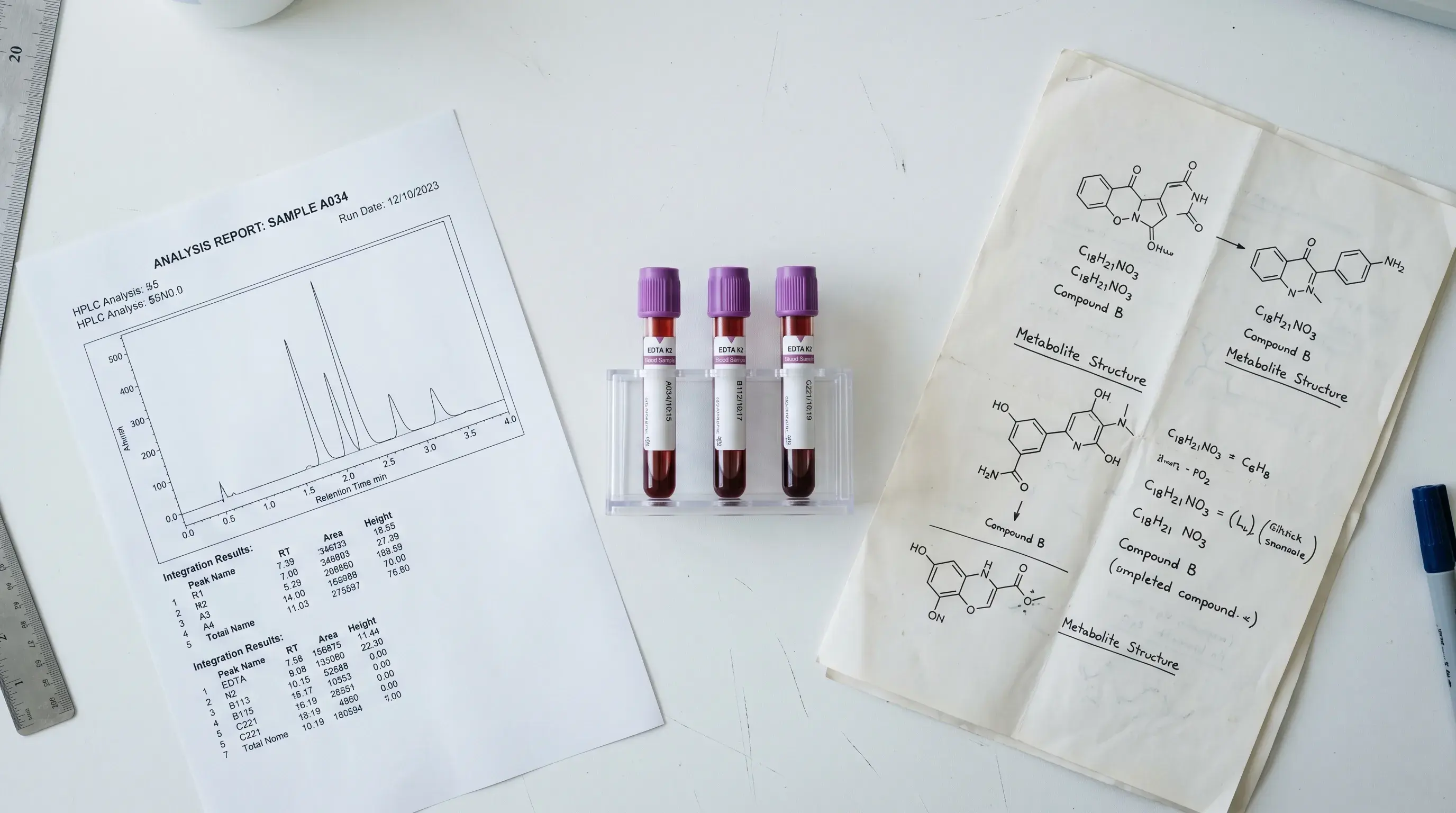
Two analytical strategies dominate. Liquid chromatography-mass spectrometry (LC-MS), particularly with isotope dilution, is the gold standard for NAD+ quantitation. The technique separates NAD+ from related compounds (NADH, NMN, NR, NAM, NADP+) by chromatography and detects each by its mass-to-charge ratio. Stable-isotope-labeled internal standards correct for matrix effects and recovery losses. Demarest et al. (2019, PMID 31063959) published a detailed validation of an LC-MS workflow specifically designed for clinical pharmacokinetics, including specificity, linearity, lower limit of quantitation, accuracy, and stability data.
Enzymatic cycling assays — the older approach — exploit NAD+'s role as an enzyme cofactor. Alcohol dehydrogenase or a similar enzyme cycles NAD+/NADH while a colorimetric or fluorescent reagent reports on the cycle. Cycling assays are inexpensive, run on plate readers, and are common in academic and commercial labs. They are also less specific: most cycling reagents do not cleanly distinguish NAD+ from NADH or from related dinucleotides like NADP+, depending on the kit. Numbers from cycling assays and LC-MS on the same sample do not always agree.
Several reasons LC-MS is preferred for definitive measurement:
- Specificity — separates NAD+ from NADH, NADP+, NADPH, NMN, NR, and NAM, each of which a cycling assay may partially count
- Quantitation accuracy — isotope-labeled internal standards correct for sample loss during processing
- Multiplexing — the same run measures NAD+, NMN, NR, NAM, and MeNAM together, giving a richer picture
- Stability handling — designed workflows include quenching at the collection step, mitigating the instability problem
The tradeoffs: LC-MS is expensive, requires specialized instrumentation, and turnaround is slower. Most published clinical trials in NAD+ pharmacokinetics use LC-MS; most consumer-facing or rapid-screening assays use cycling. When reading a study or a consumer report, the methodology section is more informative than the headline number.
Urinary metabolites — the indirect approach
Urinary measurement of N-methylnicotinamide (MeNAM) and its oxidation products (2py-NAM and 4py-NAM) provides an indirect window on NAD+ turnover. The biology is straightforward: NAD+ is degraded to nicotinamide (NAM), which is methylated by nicotinamide N-methyltransferase (NNMT) to MeNAM and excreted in urine. Higher urinary MeNAM correlates with higher NAD+ flux, though it does not report on a steady-state concentration.
The advantage of urinary measurement is that it integrates over time and avoids the blood-handling instability problem. The disadvantage is that it conflates flux with concentration — high turnover with a depleted pool can produce the same MeNAM as moderate turnover with a replete pool. Urinary metabolites are useful as a complementary readout in research, less useful as a standalone consumer test.
Consumer NAD+ tests — what they actually deliver
Several direct-to-consumer companies sell NAD+ measurement kits. The most prominent in 2026 is Jinfiniti Precision Medicine, which markets an Intracellular NAD Test using a dried blood spot card. A handful of longevity clinics and integrative medicine practices offer in-house finger-stick or venous draws sent to specialty labs. None of these are FDA-cleared diagnostic assays — they are research-use-only or laboratory-developed tests under CLIA certification, which permits clinical use within the issuing laboratory but does not require FDA review of analytical performance.
Pro tip: if you do consumer test, control everything you can. Collect at the same time of day, after the same fasting state, on the same day of the week, and via the same shipping route. The single biggest contributor to apparent NAD+ “changes” in consumer testing is pre-analytical variability, not biology. Pair the result with a baseline from the same lab before any intervention so the comparison is internally controlled.
A typical consumer report includes a numeric NAD+ value, a vendor- defined “optimal” range, and a population percentile. The optimal range is set by the vendor based on internal cohort distributions, not by a published consensus. A reading that falls outside the vendor range does not mean a clinically actionable deficiency exists — it means the value is unusual relative to the vendor's population, which is a different statement.
What is a normal NAD+ level — and is it a meaningful question
There is no consensus reference range for NAD+ analogous to the ranges that exist for glucose, ferritin, or 25-hydroxyvitamin D. The reasons are practical: NAD+ is not a routine clinical analyte, no large reference cohort exists with method-controlled measurements, and the molecule's instability makes cross-laboratory standardization hard. Published “typical” values come from individual research studies and apply primarily within the same methodology.
Within those constraints, a few patterns emerge from method- validated literature:
- Whole-blood NAD+ in healthy adults typically falls in the 20-40 micromolar range when measured by isotope-dilution LC-MS (Trammell 2016, PMID 27721479)
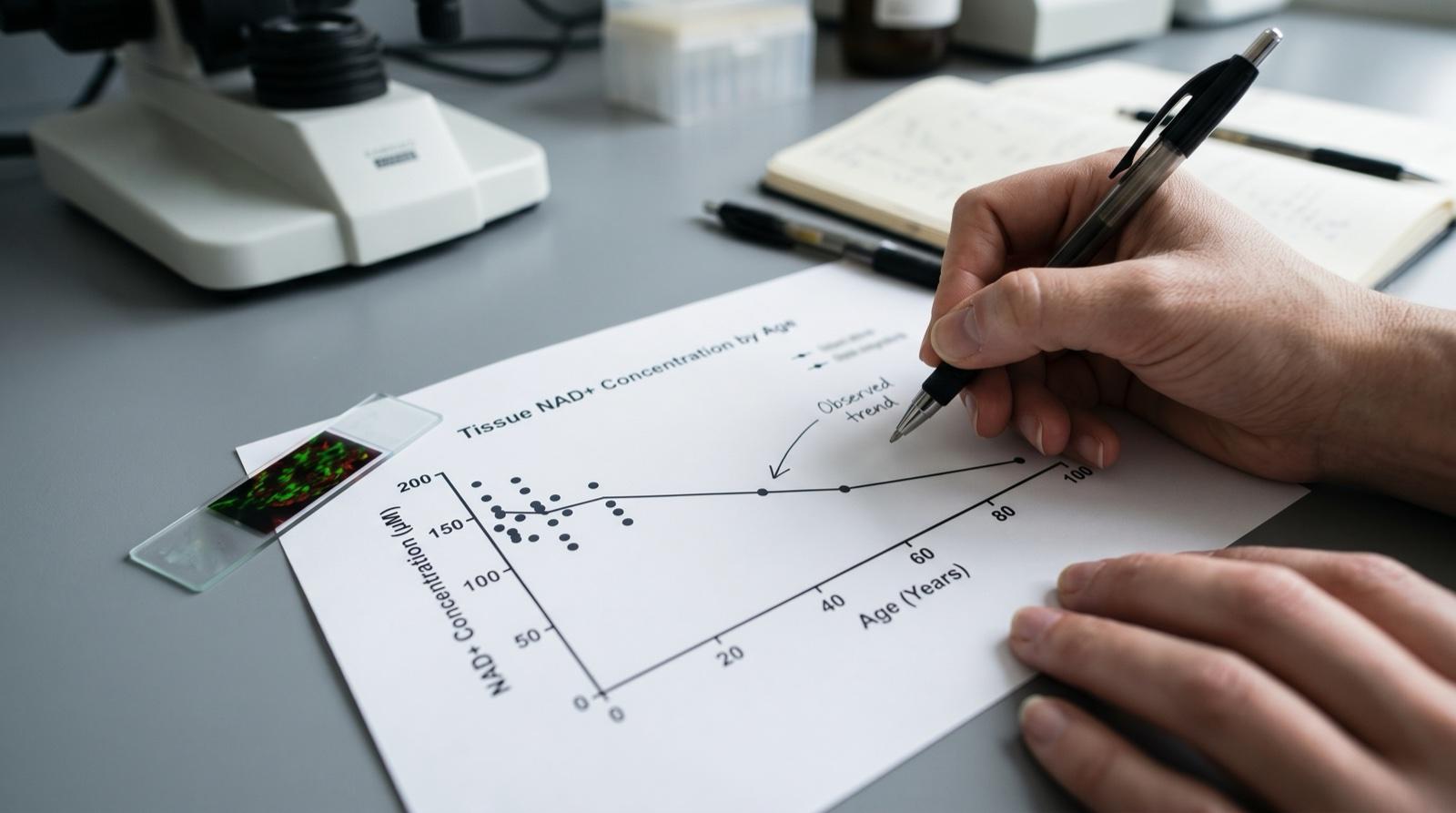
- NAD+ tends to be lower in older adults than in younger adults across multiple tissues, including blood — the observation that motivates most precursor research
- Within-person variability is meaningful — values can shift 10-30% between morning and evening or between fed and fasted states without any underlying intervention
- Sex, BMI, and acute illness all influence values — a single isolated reading without context has limited interpretability
The practical implication: the question “is my NAD+ normal?” has no defensible answer in 2026. The more answerable question is “has my NAD+ changed at this lab over time, in a way that exceeds within-person noise?” — which requires repeated measurements at the same lab using the same sample type and protocol.
Method comparison at a glance
A useful mental table to keep in mind when reading studies or evaluating a test:
| Method | Sample | What it captures | Strengths | Limitations |
|---|---|---|---|---|
| LC-MS (isotope dilution) | Whole blood, PBMC, plasma | Specific NAD+, plus NADH, NMN, NR, NAM | Gold standard, multiplexed, accurate | Expensive, slow, specialized lab |
| Enzymatic cycling assay | Whole blood, cell lysate | NAD(H) total or NAD+ depending on kit | Cheap, fast, plate-reader compatible | Less specific, kit-dependent |
| Dried blood spot (DBS) | Finger-stick blood on card | Whole-blood NAD+ post-shipping | Convenient, no phlebotomy | Pre-analytical degradation risk |
| Urinary metabolites | Spot or 24-hour urine | NAD+ turnover (MeNAM and pyridones) | Non-invasive, integrates over time | Indirect, conflates flux with pool |
The key takeaway from this table: any single measurement is one slice of a multi-compartment system, and the method shapes the answer. A “low” reading on a cycling assay can be average on LC-MS; a urinary high can mask a tissue low.
When testing is actually useful
Testing is most informative when the question is well defined and the methodology is controlled. Three scenarios where measurement adds value:
- Pharmacokinetic monitoring in a research or trial setting — paired pre/post measurements at validated labs to confirm that a precursor protocol raised NAD+, as in the NMN dosage trial summaries where this is the primary endpoint
- Within-person trend tracking over months at the same vendor with controlled collection conditions — useful for observing direction of change with an intervention
- Clinical research on age-related metabolic disease — where intracellular NAD+ in tissue or PBMC is part of a defined investigational protocol with appropriate controls
Three scenarios where testing adds little:
- Single isolated baseline measurementcompared to a published “normal” — methodology mismatch and within-person variability dominate
- Cross-vendor comparison (testing at one lab before, another lab after) — the difference is mostly assay drift, not biology
- Diagnostic decision-making in routine care — no NAD+ assay is FDA-cleared, no clinical guideline references NAD+ in standard practice, and clinicians have no validated framework for acting on a number
What is changing in NAD+ measurement
Three trends are reshaping the field in 2026. First, LC-MS instrument cost and turnaround are improving, narrowing the gap between research-grade and consumer-grade testing. Second, several groups are validating dried blood spot methodologies with appropriate stabilization to address the pre-analytical degradation problem — though external proficiency testing remains limited. Third, pharma trials of NAD+ precursors increasingly publish their validated assay protocols alongside primary results, which is creating a slowly-growing reference base for what method-controlled normal values look like.
What has not changed: NAD+ is still not a routine clinical analyte, no FDA-cleared assay exists for general use, and no consensus reference range has been published. The reference base for comparison is research literature, not clinical chemistry. Anyone marketing NAD+ testing as a definitive diagnostic readout is overstating what the methodology can support today.
Bottom line
Measuring NAD+ levels is a real research capability, but consumer access lags behind the underlying complexity. The most defensible readouts come from validated LC-MS on properly quenched whole blood or PBMCs. Consumer dried blood spot tests are convenient and useful for within-vendor trend tracking, less useful for absolute clinical interpretation. There is no universal “normal” because there is no consensus reference range, and any single measurement is shaped as much by methodology as by biology.
The deeper context for why measurement matters in the first place is the well-documented decline of NAD+ with age and the mechanistic picture of how that decline happens. For an introductory grounding in what NAD+ is and why it matters metabolically, the NAD+ primer covers the cofactor biology in plain language. For dosage context if a precursor trial is being considered, the NMN clinical-trial dosage summary walks through what doses have been used and what blood-level changes were observed.
Frequently asked questions
- Can you test your NAD+ levels?
- Yes, but with significant caveats. Research labs measure NAD+ in whole blood, isolated peripheral blood mononuclear cells (PBMCs), or via urinary metabolites using LC-MS or enzymatic cycling assays. Several direct-to-consumer companies (including Jinfiniti) offer dried blood spot or finger-stick NAD+ panels. The clinical and analytical validity of consumer testing varies, and there is no FDA-cleared NAD+ assay for routine medical use. A measured value is most useful as a within-person change over time rather than a single cross-sectional number.
- What is a normal NAD+ level?
- There is no consensus reference range. In whole blood, healthy adult values reported across method-validated studies cluster around 20-40 micromolar, but exact numbers depend on sample type (whole blood vs PBMC vs plasma), anticoagulant, processing time, and assay (LC-MS vs cycling). Trammell et al. (2016, PMID 27721479) reported whole-blood NAD+ around 25-30 micromolar in young adults using validated LC-MS, with a notable downward trend with age. Comparing your number to a published 'normal' is unreliable unless the methodology matches exactly.
- Is there a blood test for NAD+?
- Yes, in research and specialty laboratory settings. The two dominant approaches are LC-MS quantitation (gold standard, isotope-dilution preferred) and enzymatic cycling assays (cheaper, less specific). Sample type matters: whole blood captures both intracellular and minor plasma pools, while PBMC isolation measures lymphocyte intracellular NAD+ specifically. Demarest et al. (2019, PMID 31063959) described and validated an LC-MS workflow used in pharmacology trials. Routine clinical chemistry panels do not include NAD+.
- How accurate are NAD+ home tests?
- Accuracy depends on the methodology, sample handling, and whether the lab participates in any external validation. NAD+ is chemically unstable in collected blood — it degrades quickly without immediate quenching or freezing — so dried blood spot and shipped finger-stick samples are vulnerable to pre-analytical loss. Some commercial assays correlate reasonably with research methods within their own pipeline, but cross-vendor comparisons are not standardized. Treat consumer NAD+ test results as a within-vendor trend signal, not an absolute clinical number.
- What labs measure NAD+?
- Academic core facilities (Brenner Lab at City of Hope, Sauve Lab at Weill Cornell, Auwerx Lab at EPFL, and similar) run validated LC-MS NAD+ assays for research use. Specialty contract labs serving pharma trials offer GLP-validated NAD+ quantitation. On the consumer side, Jinfiniti Precision Medicine markets an Intracellular NAD Test using dried blood spots, and a small number of longevity clinics offer in-house panels. None of these are FDA-cleared diagnostic assays — all are research-use-only or laboratory-developed tests.
- Should I get my NAD+ tested before starting a precursor?
- From a strict evidence standpoint, the answer is unclear. No clinical guideline recommends NAD+ testing as a basis for supplementation, and the within-person variability of any single measurement makes a single baseline less informative than a series. If testing is pursued, paired pre-and-post measurements at the same lab, same sample type, and same time of day are the only meaningful comparison. Speak to a clinician about whether testing is appropriate for your situation; this article is reference information, not medical advice.