What Is NAD+? A Science-First Primer
NAD+ is a coenzyme in every living cell that fuels energy metabolism and regulates sirtuins, PARPs, and CD38. A primer on the biochemistry and why it matters.
NAD+ — nicotinamide adenine dinucleotide — is a small molecule present in every living cell. It has two jobs: shuttling electrons during energy metabolism, and being consumed as a substrate by enzymes that repair DNA, regulate inflammation, and tune the circadian clock. That dual role is why it matters.
What is NAD+ chemically?
NAD+ stands for nicotinamide adenine dinucleotide. The name describes the structure directly: two nucleotides linked by a pair of phosphate groups. One nucleotide contains nicotinamide (a form of vitamin B3) attached to a ribose sugar. The other contains adenine (the same base found in DNA and ATP) attached to its own ribose. The two riboses are joined by a diphosphate bridge (Bogan & Brenner, 2008, Annu Rev Nutr, PMID: 18429699).
The “+” in NAD+ refers to the oxidized state. When NAD+ picks up two electrons and one proton, it becomes NADH — the reduced form. This redox pair, NAD+/NADH, is one of the most heavily used energy-carrying systems in biology. A single human cell cycles through roughly its entire NAD+ pool every few minutes during active metabolism (Cantó, Menzies & Auwerx, 2015, Cell Metab, PMID: 26118927).
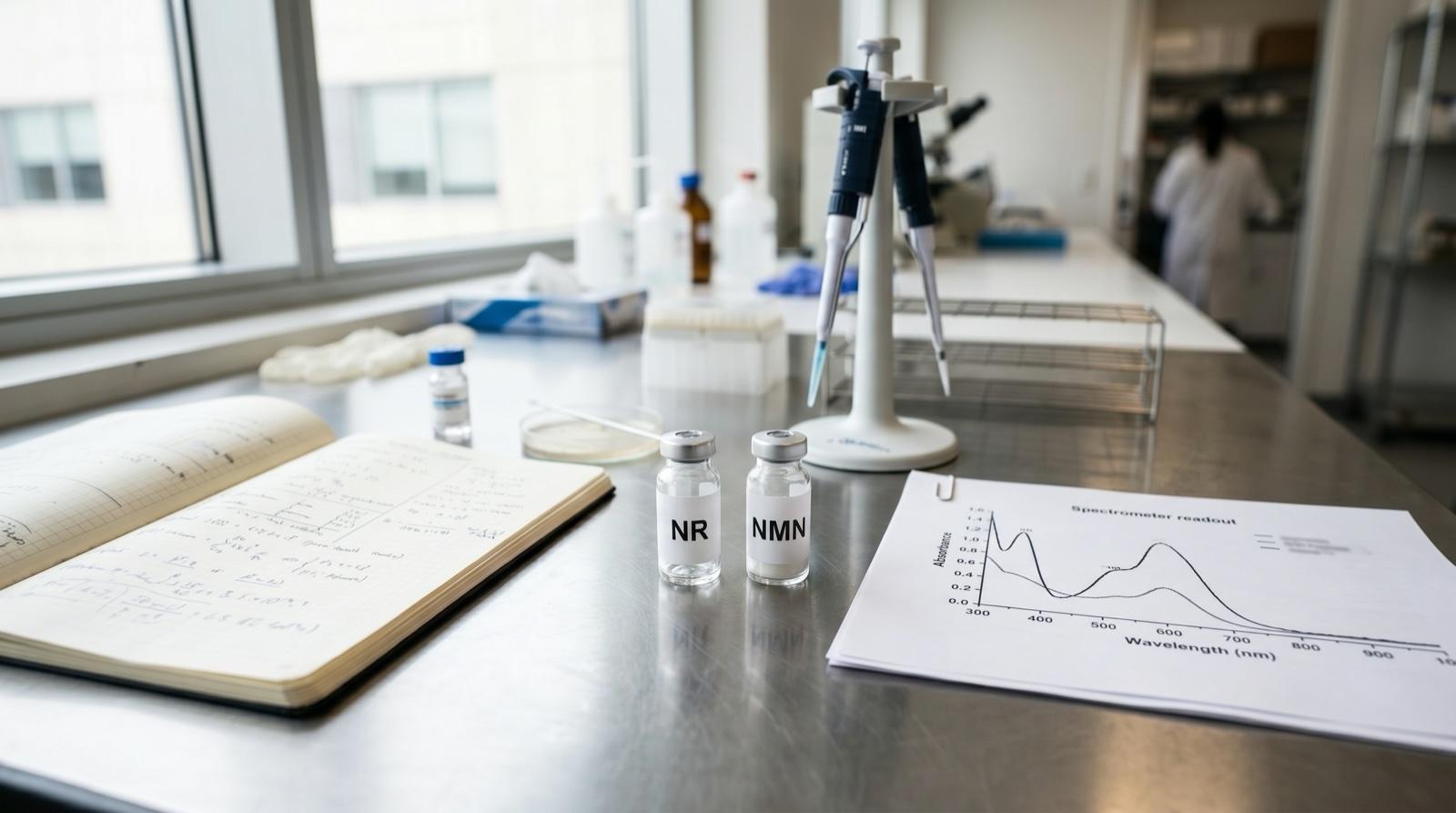
NAD+ is closely related to two other cofactors worth naming. NMN (nicotinamide mononucleotide) is exactly half of an NAD+ molecule — the nicotinamide-ribose-phosphate half. NR (nicotinamide riboside) is NMN without the phosphate. Cells use enzymes to assemble these precursors into finished NAD+, which is why both show up in supplementation research.
What does NAD+ do in cells?
NAD+ has two functional roles that are easy to confuse. The first is as a redox cofactor — a reusable electron carrier that is not consumed during a reaction. The second is as a substrate — a molecule that enzymes break apart and use up. A cell's total NAD+ pool is balanced between these two uses every moment it is alive (Imai & Guarente, 2014, Trends Cell Biol, PMID: 24786309).
What is the redox cofactor role of NAD+?
In its redox role, NAD+ shuttles electrons between reactions in central metabolism. Three pathways do most of the work:
- Glycolysis — breaking glucose into pyruvate generates NADH, converting NAD+ to its reduced form as electrons are harvested from sugar.
- The TCA cycle (also called the Krebs cycle or citric acid cycle) — further oxidation of pyruvate-derived molecules produces more NADH inside mitochondria.
- The electron transport chain — NADH hands its electrons off to the inner mitochondrial membrane, where they power ATP synthesis. NAD+ is regenerated and recycles.
The analogy worth remembering: NAD+ is an electron shuttle bus. It picks up passengers (electrons) at one metabolic stop and drops them off at another. The bus itself is not consumed — it just goes back and forth. A healthy cell maintains roughly 700-fold more free NAD+ than free NADH in the cytoplasm, keeping the bus mostly empty and ready to load more electrons (Rajman, Chwalek & Sinclair, 2018, Cell Metab, PMID: 29514064).
How is NAD+ consumed as an enzyme substrate?
Beyond redox, NAD+ is also broken apart by three enzyme families. These reactions cleave the molecule at the nicotinamide-ribose bond, permanently consuming NAD+ in exchange for a signaling event:
- Sirtuins (SIRT1 through SIRT7) — a family of seven deacetylases that remove acetyl groups from proteins, including histones, transcription factors, and mitochondrial enzymes. Each deacetylation consumes one NAD+ molecule.
- PARPs (poly-ADP-ribose polymerases) — enzymes that detect DNA damage and tag broken strands with chains of ADP-ribose to recruit repair factors. PARP1 alone can consume large fractions of nuclear NAD+ under heavy damage.
- CD38 — a glycohydrolase expressed on immune cells and, increasingly, on aged tissues. It hydrolyzes NAD+ into nicotinamide and ADP-ribose as part of immune signaling and calcium mobilization.
How is NAD+ made and recycled?
Cells do not rely on a single source for NAD+. Three biosynthetic routes converge on the same end product, each starting from a different dietary or metabolic input (Bogan & Brenner, 2008, Annu Rev Nutr, PMID: 18429699).
How does the salvage pathway recycle NAD+?
The salvage pathway is the dominant source of NAD+ in most tissues. It recycles nicotinamide — the by-product released every time sirtuins, PARPs, or CD38 consume NAD+ — back into a fresh NAD+ molecule. The rate-limiting enzyme is NAMPT (nicotinamide phosphoribosyltransferase), which attaches a ribose-phosphate group to nicotinamide to produce NMN. A second enzyme, NMNAT, adds the adenine half to finish the molecule.
This recycling loop is efficient. A nicotinamide molecule released by sirtuin activity can be back in the NAD+ pool within minutes. The downside: when NAMPT activity drops — as it does with aging in several tissues — the salvage pathway slows, and the cell becomes more dependent on fresh precursor intake to maintain NAD+ levels (Lautrup et al., 2019, Cell Metab, PMID: 31577933).
How does dietary niacin enter the Preiss-Handler pathway?
Dietary niacin (nicotinic acid) enters through a separate three-step route called the Preiss-Handler pathway. Niacin is found in meat, fish, whole grains, legumes, and fortified foods. The recommended daily allowance of niacin in the U.S. is 14-16 mg (National Institutes of Health Office of Dietary Supplements, 2022). The pathway is efficient at converting ingested niacin into NAD+, but high doses cause the well-known flushing reaction that limits tolerability.
How is NAD+ built de novo from tryptophan?
Cells can also build NAD+ from scratch using the amino acid tryptophan through the de novo pathway. This is the kynurenine pathway, which takes eight enzymatic steps to convert tryptophan into quinolinic acid and eventually into NAD+. De novo synthesis is a minor contributor to whole-body NAD+ in well-fed humans — roughly 60 mg of tryptophan equates to 1 mg of niacin equivalent — but it is the reason severe protein deficiency can produce pellagra-like symptoms.
How do supplemental NR and NMN feed the pathway?
Two newer precursors have attracted research attention because they enter the salvage pathway at later steps than nicotinamide and niacin. NR (nicotinamide riboside) was characterized as an NAD+ precursor by Belenky and colleagues in their landmark 2007 work, which demonstrated that yeast could convert NR into NAD+ through a dedicated kinase enzyme (NRK) — confirming NR as a distinct precursor route (Belenky et al., 2007, Cell, PMID: 15137942).
NMN (nicotinamide mononucleotide) is one step further along the salvage pathway — an immediate precursor to NAD+ itself. Both NR and NMN have been tested in human trials and raise blood NAD+ at studied doses. Our NR vs. NMN comparison covers the pharmacokinetic and regulatory differences. For a broader side-by-side, the precursor comparison matrix lays out NR, NMN, and NAD+ directly across cost, evidence tier, and delivery format.
Why does NAD+ matter for aging?
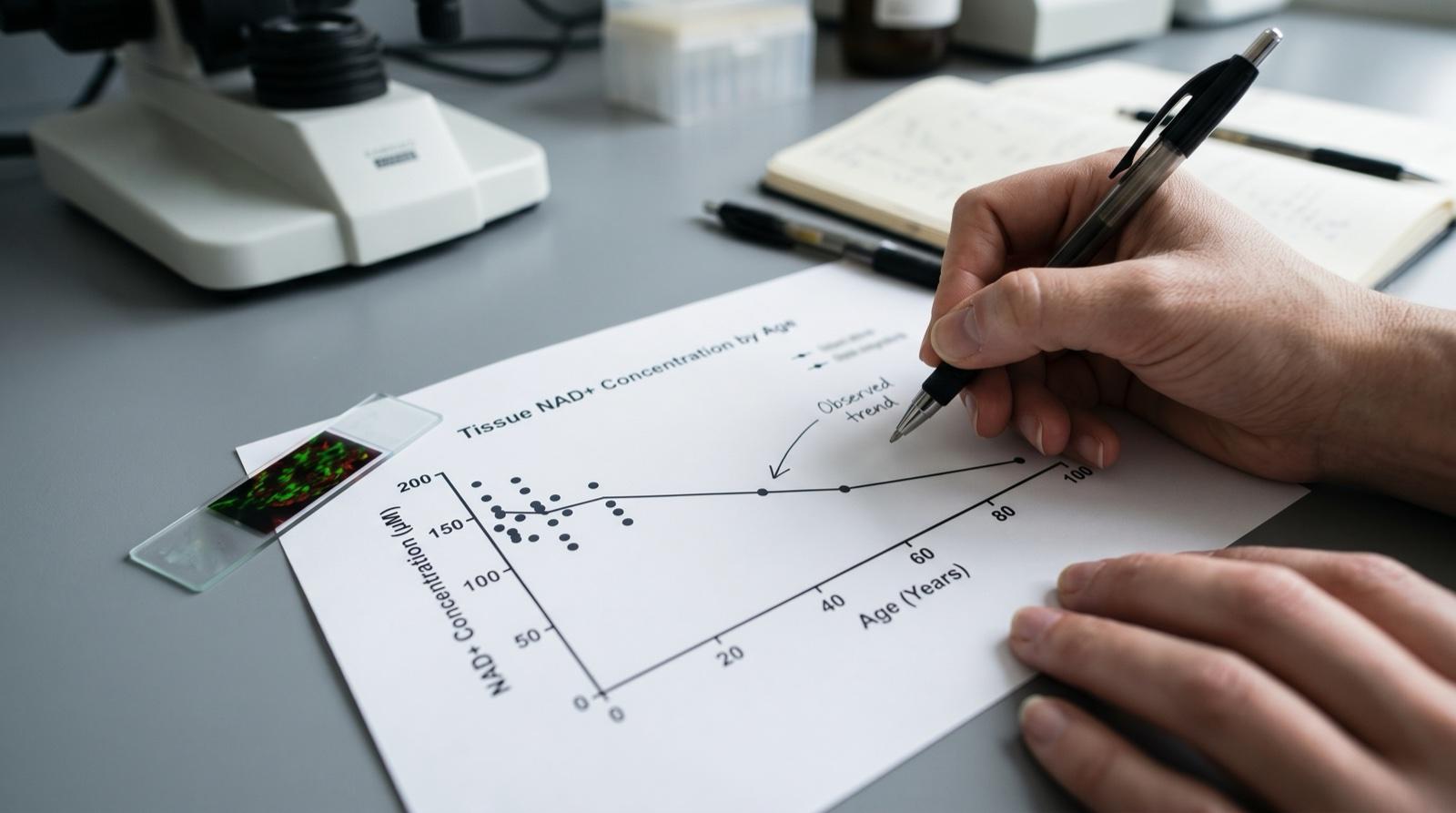
Tissue NAD+ concentrations fall roughly 50% between age 20 and 70 in measured human tissues — skin, skeletal muscle, brain, liver, and blood all show the pattern (Verdin, 2015, Science, PMID: 26785480). That decline is not a bystander finding. It correlates with reduced sirtuin activity, impaired DNA repair capacity, and mitochondrial dysfunction — three hallmarks of cellular aging.
Four mechanisms link NAD+ to healthspan biology, each backed by distinct lines of evidence:
How does NAD+ support DNA repair?
PARP1 and sister PARP enzymes use NAD+ as their sole substrate to mark DNA damage and recruit repair machinery. Low NAD+ means slower and less efficient damage detection. Our DNA repair benefit pagecovers the mechanism in depth — including the finding that PARP1 activation itself drains nuclear NAD+ pools and can starve nearby sirtuins of substrate (Lautrup et al., 2019, Cell Metab, PMID: 31577933).
How does NAD+ affect mitochondrial function?
Mitochondria depend on NAD+ for both redox chemistry (the TCA cycle and electron transport chain) and for SIRT3 — a sirtuin that deacetylates dozens of mitochondrial enzymes to regulate their activity. When mitochondrial NAD+ falls, SIRT3 substrate targets accumulate in their acetylated (often less active) forms, and oxidative phosphorylation becomes less efficient.
How does NAD+ link to circadian biology?
NAD+ concentrations oscillate on a daily cycle. NAMPT transcription is itself controlled by the circadian clock, and NAD+ availability feeds back onto SIRT1, which deacetylates core clock proteins. This bidirectional link means NAD+ levels and the body's daily rhythm are co-regulated — one reason sleep disruption and NAD+ decline tend to cluster together with age (Imai & Guarente, 2014, Trends Cell Biol, PMID: 24786309).
How does inflammation accelerate NAD+ consumption?
CD38 expression rises with age and with chronic low-grade inflammation (sometimes called inflammaging). Because CD38 is a potent NAD+ hydrolase, rising inflammation directly accelerates NAD+ consumption. This is the mechanistic link between immune dysfunction and the NAD+ decline observed in aged tissues.
Where does the evidence actually stand?
The research on NAD+ sits at three different evidence tiers, and conflating them is the most common mistake in popular coverage. It is useful to separate what is settled, what is probable, and what remains hypothesis.
Established
NAD+ is an essential coenzyme for life. Every cell requires it. Severe deficiency causes pellagra, a clinical syndrome documented since the early 1900s. Niacin (vitamin B3) was identified as the pellagra-preventing factor, and NAD+ synthesis from niacin and tryptophan is the biochemical reason dietary B3 matters. This layer of the evidence is textbook-stable.
Similarly settled: NAD+ concentrations decline with age in every mammalian tissue measured, and supplementation with niacin, NR, or NMN raises blood NAD+ in a dose-dependent way. These are repeated, reproducible findings across multiple labs.
Emerging
Whether raising NAD+ through supplementation produces meaningful health outcomes in humans is where the field is actively working. Early human trials show promising biomarker shifts — mitochondrial gene expression, insulin sensitivity in a specific subgroup, inflammatory markers — but trial durations are short, sample sizes modest, and clinical endpoints (cardiovascular events, cognitive decline, mortality) have not been measured at scale (Rajman et al., 2018, Cell Metab, PMID: 29514064).
Speculative
Claims that NAD+ supplementation extends human lifespan, reverses aging, or functions as a general-purpose longevity intervention outrun the current data. Animal studies — particularly in mice — show some extension of healthspan markers under specific conditions, but no lifespan extension trial in humans has been completed, and none is close to completion given the timescale required.
For a closer look at what happens to tissue NAD+ with age and which mechanisms drive the decline, see our dedicated post on NAD+ decline with age.
What this primer doesn't cover
This article is a conceptual and biochemical primer, not a supplementation guide. It deliberately does not address:
- Dosing protocols. Effective doses differ by precursor, body weight, and endpoint. No universal recommendation applies across NR, NMN, and niacin.
- Product selection. Brand comparisons are outside the scope of this primer; see the brand database for the review rubric.
- Individual suitability. Medication interactions, pregnancy, and specific health conditions require clinician input, not general articles.
For mechanism deep-dives, see the sirtuins, PARP, and CD38 pages. For precursor overviews, see NR, NMN, niacin, nicotinamide, and NAD+ directly. For delivery routes (oral, sublingual, IV, subcutaneous), see the delivery methods hub. Definitions for every term in this article live in the glossary.
Bottom line
NAD+ is one of the most thoroughly characterized small molecules in biochemistry. It is a coenzyme that accepts and donates electrons during energy metabolism, and it is a consumable substrate for three enzyme families — sirtuins, PARPs, and CD38 — that regulate much of what we call healthspan biology. Cells make it from three precursor routes and recycle it continuously through the salvage pathway.
The decline of tissue NAD+ with age is real and measurable. The question of whether restoring it through supplementation produces clinical benefit is the open research front. Distinguishing those two layers — the biochemistry that is settled from the interventional claims that are still maturing — is how to read any article or product label in this area without being misled.
Frequently asked questions
- What is NAD+?
- NAD+ is nicotinamide adenine dinucleotide, a coenzyme present in every living cell. It accepts and donates electrons during energy metabolism and serves as a consumable substrate for three enzyme families — sirtuins, PARPs, and CD38 — that regulate DNA repair, inflammation, and circadian biology (Rajman et al., 2018, Cell Metab).
- What does NAD+ actually do?
- NAD+ performs two distinct jobs. As a redox cofactor, it shuttles electrons through glycolysis, the TCA cycle, and the electron transport chain to produce ATP. As a substrate, it is consumed by sirtuins, PARPs, and CD38 in signaling reactions that break the molecule apart (Cantó, Menzies & Auwerx, 2015, Cell Metab).
- Where does the body get NAD+?
- Cells make NAD+ from three precursor routes: dietary niacin and nicotinamide via the Preiss-Handler and salvage pathways, tryptophan via de novo synthesis from the kynurenine pathway, and newer precursors like NR and NMN that feed directly into the salvage loop (Bogan & Brenner, 2008, Annu Rev Nutr).
- Why is NAD+ linked to aging?
- Tissue NAD+ concentrations fall roughly 50% between age 20 and 70 in measured human tissues (Massudi et al., 2012). The decline correlates with reduced sirtuin activity, impaired DNA repair, and mitochondrial dysfunction — making NAD+ one of the most-studied longevity targets in mammalian biology (Verdin, 2015, Science).
- Do NAD+ supplements work?
- Oral precursors like NR and NMN reliably raise blood NAD+ by 30-60% at studied doses (Martens et al., 2018; Yoshino et al., 2021). Whether this blood elevation translates to tissue-level restoration and measurable healthspan outcomes is the active research question — strong on biomarkers, emerging on clinical endpoints.