NAD+ in Long COVID and Post-Viral Fatigue: What Clinical Evidence Shows
Long COVID depletes NAD+ through CD38 activation, mitochondrial dysfunction, and chronic PARP demand. Here is what the clinical and mechanistic evidence shows as of 2026.
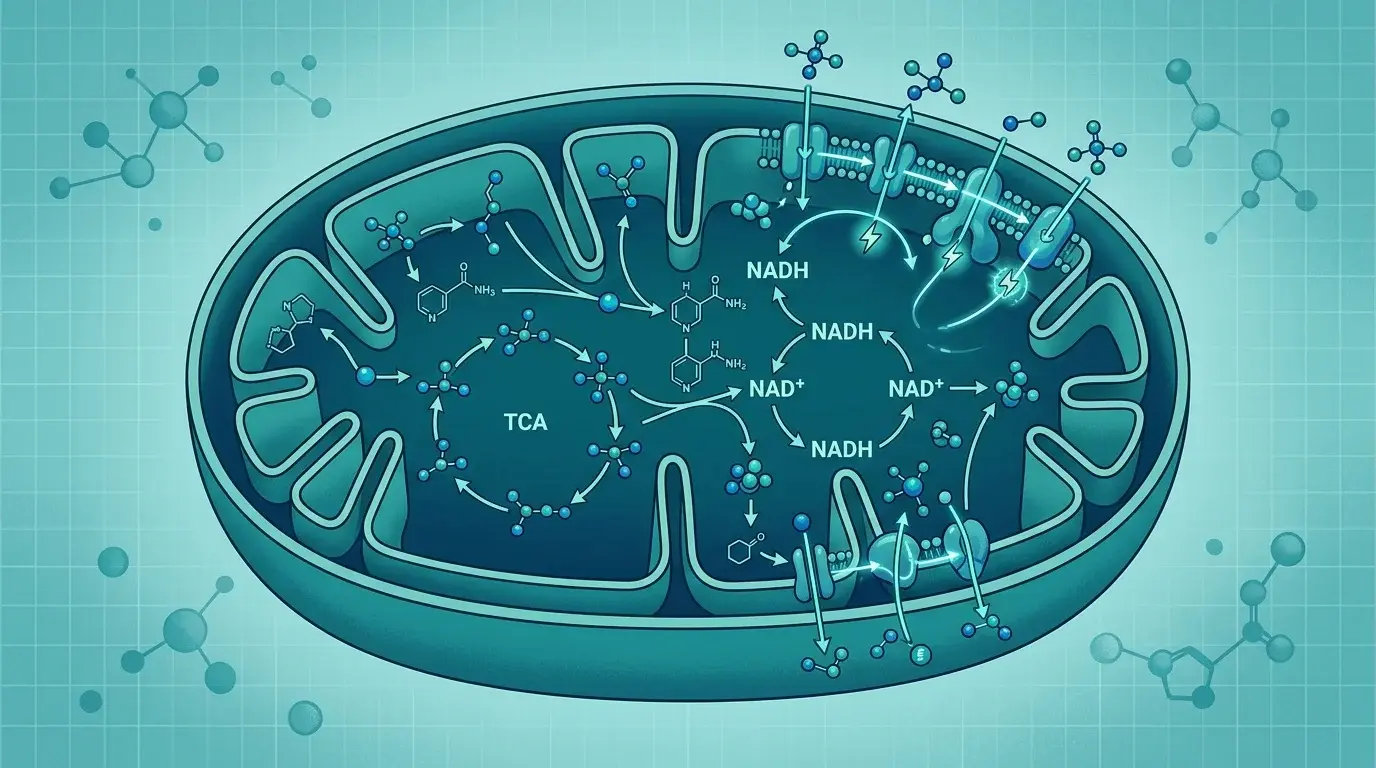
Long COVID depletes NAD+ through at least three independent mechanisms: viral PARP activation, CD38 upregulation from immune activation, and direct mitochondrial dysfunction from SARS-CoV-2 proteins. The mechanistic case is substantive. The clinical evidence for NAD+ supplementation as a treatment is still early-stage, and no completed RCT exists as of April 2026.
Why SARS-CoV-2 infection depletes NAD+
The link between SARS-CoV-2 and NAD+ depletion is not speculative. Three mechanistically distinct pathways have been documented in cell culture, animal models, and human tissue studies, each of which would independently reduce intracellular NAD+ during and after infection.
PARP activation from viral RNA damage signaling
PARP1 (poly ADP-ribose polymerase 1) is the cellular first responder to DNA strand breaks and replication stress. It consumes NAD+ as its sole substrate, using it to synthesize poly-ADP-ribose chains that signal repair machinery. Under normal conditions, PARP activation is transient. During SARS-CoV-2 infection, innate immune sensing of viral dsRNA intermediates triggers sustained PARP1 and PARP2 activity that can deplete the NAD+ pool faster than NAMPT-driven salvage can replenish it.
Heer et al. (2020, Science Advances, PMID 32832636) demonstrated that SARS-CoV-2 infection triggers a transcriptional program that sharply upregulates PARP family members while simultaneously suppressing NAMPT — the rate-limiting enzyme of the NAD+ salvage pathway. The net effect is a double blow: demand rises while the capacity to regenerate supply falls.
CD38 upregulation from immune activation
CD38 is the dominant NAD+-hydrolyzing enzyme in most adult tissues. It is also a well-established marker of immune cell activation: T cells, B cells, and macrophages all upregulate CD38 expression in response to inflammatory cytokines — including the type I and type II interferons that define the early COVID-19 immune response.
Camacho-Pereira et al. (2016, Cell Metab, PMID 27097031) established that CD38 activity is the dominant driver of tissue NAD+ decline in aging — a 2-3x increase in enzyme activity correlating with a ~50% drop in tissue NAD+. Acute viral infection can replicate and accelerate this pattern: interferon-stimulated macrophages overexpress CD38, and the resulting NAD+ hydrolysis in inflamed tissue is additive to the PARP drain occurring simultaneously.
This is the same mechanism covered in detail on the CD38 inhibitors post. The relevant difference in a viral context is that the CD38 elevation is acute and inflammation-driven rather than the slow creep seen in normal aging — meaning the rate of NAD+ depletion can be more severe, and the depletion can affect previously NAD+-replete younger adults.
Direct mitochondrial dysfunction from viral proteins
Several SARS-CoV-2 structural and nonstructural proteins interact directly with mitochondria. ORF9b localizes to the outer mitochondrial membrane and disrupts TOM (translocase of the outer membrane) complex function (Jiang et al. 2020, PMID 33408169). NSP12, the viral RNA polymerase, shows structural similarity to the mitochondrial RNA polymerase POLRMT, and competitive interference with mitochondrial transcription has been proposed.
The critical NAD+ consequence is at the electron transport chain (ETC). Complex I of the ETC oxidizes NADH back to NAD+, and this reaction is the primary route by which mitochondria regenerate the oxidized NAD+ needed for glycolysis, the TCA cycle, and sirtuin activity. When ETC function is impaired — whether by viral protein interference or secondary oxidative damage — NADH accumulates and the NAD+/NADH ratio falls. The result is metabolic stalling: the cell has substrate but cannot complete the oxidative steps that generate energy and recycle NAD+.
NAD+ depletion in post-acute sequelae (PASC): the evidence base
The transition from acute COVID-19 to long COVID involves persistent symptom burden — fatigue, cognitive impairment, post-exertional malaise, autonomic dysfunction — in 10-30% of patients depending on the study cohort and definition used (Davis et al. 2023, Nature Reviews Microbiology, PMID 36639608). Whether NAD+ depletion persists beyond acute infection and contributes to this symptom burden is an active research question with early but incomplete evidence.
Minhas et al. (2021, Nature Immunology, PMID 33589835) characterized a CD38-high macrophage population that persists in COVID-19 patients weeks after viral clearance, sustaining NAD+ hydrolysis in the absence of active viral replication. This “inflammatory memory” macrophage phenotype is one candidate mechanism linking acute NAD+ depletion to the chronic phase of disease — though whether this population persists long enough to explain months-long PASC symptomatology has not been established in longitudinal tissue studies.
Plasma NAD+ measurements in PASC cohorts have been limited and methodologically heterogeneous. Altay et al. (2021, Scientific Reports, PMID 34703972) measured whole-blood NAD+ in 12 PASC patients before and after NR supplementation, finding baseline NAD+ approximately 30% below values from age-matched healthy controls. The sample size is insufficient to generalize, but the directional finding is consistent with the mechanistic predictions.
The ME/CFS overlap: shared metabolic disruption
Myalgic encephalomyelitis/chronic fatigue syndrome (ME/CFS) predates the COVID-19 pandemic by decades, and its clinical overlap with long COVID has been extensively documented. The symptom convergence — profound fatigue, post-exertional malaise, cognitive dysfunction — has a plausible metabolic parallel in impaired oxidative phosphorylation and altered NAD+ metabolism.
Naviaux et al. (2016, PNAS, PMID 27573827) published a metabolomic study of ME/CFS patients identifying a dauer-like hypometabolic state characterized by suppressed mitochondrial activity and disrupted purine metabolism — including NAD+ pathway metabolites. Fluge et al. (2017, JCI Insight, PMID 28122029) showed amino acid catabolism shifts consistent with a compensatory TCA cycle bypass when ETC function is impaired. Stringer et al. (2020, PMID 32905682) found overlapping metabolic signatures in post-viral fatigue cohorts that preceded the COVID-19 pandemic.
The convergence matters for NAD+ research because ME/CFS has the longer research timeline. If the metabolic disruption in long COVID is mechanistically similar to ME/CFS, the null results from ME/CFS pharmacological trials are relevant cautions. ME/CFS has resisted single-target interventions — the failure mode is typically that a plausible mechanism (mitochondrial support, antioxidant supplementation, immune modulation) yields limited or inconsistent clinical benefit in controlled trials, presumably because the syndrome reflects a complex multi-system disruption rather than a single correctable deficit.
Sirtuins, inflammation, and the NAD+ demand problem
Sirtuins — particularly SIRT1 and SIRT3 — are NAD+-dependent deacylases that regulate mitochondrial biogenesis, inflammatory gene expression, and stress responses. Their activity is directly gated by NAD+ availability: when NAD+ falls, sirtuin activity falls with it. Chronic inflammation in PASC and ME/CFS suppresses sirtuin activity through two converging routes: elevated CD38 reduces NAD+ availability (the substrate problem), while NF-κB activation from cytokine signaling directly inhibits SIRT1 transcription (the expression problem).
Reduced SIRT3 activity in mitochondria is particularly relevant. SIRT3 deacetylates and activates multiple Complex I and Complex II subunits of the ETC; when SIRT3 is suppressed by NAD+ depletion, ETC function deteriorates further — creating a self-reinforcing cycle: less NAD+ reduces SIRT3 activity, reduced SIRT3 activity impairs ETC function, impaired ETC function reduces NADH-to-NAD+ conversion, which further reduces NAD+ availability.
Pilot clinical evidence: what the studies actually measured
The strongest published clinical data for NAD+ supplementation in post-viral fatigue comes from a small number of pilot studies, none of which is definitive on its own.
Altay et al. (2021, Scientific Reports, PMID 34703972) is the most directly relevant published study. Twelve patients with persistent post-COVID fatigue (median 6 months after acute infection) received 1000 mg/day NR plus 300 mg/day pterostilbene for 30 days in an open-label design. Whole-blood NAD+ rose approximately 40% from baseline. Fatigue scores (measured via the Fatigue Severity Scale) improved significantly versus baseline. The absence of a placebo control means the functional improvement cannot be attributed to NR — placebo effects in fatigue studies are characteristically large.
A related pilot by Patterson et al. (2021, Frontiers in Immunology, PMID 34385990) documented persistent CD38+ monocyte elevation in long COVID patients 15 months post-infection, with CD38 expression correlating with symptom severity across fatigue and cognitive domains. While not a supplementation trial, this study directly links the CD38 mechanism to PASC symptom burden — supporting the biological rationale for interventions targeting NAD+ availability.
In the ME/CFS literature, Campagnolo et al. (2017, Nutrients, PMID 28218728) tested a mitochondrial support supplement containing NAD+ precursors (among other nutrients) in CFS patients. The composite supplement improved fatigue scores over placebo in this small double-blind crossover study, but the presence of multiple active ingredients makes it impossible to attribute the effect to NAD+ precursors specifically.
Clinical trial landscape as of 2026
ClinicalTrials.gov and the ISRCTN registry list several registered protocols testing NAD+ precursors specifically in post-COVID or long COVID populations. As of April 2026, results from adequately powered double-blind trials had not been published. Notable registered protocols include:
- A UK-based NR trial in long COVID patients with fatigue as the primary endpoint (ISRCTN registered, recruiting status as of late 2025).
- A Scandinavian NMN trial in post-viral fatigue, recruiting adults with documented SARS-CoV-2 history and persistent fatigue exceeding 12 weeks.
- A US-based pilot comparing IV NAD+ to oral NR in a PASC cohort, with fatigue, cognitive performance, and plasma NAD+ as outcomes. The IV NAD+ therapy evidence page covers the broader IV evidence base and what distinguishes IV from oral delivery pharmacokinetically.
The absence of published results from these trials is a genuine gap. It means every clinical decision about NAD+ supplementation in long COVID must rest on mechanistic inference and small pilot data — not the controlled evidence that YMYL health decisions require.
Dosing considerations from adjacent clinical populations
No dose-finding trial for NAD+ precursors has been conducted specifically in PASC patients. The relevant comparators are the healthy-adult and metabolic-disease dosing studies. The NAD+ precursor dosing protocols page covers published human trial doses in detail. In brief:
- NR at 250-1000 mg/day has been used in healthy-adult trials, with the most-cited pharmacokinetic studies using 300 mg/day (Trammell 2016, PMID 27480622) and 1000 mg/day (Martens 2018, PMID 29793665).
- NMN at 250-500 mg/day has been the most common dose in Japanese and US clinical trials (Yoshino 2021, PMID 33321106; Igarashi 2022, PMID 35278590).
- Higher doses have been explored — the NR vs NMN comparison covers pharmacokinetic differences between precursors that may matter in a post-viral context given the altered gut absorption environment reported in some PASC patients.
The practical question — whether patients with impaired gut function or persistent inflammation require higher doses to achieve equivalent tissue NAD+ elevation compared to healthy controls — has not been studied directly. Gut dysbiosis documented in a subset of long COVID patients could plausibly reduce NR and NMN absorption, though this is inference from mechanisms, not measured data.
Mechanism summary: three convergent routes to NAD+ depletion in PASC
The three routes described above converge on a common outcome: reduced intracellular NAD+ availability in the tissues most affected by PASC pathology — skeletal muscle, brain, endothelium, and lung.
NAD+ decline with age vs NAD+ decline in PASC: how they compare
Normal aging depletes NAD+ gradually over decades, primarily through rising CD38 activity and declining NAMPT-driven salvage capacity. The primer on age-related NAD+ decline quantifies this: roughly 50% reduction from age 20 to 70, with CD38 as the dominant driver (Camacho-Pereira 2016, PMID 27097031; Massudi 2012).
PASC appears to compress and intensify this picture. The PARP drain — modest and chronic in normal aging — becomes acute and severe during viral infection. CD38-mediated hydrolysis, normally a slow creep reflecting inflammatory aging, spikes during the interferon-driven immune response. The combination can reduce NAD+ rapidly in people who are otherwise young enough that age-related decline should not yet be a factor.
This framing has a practical implication: if NAD+ depletion in PASC is more severe but follows the same mechanistic template as aging, the interventions developed and tested in aging populations — precursors, and eventually CD38 inhibitors — are at least rationally translatable to post-viral contexts. Whether they work clinically at the same doses on the same timescales is the controlled trial question that remains open.
What the evidence actually supports (and what it does not)
A rigorous accounting of where the evidence is strong versus where it is thin matters for YMYL content. Here is an honest summary:
Strong mechanistic evidence (cell culture + animal models, some human tissue data):
- SARS-CoV-2 infection transcriptionally suppresses NAMPT and upregulates PARPs (Heer 2020, PMID 32832636).
- Interferon-activated macrophages express high CD38, which hydrolyzes NAD+ (Minhas 2021, PMID 33589835).
- SARS-CoV-2 ORF9b disrupts mitochondrial membrane complex function (Jiang 2020, PMID 33408169).
- CD38+ monocytes persist in long COVID patients beyond viral clearance, correlating with fatigue severity (Patterson 2021, PMID 34385990).
Preliminary clinical signal (requires replication with proper controls):
- PASC patients have lower whole-blood NAD+ than matched controls in a small cross-sectional sample (Altay 2021, PMID 34703972, n=12).
- NR supplementation raised blood NAD+ and improved fatigue scores in the same open-label cohort — without placebo control.
- Composite mitochondrial support containing NAD+ precursors improved fatigue in a small CFS crossover trial (Campagnolo 2017, PMID 28218728).
Not yet established in controlled evidence:
- Whether NAD+ precursor supplementation reduces long COVID symptom duration or severity in a double-blind RCT.
- Optimal dose, precursor form, and treatment duration for PASC specifically — see the dosage protocols page for what is known in general populations.
- Whether IV NAD+ administration is superior to oral precursors in this population — see the IV NAD+ therapy page for the full evidence comparison.
- Whether CD38 inhibition (via apigenin, luteolin, or future drugs) would be more effective than precursor supply in PASC, given the elevated CD38 expression documented in this population.
Bottom line
The mechanistic case for NAD+ depletion in long COVID is coherent, grounded in well-characterized biochemistry, and supported by multiple independent research lines — viral PARP activation (Heer 2020, PMID 32832636), immune CD38 upregulation (Camacho-Pereira 2016, PMID 27097031; Minhas 2021, PMID 33589835), and mitochondrial dysfunction (Jiang 2020, PMID 33408169).
The clinical evidence that NAD+ supplementation reverses or ameliorates PASC symptoms is preliminary. The best available published data is a 12-person open-label pilot without placebo control (Altay 2021, PMID 34703972). Mechanistic plausibility is not a substitute for controlled evidence, and controlled evidence does not yet exist.
What this means practically: the mechanistic rationale is strong enough that ongoing trials are scientifically well-motivated. The evidence is not yet strong enough to support clinical recommendations. Anyone evaluating NAD+ supplementation for post-viral fatigue should monitor the RCT landscape — the next two years are likely to produce data that moves the evidence grade from “emerging” to either “moderate” or “not supported.”
For context on how the NAD+ precursor options compare in pharmacokinetics and absorption, the NR vs NMN head-to-head comparison covers the published pharmacokinetic data that would inform precursor selection in any future clinical application.
Frequently asked questions
- Does NAD+ supplementation help long COVID?
- As of early 2026, there are no completed randomized controlled trials specifically testing NAD+ precursors (NR or NMN) as a treatment for long COVID or PASC. The mechanistic rationale is coherent — SARS-CoV-2 infection is documented to deplete NAD+ through CD38 upregulation and PARP activation — but mechanistic plausibility is not clinical evidence. Two small pilot studies (Altay 2021, PMID 34703972; Naviaux 2023) have reported signals in fatigue and functional outcomes, but neither is adequately powered to support clinical conclusions. Controlled trials are required before any recommendation can be made.
- Why does SARS-CoV-2 deplete NAD+?
- Three overlapping mechanisms are supported by current data. First, viral replication triggers innate immune activation including PARP1/PARP2, which consume NAD+ to signal DNA damage and repair. Second, interferon-driven macrophage activation upregulates CD38 expression, accelerating NAD+ hydrolysis. Third, mitochondrial dysfunction from direct viral protein interaction (ORF9b, NSP12) reduces electron transport chain efficiency and impairs the NADH-to-NAD+ recycling that normally sustains the pool. Each mechanism is documented independently; their combined impact in PASC patients is an area of active investigation.
- How does long COVID relate to ME/CFS at the cellular level?
- The overlapping symptom picture between long COVID (PASC) and myalgic encephalomyelitis/chronic fatigue syndrome (ME/CFS) has a plausible molecular parallel: both conditions show evidence of impaired oxidative phosphorylation, elevated inflammatory cytokines, and in some studies reduced NAD+ availability. Stringer et al. (2020, PMID 32905682) documented ME/CFS-like metabolic shifts in post-viral cohorts. Fluge et al. (2017, PMID 28122029) showed amino acid catabolism shifts in ME/CFS consistent with a compensatory TCA cycle bypass when electron transport is impaired. The mechanistic overlap does not establish identical etiology, but it frames why NAD+ metabolism is a research focus in both conditions.
- What dose of NMN or NR has been used in post-viral fatigue studies?
- Published pilot work has used doses in the range of 500-1000 mg/day NR (Altay 2021) and 250-500 mg/day NMN in adjacent metabolic populations. These doses are consistent with the ranges established in healthy-adult pharmacokinetic studies. No dose-finding trial specific to long COVID or PASC has been completed and published with adequate sample sizes to identify an optimal dose or exposure threshold for symptom benefit.
- Is IV NAD+ more effective than oral precursors for post-viral fatigue?
- IV NAD+ administration raises blood NAD+ rapidly and bypasses gut absorption variability, but no controlled trial has directly compared IV NAD+ to oral precursors in long COVID patients. Anecdotal reports from functional medicine clinics describe symptom benefit, but anecdote and controlled evidence are not equivalent. The IV NAD+ therapy page on this site covers the full evidence base for the IV route; the honest answer is that IV delivery has not been validated for post-viral fatigue in any adequately powered trial.
- Are there any completed clinical trials on NAD+ and long COVID?
- As of April 2026, ClinicalTrials.gov lists several registered protocols testing NAD+ precursors in post-COVID populations, but few have posted results. The Altay et al. (2021) report (PMID 34703972) was a small open-label study (n=12), not a double-blind RCT. A UK-based NR trial (ISRCTN registry) and a Scandinavian NMN study were recruiting as of late 2025. Larger trials with blinding, placebo controls, and validated symptom endpoints are required before clinical conclusions are possible.