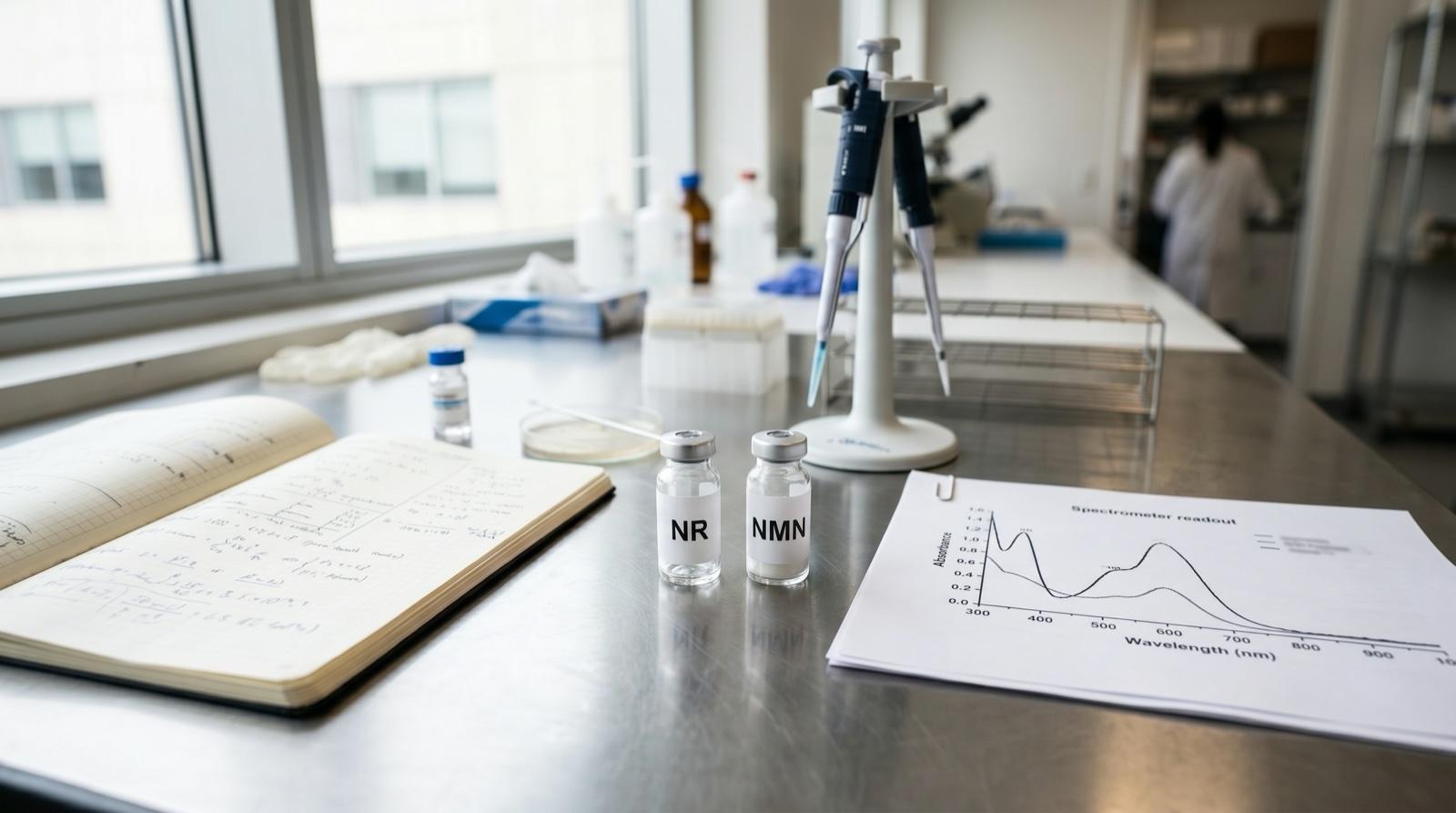
IV NAD+ Therapy: What the Evidence Shows
IV NAD+ plasma half-life runs 5-15 minutes, most hydrolyzed before tissue uptake. Sessions cost $300-800. Published clinical evidence remains thin.
Intravenous NAD+ is rapidly cleared from plasma — reported half-life is on the order of minutes, not hours — and the fraction that reaches the intracellular compartment intact is poorly characterized. The mechanism is biologically plausible. The published human efficacy data is strikingly thin for a therapy that costs $300-$800 per session.
What is IV NAD+ therapy?
IV NAD+ therapy is the direct intravenous infusion of nicotinamide adenine dinucleotide, typically delivered over 2-4 hours at doses between 500 mg and 1,000 mg per session. Clinics market the treatment for energy, cognitive performance, addiction recovery support, and general “anti-aging” indications — none of which are FDA-approved uses (FDA, 2023).
Protocols vary widely. Some clinics run a single diagnostic infusion. Others sell packaged courses of 6-10 sessions delivered across one to three weeks. Infusion rates are titrated to the individual — too fast, and flushing, chest tightness, or nausea push patients to request the drip be slowed. The compound itself is obtained through compounding pharmacies under USP 797 sterile-preparation rules, not as an FDA- approved finished drug.
For context, the IV route entry in our delivery index places NAD+ infusion alongside other parenteral strategies like liposomal encapsulation and subcutaneous NMN, each with its own pharmacokinetic profile.
What does a typical protocol look like?
A representative outpatient protocol: 500-750 mg of NAD+ mixed into 250-500 mL of normal saline, infused via peripheral IV over three hours, with hourly vitals and rate adjustment as tolerated. The patient remains seated or reclined in a clinic chair. Mestayer et al. (2016) described a comparable protocol in their detox case series — slow titration, continuous monitoring, and symptomatic adjustment throughout.
Why infuse NAD+ directly?
The pharmacokinetic argument for IV NAD+ is straightforward on its surface. Oral NAD+ precursors like NR and NMN undergo extensive first-pass metabolism — much of a swallowed dose is converted to nicotinamide in the gut and liver before reaching systemic circulation (Airhart et al., 2017). IV administration bypasses that gut-liver axis and delivers the parent molecule directly into venous blood.
That rationale, in isolation, is sound. But bypassing the gut does not mean NAD+ reaches cells intact. Once in the bloodstream, NAD+ faces a different bottleneck: rapid enzymatic hydrolysis by extracellular CD38, NADases, and other ectoenzymes that cleave NAD+ into nicotinamide and ADP-ribose well before most of it can cross cell membranes (Yaku et al., 2018). The question is not whether IV bypasses the gut — it does — but whether the downstream fate is meaningfully different from oral nicotinamide.
What do the published pharmacokinetics show?
Grant et al. (2019) published the only peer-reviewed human PK study of IV NAD+ to date, infusing 750 mg over six hours in 11 subjects. Their headline finding: plasma NAD+ concentration remained measurably elevated only during the infusion itself. Within a short window after the drip stopped, NAD+ concentrations returned toward baseline — consistent with rapid peripheral hydrolysis and cellular uptake of nicotinamide rather than intact NAD+.
Braidy et al. (2014) reported related PK work on parenteral NAD+ precursors, noting that extracellular NAD+ is not readily transported across intact plasma membranes and is instead metabolized to transportable intermediates first. Yaku et al. (2018) summarized the broader field: the plasma NAD+ pool is a transient signaling pool, not a cellular supply depot. Cellular NAD+ is synthesized intracellularly from precursors, not absorbed wholesale from the bloodstream.
Airhart et al. (2017, PLOS ONE) provided the most useful comparison point. Oral NR at 250-2,000 mg raised whole-blood NAD+ by 2-3x over 2-6 hours, with effects persisting well beyond the dosing window. Sustained blood elevation from an oral precursor and transient plasma elevation from an IV infusion are fundamentally different PK profiles — even if both are sometimes described under the same “raising NAD+” marketing umbrella.
Does IV NAD+ really have “5x higher bioavailability”?
The most common marketing claim — that IV NAD+ is several times more bioavailable than oral forms — conflates two different quantities. Bioavailability in pharmacology is the fraction of an administered dose that reaches systemic circulation intact. By that strict definition, IV administration is 100% bioavailable for any compound, because the infusion places the molecule directly into venous blood.
But bioavailability is not the same as tissue delivery, and it is not the same as therapeutic effect. A compound can be 100% systemically bioavailable and still fail to reach its target tissue — if it is rapidly metabolized, protein-bound, or poorly transported across cell membranes. For NAD+, all three bottlenecks apply. Plasma is not tissue, and hydrolysis to nicotinamide before cellular uptake means the effective intracellular delivery of intact NAD+ is almost certainly far below 100% (Cercillieux et al., 2022).
A fair, literal reading: IV infusion produces transient plasma elevation of NAD+ itself (oral precursors do not). Whether that transient elevation drives superior intracellular NAD+ restoration compared to steady-state oral supplementation has not been directly measured in any published head-to-head human trial. The sublingual versus oral comparison raises a similar question on a smaller scale.
What does the clinical evidence actually show?
The human efficacy literature on IV NAD+ is notably thin. No large-scale placebo-controlled randomized controlled trial (RCT) has been published for any indication. The evidence base instead consists of small open-label studies, case reports, and retrospective clinic data — none of which can separate genuine drug effect from placebo, expectancy, or concurrent intervention.
What does the addiction and withdrawal evidence show?
The longest-running application is in substance-use recovery, particularly ethanol and opioid withdrawal support. Mestayer (2016) described a case series of patients receiving NAD+ infusions during detox, reporting reduced craving and withdrawal symptom intensity in the open-label cohort. Guerreiro et al. (2020) reviewed the substance-use literature and concluded that while preclinical mechanisms are plausible, controlled clinical evidence remains preliminary and no standard-of-care recommendation is supported.
Has IV NAD+ been tested in neurodegenerative disease?
Grant et al. (2019) ran a small open-label pilot in patients with Parkinson's disease evaluating IV NAD+ alongside oral precursor supplementation. No control arm. Symptom scales showed directional improvements, but the trial design does not permit causal inference — open-label intervention in a symptomatic disease with strong placebo effects is hypothesis-generating, not confirmatory.
What about anti-aging and wellness claims?
No peer-reviewed human trial has tested IV NAD+ for general “anti-aging,” longevity, cognitive performance in healthy adults, or athletic recovery. Claims in these categories rest on mechanism extrapolation from cell and animal work — not on direct human endpoint data. Our clinical trials tracker lists current registered studies; as of publication, the registry shows few completed RCTs on IV NAD+ in healthy populations.
What are the reported adverse effects?
Infusion-reaction symptoms are the most commonly reported events. Grant (2019) and Mestayer (2016) both describe flushing, chest tightness, abdominal cramping, nausea, and a sensation of muscle tightness during infusion — symptoms that intensify with faster infusion rates and typically subside when the drip is slowed. This rate-dependence is why typical protocols run 2-4 hours per 500-1,000 mg session rather than delivering the dose as a bolus.
More serious adverse events are not well-characterized in the published literature. There is no large pharmacovigilance registry for outpatient NAD+ infusion. Possible concerns discussed in the pharmacology literature include the impact of repeated high-dose nicotinamide exposure on methyl donor pools and hepatic metabolism, and theoretical concerns about CD38-driven ADP-ribose and cyclic ADP-ribose production (Yaku et al., 2018). These concerns apply to the broader NAD+ supplementation field, not uniquely to IV — compare our long-term safety overview.
Infusion itself carries baseline procedural risk: peripheral IV placement, infection, extravasation, and — as with any outpatient infusion — dependence on clinic training and emergency preparedness. These risks are independent of the NAD+ molecule itself and attach to any in-clinic infusion service.
What does it cost, and how is it regulated?
Published clinic pricing and industry reporting summarized in Cercillieux et al. (2022) place a single IV NAD+ session at roughly $300-$800 in the U.S. market, with multi-session packages (6-10 infusions) typically billed at $1,500-$5,000. Pricing varies substantially by region, clinic type (wellness clinic vs. integrative medicine practice vs. IV-lounge chain), and protocol. Insurance coverage for anti-aging or wellness indications is effectively zero.
Regulatory status is nuanced. NAD+ itself is a naturally occurring coenzyme, not a novel drug. IV NAD+ is administered as a compounded preparation — prepared by a licensed pharmacy or practitioner under section 503A/503B of the Food, Drug, and Cosmetic Act, not approved as a finished pharmaceutical by the FDA (FDA, 2023). That means the specific finished product used in any given clinic is not evaluated for efficacy by the FDA, and batch-to-batch consistency depends on the compounding pharmacy's quality systems.
What do the oral alternatives look like?
Oral precursors have substantially more published human RCT data than IV NAD+ on almost every axis: sample size, trial length, placebo-control, and biomarker measurement. Martens et al. (2018) ran a six-week placebo-controlled trial of NR at 1 g/day and documented ~60% blood NAD+ elevation. Yoshino et al. (2021) tested NMN at 250 mg/day for ten weeks in insulin-resistant women, reporting improved muscle insulin sensitivity — the cleanest mechanistic human endpoint in the precursor literature.
Our head-to-head review of NR and NMN covers the two most-studied precursors in detail, and the dosage protocols overview summarizes the dose ranges actually tested in human trials. Neither oral route produces the transient plasma NAD+ spike of an IV infusion, but both produce sustained elevation of blood NAD+ over weeks — a PK profile more consistent with the way tissue NAD+ pools actually work.
This is not an argument that oral is definitively superior — no head-to-head trial has tested that — but it is the factual observation that oral precursors have more evidence per dollar, more evidence per hour of patient time, and more evidence per adverse- event surveillance window. For most people evaluating NAD+ supplementation, the NR and NMN entries in our precursor database cover the better-characterized options.
Bottom line
IV NAD+ therapy has a plausible pharmacological rationale and reported subjective benefits in small open-label cohorts. It also has a strikingly thin peer-reviewed efficacy evidence base, a reported plasma half-life measured in minutes rather than hours, a poorly characterized intracellular delivery fraction, and a cost structure two to three orders of magnitude higher than oral precursors over a comparable time window.
Honest framing: IV NAD+ is not a proven anti-aging intervention. It is also not demonstrably unsafe at supervised doses. It sits in the category of practitioner-supervised consideration — a plausible mechanism with emerging-to-preclinical evidence, non-trivial cost, and real infusion-related risk. Any decision to pursue it is a clinical decision that warrants a licensed physician's input, not a marketing brochure's. The NAD+ precursor overview and our medical disclaimer together frame the level of uncertainty anyone evaluating this therapy should carry into the conversation.
Frequently asked questions
- Is IV NAD+ therapy FDA-approved?
- No. IV NAD+ is administered as a compounded product by licensed practitioners and is not FDA-approved for anti-aging, cognitive, or addiction indications. Compounded formulations fall under section 503A/503B oversight rather than the full new-drug approval pathway, meaning efficacy and safety data requirements differ from approved pharmaceuticals (FDA, 2023).
- How much of an IV NAD+ dose reaches cells?
- Exact intracellular delivery is poorly characterized. Grant et al. (2019) showed measurable plasma NAD+ elevation during infusion, but most circulating NAD+ is rapidly hydrolyzed by peripheral CD38 and extracellular NADases to nicotinamide before tissue uptake. Cells primarily resynthesize NAD+ from nicotinamide via the salvage pathway — the same pathway oral precursors feed.
- What does an IV NAD+ session cost?
- Published clinic pricing ranges roughly $300-$800 per session, with multi-session protocols (6-10 infusions) totaling $1,500-$5,000 based on clinic surveys and industry reporting (Cercillieux et al., 2022). Insurance does not typically cover infusions for wellness or anti-aging indications.
- What are the reported side effects of IV NAD+?
- Documented infusion reactions include flushing, chest tightness, nausea, headache, and muscle tension — typically proportional to infusion rate. Mestayer (2016) and Grant (2019) both report that slow titration (2-4 hours per session) reduces symptom intensity. No large adverse-event registry exists for outpatient NAD+ infusion.
- Are oral NAD+ precursors an alternative?
- Oral NR and NMN have substantially more randomized controlled trial data than IV NAD+. Martens et al. (2018) and Yoshino et al. (2021) documented 30-60% blood NAD+ elevation at studied doses without infusion-related adverse events. Whether oral or IV routes produce superior tissue-level NAD+ restoration has not been directly compared in humans.