NAMPT: The Rate-Limiting Enzyme Behind NAD+ Decline (And Why It Matters More Than Precursors)
NAMPT — not precursor supply — sets the ceiling on NAD+ biosynthesis. Why nicotinamide phosphoribosyltransferase declines with age, and what activators show in human and animal trials.
Almost every conversation about raising NAD+ skips past the one enzyme that decides whether any of it actually works. The NAMPT enzyme — short for nicotinamide phosphoribosyltransferase — is the rate-limiting step of the NAD+ salvage pathway, and its decline with age does more to suppress tissue NAD+ than any shortage of precursor substrate ever could.
What is NAMPT, and why is it rate-limiting?
NAMPT is the enzyme that converts free nicotinamide — the leftover fragment released every time a sirtuin, PARP, or CD38 enzyme breaks apart NAD+ — back into nicotinamide mononucleotide (NMN). NMN is then rapidly converted into NAD+ by the NMNAT family of enzymes. This two-step loop is the salvage pathway, and in mammalian cells it accounts for the overwhelming majority of NAD+ biosynthesis. The alternative routes — de novo synthesis from tryptophan and the Preiss-Handler pathway from dietary niacin — exist, but neither carries enough flux to maintain steady-state NAD+ on its own (Revollo et al., J Biol Chem 2004, PMID: 15381699).
The reason NAMPT is rate-limiting and not NMNAT comes down to substrate kinetics. PRPP, the second substrate NAMPT needs, is abundant inside cells. NMNAT enzymes operate well below saturation under normal conditions. Nicotinamide concentrations are also reasonably stable. What varies — by tissue, by age, by time of day, and by inflammatory state — is NAMPT itself. When NAMPT activity drops, the entire NAD+ recycling loop slows even if every other component is intact.
iNAMPT vs eNAMPT: two enzymes, two roles
The same NAMPT protein operates in two compartments with strikingly different functions. Inside cells, iNAMPT (intracellular NAMPT) drives the salvage reaction and directly determines local NAD+ availability. Outside cells, eNAMPT (extracellular NAMPT) circulates in plasma after being secreted — primarily from adipose tissue — and behaves both as a functional enzyme and as an adipokine signaling molecule.
Yoshida et al. (Cell Metab 2019, PMID: 31204283) showed that adipose-specific overexpression of eNAMPT in aged mice raised hypothalamic NAD+, restored circadian activity, and extended physical healthspan. The reverse experiment — adipose-specific NAMPT knockout — accelerated frailty and shortened lifespan. This is one of the cleanest demonstrations that NAMPT is not just a local cellular housekeeper but a systemic regulator that links adipose biology to whole-body NAD+ status.
For human translation, the implication is uncomfortable. If adipose-derived eNAMPT is a major systemic NAD+ regulator, then anything that disrupts adipose biology — chronic obesity, severe caloric restriction, lipodystrophy, or even surgical adipose loss — should depress eNAMPT and, by extension, NAD+ across multiple distant tissues. Cross-sectional human data is consistent with this: circulating eNAMPT levels fall roughly 30 percent between young and elderly cohorts, with steeper decreases in subjects with metabolic dysfunction.
Why does NAMPT decline with age?
NAMPT decline is not a single failure. Three converging mechanisms suppress NAMPT expression and activity over the lifespan, and they compound on each other.
- Chronic inflammation.NAMPT transcription is regulated by a feedback loop involving SIRT1 and circadian transcription factors. Chronic low-grade inflammation — the “inflammaging” phenomenon — depresses SIRT1 activity, which in turn flattens NAMPT expression. Once NAD+ falls, SIRT1 loses its substrate, and the loop self-reinforces.
- Circadian disruption. NAMPT is one of the most robustly oscillating enzymes in mammalian biology, with expression driven by the BMAL1/CLOCK transcriptional complex (Ramsey et al., Science 2009, PMID: 19286518). Aging flattens circadian amplitude in virtually every tissue measured. Shift work, irregular sleep, and late-night light exposure compound the effect by suppressing the peak NAMPT phase that normally rebuilds NAD+ overnight.
- Senescence-associated secretion. Senescent cells release a complex secretome (the SASP) that includes cytokines and microRNAs which suppress NAMPT in nearby healthy cells. Because senescent cell burden rises sharply with age, this paracrine suppression compounds the cell-autonomous decline.
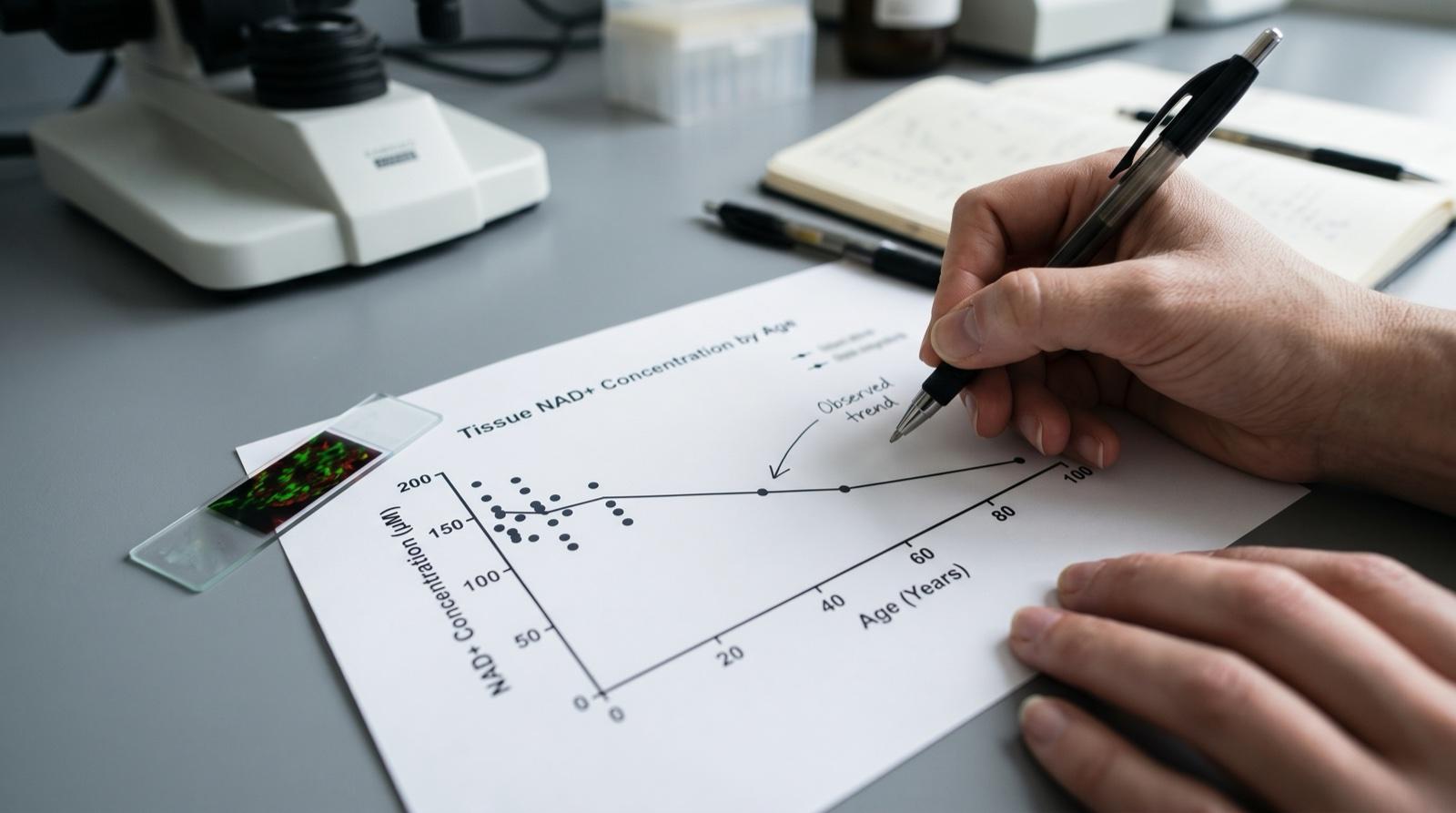
On top of those three drivers, CD38 expression rises 2 to 3 fold with age (Camacho-Pereira et al., Cell Metab 2016, PMID: 27304511) — increasing the demand on the salvage pathway at exactly the moment NAMPT is least able to keep up. The result is the well-documented ~50 percent tissue NAD+ decline by age 70 that we cover in detail in our piece on why tissue NAD+ drops 50 percent by 70.
Is NAMPT more important than NAD+ precursors?
This is the most useful framing question for anyone evaluating NAD+ interventions. The honest answer is that NAMPT and precursors operate on different parts of the same equation, and which one matters more depends on whether the binding constraint is supply or recycling capacity.
Oral precursors raise blood NAD+ reliably. Martens et al. (Nat Commun 2018, PMID: 29599478) showed 60 percent elevation with 1 g/day NR for six weeks in middle-aged adults. Yoshino et al. (Science 2021, PMID: 33888596) showed that 250 mg/day NMN for ten weeks improved muscle insulin sensitivity in prediabetic women. These are real biochemical effects. But both interventions enter the salvage pathway downstream of NAMPT, which means they bypass the bottleneck rather than restore it. They lift the floor of the pool but cannot raise the ceiling that a healthy NAMPT recycling rate would otherwise set.
Imagine NAD+ biosynthesis as a sink with a partially clogged drain recirculating water back to the faucet. Adding more water at the faucet (precursors) raises the water level, but the recirculation loop is still slow. Unclogging the recirculation pump (NAMPT) restores normal throughput at the original input rate. Both interventions raise the level — but only one fixes the underlying mechanism. For chronic age-related NAD+ decline, the mechanistic case is stronger for addressing the recycling rate.
Comparing intervention evidence: a quick reference
The contrast between precursor supplementation and NAMPT-targeted approaches looks roughly like this when you stack the human evidence:
| Intervention | Mechanism | Human Evidence | Tissue NAD+ Effect |
|---|---|---|---|
| Oral NR (1 g/day) | Salvage pathway substrate, downstream of NAMPT | Strong: blood NAD+ +60% (Martens 2018, PMID: 29599478) | Confirmed in muscle (Elhassan 2019, PMID: 31738826) |
| Oral NMN (250-900 mg/day) | Salvage pathway substrate, downstream of NAMPT | Moderate: blood NAD+ +30-50%, insulin sensitivity (Yoshino 2021, PMID: 33888596) | Inferred; limited direct biopsy data |
| Aerobic exercise | Upregulates muscle NAMPT expression | Moderate: muscle NAMPT +25-30% (Costford 2010, PMID: 19996381) | Confirmed in skeletal muscle |
| Caloric restriction | Raises NAMPT via SIRT1 feedback | Strong in animals, limited human data | Multi-tissue elevation in rodents (Yang 2007, PMID: 17889652) |
| NAMPT activators (P7C3, SBI-797812) | Direct NAMPT enzyme activation | Preclinical only as of 2026 | Tissue NAD+ restoration in animal models |
| CD38 inhibition (78c, apigenin) | Reduces NAD+ degradation, indirect NAMPT preservation | Preclinical; early human trials beginning | Indirect NAD+ restoration via reduced consumption |
Can you boost NAMPT naturally? What the evidence shows.
Three interventions have human or robust animal data showing measurable effects on NAMPT activity. Each works through a different upstream regulator, which is useful because they likely stack rather than compete.
Aerobic exercise
Costford et al. (Am J Physiol Endocrinol Metab 2010, PMID: 19996381) biopsied skeletal muscle from sedentary adults before and after three weeks of structured endurance training and found NAMPT protein rose roughly 25 to 30 percent. The effect was dose-dependent and persisted as long as the training continued. Subsequent work has shown that even single bouts of moderate-intensity exercise transiently elevate NAMPT expression via AMPK and SIRT1 signaling. We cover the full picture in how training raises NAD+ levels.
Caloric restriction and time-restricted eating
Caloric restriction raises NAMPT in liver and muscle in rodent studies, with the effect linked to SIRT1 activation and deacetylation-driven transcriptional changes. Human data is thinner — full caloric restriction is hard to study at scale and harder to sustain — but time-restricted eating preserves the circadian NAMPT oscillation that aging flattens. Reasonable behavioral interpretation: the main mechanism is keeping the fasting-state metabolic signaling intact, not the absolute calorie count.
Sleep and circadian alignment
Because NAMPT expression is BMAL1/CLOCK-driven, anything that flattens circadian amplitude flattens NAMPT oscillation. Shift work, chronic light exposure during the biological night, and irregular sleep timing all suppress the NAMPT peak that normally rebuilds NAD+ during the rest phase. There is no clinical trial yet showing that improving sleep regularity raises NAMPT in humans, but the mechanistic case is consistent enough that sleep hygiene is a defensible NAD+ intervention even without a randomized trial.
SIRT1 activators
Resveratrol, pterostilbene, and related polyphenols activate SIRT1, which sits in a positive feedback loop with NAMPT — SIRT1 deacetylates and stabilizes NAMPT, while NAMPT-derived NAD+ activates SIRT1. Activating one arm of the loop should, in principle, boost the other. Human evidence for resveratrol is mixed and bedeviled by bioavailability problems; pterostilbene shows better pharmacokinetics but has less clinical data. The mechanism is plausible; the magnitude of effect in humans is uncertain.
Direct NAMPT activators: the next pharmacological frontier
Small molecules that directly activate NAMPT — rather than working through SIRT1 or upstream signaling — are an active drug development target. The most studied compounds include P7C3 (originally identified as a neuroprotective agent before its NAMPT mechanism was characterized) and SBI-797812 (a more potent and selective NAMPT activator developed at Sanford Burnham Prebys).
Gardell et al. (Nat Commun 2019, PMID: 31506434) characterized SBI-797812 and showed it raises NAD+ in liver, muscle, and kidney in mice without the off-target effects that limited earlier NAMPT modulators. The compound has not yet entered human trials as of 2026, but the chemistry is workable and at least three pharma programs are pursuing related scaffolds.
The clinical case for direct NAMPT activators rests on a specific argument: if the bottleneck is the recycling enzyme, restoring it should produce a larger and more durable NAD+ effect than continually topping up precursor input. This is the same logic that motivates the CD38 inhibitor program — target the kinetic problem, not the substrate problem. Both approaches remain unproven in humans, but both have a more defensible mechanistic story than oral precursors do for chronic age-related decline.
Practical implications for evaluating NAD+ interventions
The NAMPT lens reframes how to read the supplement-versus-intervention landscape. Three takeaways are worth keeping in mind:
- Blood NAD+ elevation is not the same as restored biosynthesis capacity. Precursors raise the pool by adding input. Restoring NAMPT raises it by fixing the rate of recycling. The first is easier to measure; the second is more durable.
- Behavioral interventions are not just "the boring alternative" to supplements. Exercise raises NAMPT measurably in human muscle biopsies. Caloric restriction does in animals. These are mechanistic, not metaphorical, NAD+ interventions — and they target the bottleneck that precursors cannot.
- The next decade of NAD+ pharmacology will likely be about NAMPT activators and CD38 inhibitors, not better precursors. Both target rate constants rather than substrate concentrations, which is the more biochemically interesting place to intervene.
Bottom line
NAMPT is the rate-limiting enzyme of NAD+ biosynthesis, and its decline is one of the central reasons tissue NAD+ falls with age. Precursor supplements work by feeding the pathway downstream of NAMPT — useful, but inherently capped by recycling capacity. Exercise, circadian alignment, and (eventually) direct NAMPT activators target the bottleneck itself.
For anyone evaluating NAD+ interventions in 2026, the most defensible framing is to think about both arms of the equation: precursor input and recycling rate. The intervention that wins on supply does not automatically win on durability. Understanding NAMPT is what makes that distinction visible.
Frequently asked questions
- What is NAMPT and what does it do?
- NAMPT (nicotinamide phosphoribosyltransferase) is the rate-limiting enzyme of the NAD+ salvage pathway. It converts nicotinamide — the byproduct released every time CD38, sirtuins, or PARPs consume NAD+ — back into nicotinamide mononucleotide (NMN), which is then converted to NAD+ by NMNAT enzymes. Because nearly all cellular NAD+ in mammals comes from this recycling loop rather than from de novo synthesis, NAMPT activity sets the practical ceiling on tissue NAD+ levels (Revollo et al., J Biol Chem 2004, PMID: 15381699).
- Why does NAMPT decline with age?
- Multiple converging mechanisms drive NAMPT decline: chronic inflammation suppresses NAMPT transcription via NF-kB-linked feedback (Yoshida et al., Cell Metab 2019, PMID: 31204283); circadian disruption flattens the BMAL1/CLOCK-driven oscillation that normally sets NAMPT rhythm (Ramsey et al., Science 2009, PMID: 19286518); and senescent cells secrete factors that further depress NAMPT expression in surrounding tissue. In humans, plasma eNAMPT falls roughly 30 percent between young and aged adults, with steeper drops in adipose tissue.
- Is NAMPT more important than NAD+ precursors like NMN or NR?
- Mechanistically, yes — at the level of total NAD+ biosynthesis flux. Oral NMN and NR raise blood NAD+ by 30 to 60 percent in human trials (Martens et al., Nat Commun 2018, PMID: 29599478; Yoshino et al., Science 2021, PMID: 33888596), but they enter the salvage pathway downstream of NAMPT and cannot exceed the rate at which NMNAT enzymes can phosphorylate them. If NAMPT activity is the bottleneck for endogenous recycling, restoring NAMPT raises the entire pool baseline rather than topping up the input.
- What enzyme makes NAD+ from nicotinamide?
- NAMPT converts nicotinamide plus 5-phosphoribosyl-1-pyrophosphate (PRPP) into nicotinamide mononucleotide (NMN). NMN is then converted to NAD+ by one of three NMNAT isoforms (NMNAT1 in nucleus, NMNAT2 in cytoplasm, NMNAT3 in mitochondria). NAMPT is the rate-limiting step of this two-step salvage pathway because PRPP is abundant and NMNAT enzymes are not normally limiting.
- Can you boost NAMPT naturally?
- Three interventions have measurable effects on NAMPT in human or animal data: aerobic exercise (Costford et al., Am J Physiol Endocrinol Metab 2010, PMID: 19996381) increases skeletal muscle NAMPT roughly 25 to 30 percent after weeks of training; caloric restriction raises NAMPT in liver and muscle in rodent studies (Yang et al., Cell 2007, PMID: 17889652); and time-restricted eating preserves circadian NAMPT oscillation. SIRT1 activators like resveratrol and pterostilbene indirectly support NAMPT via the SIRT1–NAMPT positive feedback loop, but human evidence is thinner than for exercise.
- What is the difference between iNAMPT and eNAMPT?
- iNAMPT (intracellular NAMPT) sits inside cells and catalyzes the salvage reaction locally. eNAMPT (extracellular NAMPT) is secreted — primarily by adipose tissue — into the bloodstream where it acts both as a circulating enzyme and as an adipokine signaling molecule. Adipose-specific eNAMPT overexpression in mice extends healthspan and improves physical function in aged animals (Yoshida et al., Cell Metab 2019, PMID: 31204283), suggesting eNAMPT is a systemic NAD+ regulator, not just a local one.