NAD+ vs Rapamycin vs Metformin: Three Longevity Interventions in Human Trials
A neutral comparison of NAD+, rapamycin, and metformin: mechanism, human trial evidence, dosing, safety, and FDA status. None is approved for longevity.
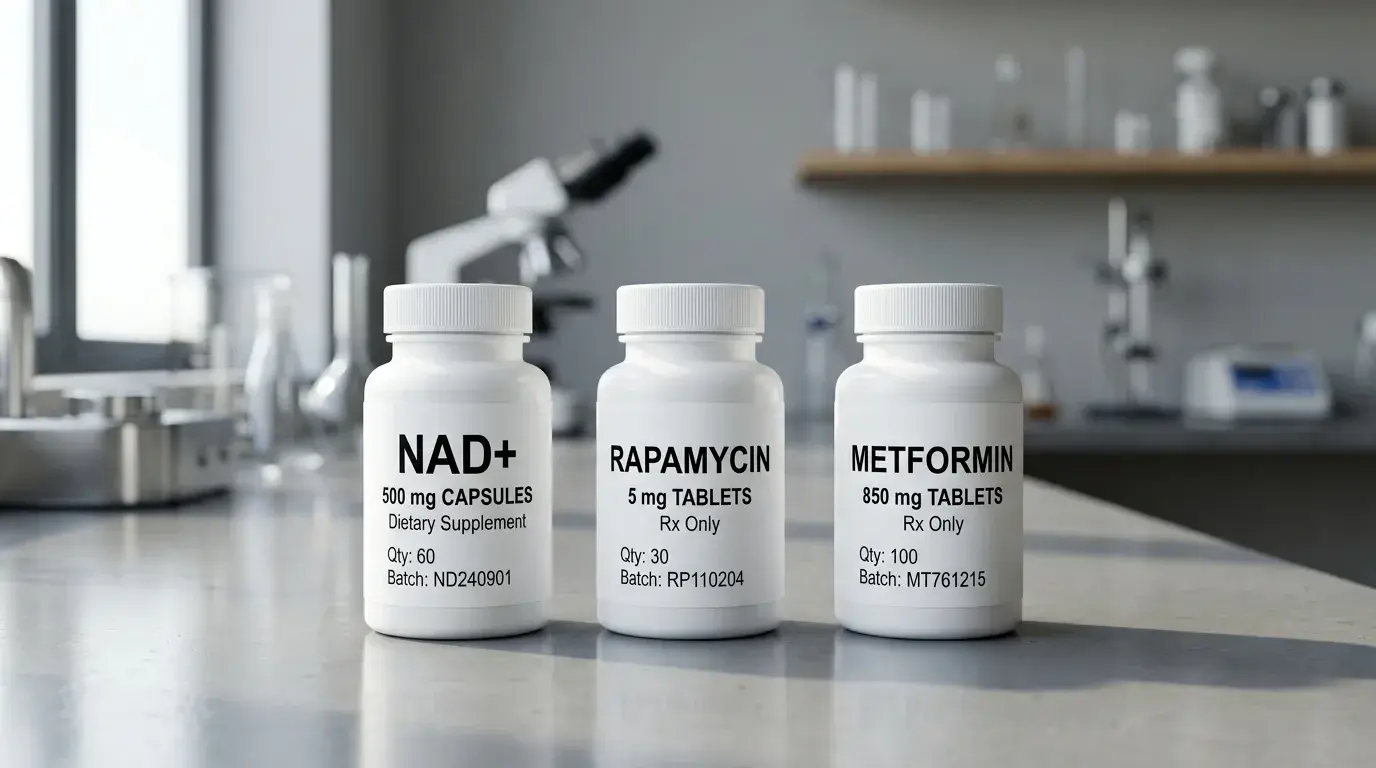
NAD+ precursors, rapamycin, and metformin are the three most discussed small-molecule longevity interventions with human trial data. They target different pathways — sirtuin/PARP cofactor supply, mTORC1 inhibition, and AMPK activation — and their evidence bases differ in depth, duration, and clinical endpoints. None is FDA-approved for longevity, and no randomized human trial has demonstrated a lifespan benefit for any of them.
Why compare these three at all?
Rapamycin, metformin, and NAD+ precursors dominate the geroscience conversation for one reason: each has been nominated as a candidate intervention by the National Institute on Aging's Interventions Testing Program (ITP) or by independent geroscience consortia, and each has at least preliminary human data. Most other longevity candidates — senolytics, GDF11, klotho, GLP-1 agonists for aging — either lack human trial infrastructure or are too early-stage to compare side-by-side.
The comparison is not “which works best.” No human trial has compared any two of them head-to-head, and no human longevity outcome trial has reported for any of them. The useful comparison is mechanism, evidence quality, dosing reality, safety profile, and regulatory status. That comparison shows three interventions at different points along the same translational arc — preclinical promise to human-grade evidence — with very different commercial and clinical contexts.
How do the three pathways differ mechanistically?
Each intervention enters the metabolic network at a different node. The pathways converge downstream — all three influence autophagy, mitochondrial function, and inflammatory tone — but the entry points are biochemically distinct.
Rapamycin inhibits mTORC1
Rapamycin (sirolimus) binds FKBP12, and the rapamycin-FKBP12 complex inhibits mechanistic target of rapamycin complex 1 (mTORC1). mTORC1 is the central nutrient-sensing kinase: when active, it drives protein synthesis, lipid synthesis, and ribosome biogenesis while suppressing autophagy. Inhibiting it produces a partial fasting mimetic state — increased autophagy, reduced anabolic load, and shifted protein quality control. Bjedov et al. (2010, Cell Metab) and the ITP's rapamycin lifespan studies (Harrison et al., 2009, Nature, PMID 19587680; Miller et al., 2011, J Gerontol A Biol Sci Med Sci) established the lifespan signal in mice.
Metformin activates AMPK indirectly
Metformin's primary action at therapeutic doses is partial inhibition of mitochondrial complex I, which reduces ATP production and lowers the AMP:ATP ratio. AMP-activated protein kinase (AMPK) senses that energy stress and switches the cell from anabolic to catabolic mode — increased glucose uptake, fatty acid oxidation, autophagy, and mitochondrial biogenesis. Metformin also inhibits hepatic glucose output (its diabetes mechanism) and modulates the gut microbiome. The longevity hypothesis rests on AMPK activation partially mimicking caloric restriction without dietary change.
NAD+ precursors fuel sirtuins, PARPs, and CD38
NAD+ is a cofactor, not a signaling molecule in the same sense as rapamycin's direct kinase inhibition. Cellular NAD+ levels decline with age across multiple tissues — see our primer on NAD+ tissue decline for the mechanistic picture. NAD+ precursors enter the salvage pathway and raise NAD+ availability, which in turn supports sirtuin (SIRT1-7) deacylation activity, PARP-mediated DNA damage response, and CD38 NADase activity. The proposed longevity contribution is the sirtuin axis — SIRT1 and SIRT3 in particular — modulating mitochondrial function, oxidative stress, and inflammatory signaling.
What does the rapamycin human evidence show?
Rapamycin has the strongest preclinical lifespan evidence of any small-molecule longevity candidate. The NIA's Interventions Testing Program — a multi-site standardized lifespan protocol — reported median lifespan extension in genetically heterogeneous mice when rapamycin was started in midlife (Harrison 2009; Miller 2011). That signal has held across replications and across late-life dosing windows. The translational question is whether the mouse lifespan signal predicts a human longevity benefit at tolerable doses.
Mannick et al. (2014, Sci Transl Med, PMID 24430518) ran the first major translational human trial. Healthy elderly adults received weekly RAD001 (everolimus, a rapamycin analog with similar mTORC1 kinetics) for six weeks at 0.5 mg/week, 5 mg/week, or 20 mg/month before influenza vaccination. The treatment groups showed enhanced antibody responses to vaccination — a marker of restored adaptive immune function. A follow-up trial (Mannick et al., 2018, Sci Transl Med, PMID 24856518/27440762 in some indices) extended the result to reduced respiratory tract infection rates over 12 months in community-dwelling elderly.
The Mannick trials are the cleanest human evidence that mTOR inhibition produces a measurable geroscience-relevant outcome — immune restoration — at doses tolerated for months. They are immune-endpoint trials, not lifespan trials. Extrapolating from improved vaccine response to extended lifespan requires assumptions the data do not directly support.
PEARL: the first randomized rapamycin longevity safety trial
The PEARL trial (NCT04488601, Participatory Evaluation of Aging with Rapamycin for Longevity), led by Dr. Stefanie Kennon-McGill and the AgelessRx team, is the first randomized placebo-controlled trial of rapamycin specifically designed for geroscience endpoints in healthy adults. Participants receive 5-10 mg compounded rapamycin weekly for 48 weeks. Primary endpoints are lean muscle mass and visceral adiposity changes by DEXA, with safety as a co-primary. PEARL is not a lifespan trial — no longevity trial of any kind in healthy adults has been adequately powered for an all-cause mortality endpoint at any reasonable duration — but it is the first to characterize off-label rapamycin in a controlled geroscience cohort.
Smaller trials and observational case series — particularly those documented through specialty longevity clinics and patient registries — have suggested weekly low-dose rapamycin (3-8 mg/week) is tolerated by most healthy adults for periods exceeding two years, with mouth ulcers, lipid elevation, and occasional infections as the main reported issues. These are not randomized data. The published peer-reviewed evidence for off-label rapamycin in healthy adults remains thin.
What does the metformin human evidence show?
Metformin has the largest population-scale observational dataset of any longevity candidate, by virtue of being prescribed to millions of people with type 2 diabetes since 1957. Bannister et al. (2014, Diabetes, Obesity and Metabolism) compared all-cause mortality in diabetics on metformin against non-diabetic matched controls in a UK primary care database and reported lower mortality in the metformin-diabetic group than in the non-diabetic comparison. The finding was widely cited as evidence that metformin might extend lifespan beyond its diabetes effect.
Subsequent reanalyses (Campbell et al., 2017; others) raised confounding concerns: prescribing patterns, indication bias, and survivor effects can produce apparent metformin advantages that disappear under stricter matching. The observational signal is suggestive but not strong evidence for a causal longevity benefit.
MILES: metformin in healthy older adults
Kulkarni et al. (2018, Aging Cell, PMID 32877101) reported the MILES (Metformin to Induce Longevity Effects in the Skeletal Muscle) trial — a randomized placebo-controlled trial in older adults without diabetes, testing metformin 1700 mg/day for 12 weeks. Skeletal muscle biopsy gene expression analysis showed metformin altered transcriptomic patterns toward a younger profile in some pathways, but participants showed reduced anabolic response to exercise — a tradeoff that has been raised as a concern for healthy adults using metformin alongside resistance training. MILES did not report functional or longevity endpoints.
TAME: the first geroscience-endpoint metformin trial
The TAME trial (NCT04571437, Targeting Aging with Metformin), led by Dr. Nir Barzilai at the American Federation for Aging Research, was designed as the first U.S. trial framed around a composite geroscience endpoint — incidence of any age-related disease (cancer, dementia, cardiovascular disease, mortality) over six years in adults aged 65-80. The trial would treat 3,000 participants with metformin 1500 mg/day or placebo. As of 2026, TAME has faced funding shortfalls and has not enrolled at the originally planned scale. The trial design itself — using a composite geroscience endpoint with FDA engagement — is an important regulatory precedent regardless of outcome.
Konopka et al. (2019, Aging Cell) and other smaller trials have examined metformin in non-diabetic older adults and reported mixed effects on insulin sensitivity, mitochondrial function, and exercise response. The pattern across trials is a metabolic intervention that has substantial effect sizes in diabetes and more modest, sometimes counterproductive effects in healthy older adults. No randomized trial has reported an all-cause mortality or lifespan endpoint for metformin in non-diabetic populations.
What does the NAD+ precursor human evidence show?
NAD+ precursors have the largest number of placebo-controlled randomized trials of the three interventions, but the trials are shorter and the endpoints are mostly biomarker-level. Our dosing protocols summary catalogs the dose ranges; this section focuses on what the evidence does and does not show.
Trammell et al. (2016, Nat Commun, PMID 26877054) characterized the first pharmacokinetic dataset for NR in humans — single oral doses raised blood NAD+ roughly 2.7-fold at 1 g, with reproducible dose-response across multiple subjects. The trial established that oral NR is bioavailable and that the salvage pathway responds at dose-relevant exposures.
Martens et al. (2018, Nat Commun, PMID 29404862) tested NR at 1 g/day for six weeks in healthy middle-aged and older adults. Blood NAD+ rose ~60% versus baseline, and the trial reported a modest reduction in systolic blood pressure (~6 mm Hg) in the prehypertensive subgroup. The result is the cleanest mid-duration safety and biomarker dataset for chronic NR dosing.
Yoshino et al. (2021, Science, PMID 33888614) tested NMN at 250 mg/day for 10 weeks in postmenopausal women with prediabetes. The trial reported improved muscle insulin sensitivity (the primary endpoint), without changes in body composition or systemic insulin sensitivity. The result is the first placebo-controlled functional metabolic improvement attributable to NMN in humans.
Brakedal et al. (2022, Cell Metab, PMID 35235774) — the NADPARK trial — tested NR in early-stage Parkinson's disease. NR engaged its target pathways (raised brain NAD+ measured by 31P-MRS, altered cerebrospinal fluid metabolite profile) and showed encouraging directional changes in clinical scores. The trial is a proof of pathway engagement in a CNS condition where NAD+ has mechanistic plausibility.
What the NAD+ evidence does not show
No NAD+ precursor trial has reported an all-cause mortality, major adverse cardiovascular event, or biological-age endpoint with randomization, adequate power, and multi-year duration. The longest published placebo-controlled trials run 8-12 weeks. The translational gap for NAD+ is the same one rapamycin and metformin face: biomarker movement is documented, lifespan benefit in humans is not. Long-term safety questions are covered in our long-term NAD+ safety overview.
How do the three dosing realities compare?
Dose comparison across the three is not apples-to-apples — they target different pathways with different pharmacokinetics — but the practical dosing landscape differs in important ways.
- Rapamycin: Off-label longevity protocols typically use 3-8 mg compounded weekly, sometimes cycled (e.g., on for eight weeks, off for two). The PEARL trial uses 5-10 mg/week. Transplant doses (2-5 mg/day continuous) are far higher and immunosuppressive; weekly low-dose protocols are designed to avoid that profile.
- Metformin: Standard diabetes dose is 500-2000 mg/day, divided. TAME and most longevity-framed trials use 1500-1700 mg/day. The dose space for metformin in non-diabetics is narrower than for diabetes — the upper end is constrained by gastrointestinal tolerability rather than efficacy ceiling.
- NAD+ precursors: Published NR trials span 100-2000 mg/day; published NMN trials span 125-1200 mg/day. See our NMN dosage breakdown and precursor dosing protocols summary for the full picture. Most efficacy data clusters at 250-1000 mg/day for NR and 250-600 mg/day for NMN.
A useful dose-comparison framing
A comparison table could plot the three interventions by typical longevity-protocol dose, FDA-approved indication dose, route of administration (all three are oral), and dosing frequency (rapamycin weekly, metformin daily-divided, NAD+ precursors daily). The mismatch between approved-indication dose and longevity-protocol dose is largest for rapamycin (weekly vs. daily) and smallest for NAD+ precursors (no approved indication, supplement dosing). That mismatch is itself a signal of the regulatory immaturity of the longevity use case for all three.
How do the safety profiles compare?
Each compound has a distinct safety profile and a distinct boundary on what is known. The honest comparison is not which is safest absolutely but which is safest at its longevity-protocol dose for the duration being considered.
Rapamycin safety
At transplant doses (2-5 mg/day continuous), rapamycin is immunosuppressive and carries documented risks of infection, impaired wound healing, lipid elevation, glucose intolerance, and mouth ulcers. Weekly low-dose protocols (3-8 mg/week) are designed to capture geroprotective mTORC1 inhibition without the chronic immunosuppression. Mannick's trials documented that weekly dosing actually enhances rather than suppresses adaptive immunity in elderly adults. The most common reported issues in low-dose protocols are mouth ulcers and modest lipid increases. Long-term safety in healthy adults is the open question PEARL is designed to characterize.
Metformin safety
Metformin's safety profile is well-characterized after seven decades of clinical use. Common issues are gastrointestinal upset (nausea, diarrhea, particularly at initiation) and B12 depletion with long-term use. Lactic acidosis is rare and largely confined to renal-impaired patients, though the FDA softened earlier renal contraindications in 2016. The MILES trial signal — reduced anabolic response to exercise — is not a classical safety event but is a relevant tradeoff for healthy adults whose protocol includes resistance training. Metformin's long-term safety in healthy non-diabetic adults at 1500 mg/day is less characterized than its safety in diabetics at the same dose.
NAD+ precursor safety
Conze et al. (2019, Sci Rep, PMID 31316207) reported NR safety at doses up to 2,000 mg/day for 8 weeks without serious adverse events. NMN trials (Yoshino 2021 at 250 mg/day for 10 weeks; Yamaguchi 2022 at up to 900 mg/day for 60 days) reported similarly clean profiles. The honest boundary on NAD+ precursor safety is the same as the efficacy boundary: human data extends to roughly 12 weeks of randomized exposure. Multi-year safety data in healthy adults does not exist for either NR or NMN.
What is the current FDA status of each?
The regulatory picture is the cleanest line of differentiation between the three.
Rapamycin (sirolimus) is FDA-approved for the prevention of organ rejection in kidney transplant patients (1999), for lymphangioleiomyomatosis (2015), and for certain rare vascular malformations. All longevity use is off-label. Compounded rapamycin is available through specialty pharmacies on physician prescription. The FDA has not granted a longevity indication for any drug, including rapamycin.
Metforminis FDA-approved for type 2 diabetes management (1994 in the U.S., earlier in Europe). All longevity use is off-label. Metformin is widely available, inexpensive, and prescribed in tens of millions of courses annually in the U.S. alone. The TAME trial was structured in part to engage the FDA on a geroscience composite endpoint — a regulatory precedent that could shape future longevity drug approvals regardless of TAME's outcome.
NAD+ precursorshave a more complicated regulatory picture. Nicotinamide riboside (NR, ChromaDex's Niagen) received FDA GRAS status in 2015 (NDIN 822) and is sold as a dietary ingredient. Nicotinamide mononucleotide (NMN) was excluded from dietary supplement classification by the FDA in 2022 on the grounds that it had been investigated as a drug — a determination that affected commercial NMN distribution in the U.S. but did not impose a ban. Neither NR nor NMN is an FDA-approved drug. Our NR vs NMN comparison covers the regulatory and evidence differences in detail.
Are combination protocols rational?
Some longevity practitioners combine two or all three of the interventions on a mechanistic-stacking rationale: rapamycin for autophagy and mTORC1 inhibition, metformin for AMPK activation and insulin sensitivity, NAD+ precursors for sirtuin/PARP cofactor supply. The rationale is reasonable on paper. The evidence base for combination protocols is essentially zero — no randomized trial has tested any pairing or all three together for any longevity-relevant endpoint.
Theoretical considerations cut in both directions. AMPK and mTOR cross-regulate, so adding metformin to rapamycin may amplify the autophagy effect or may create offsetting metabolic shifts. NAD+ precursors have not been studied in combination with either of the other two in published human trials. Drug-interaction data relevant to combinations is covered in our NAD+ drug interactions overview. The honest stance is that combination protocols are extrapolation layered on extrapolation.
Side-by-side: a useful framing
Pulling the comparison together across the dimensions that matter:
- Mechanism: Rapamycin (mTORC1 inhibition, direct kinase). Metformin (AMPK activation, indirect via complex I). NAD+ precursors (sirtuin/PARP/CD38 cofactor supply).
- Strongest preclinical lifespan signal: Rapamycin (ITP mouse data, multiple replications). Metformin (heterogeneous, smaller effect). NAD+ precursors (preclinical data exists but no consistent mouse lifespan extension at typical doses).
- Strongest human translational evidence: Rapamycin (Mannick immune trials, PEARL active). Metformin (large observational, MILES gene-expression). NAD+ precursors (multiple RCTs with biomarker and limited functional endpoints).
- Longest randomized human exposure documented: Metformin (decades in diabetics, 12 weeks in MILES non-diabetics). Rapamycin (12 months in Mannick 2018; ongoing PEARL). NAD+ precursors (8-12 weeks in published RCTs).
- FDA approval for longevity: None of the three. All off-label or off-classification.
- Regulatory accessibility: Metformin (most accessible — cheap, prescribed daily). Rapamycin (specialty compounding, physician prescription). NAD+ precursors (NR widely available as supplement; NMN constrained in U.S.).
Bottom line
Rapamycin has the strongest preclinical lifespan data and the best human evidence of a geroscience-relevant outcome (immune restoration in elderly adults). It is also the highest-friction intervention to access — specialty compounding, physician prescription, and a safety profile that requires monitoring at chronic doses. PEARL is the first randomized rapamycin longevity trial, and its readout will be informative regardless of direction.
Metformin has the largest observational dataset and the most regulatory precedent for a geroscience trial design (TAME). The observational signal is real but heavily confounded; the randomized evidence in healthy non-diabetics is mixed and includes a real tradeoff in exercise response. Metformin is the most accessible of the three and the cheapest, which makes it both the easiest to adopt and the easiest to mis-frame as a low-stakes longevity drug.
NAD+ precursors have the most short-duration randomized human trials but the shortest individual trial durations and the most biomarker-focused endpoints. The evidence base is growing — NR has been characterized across pharmacokinetic, metabolic, and neurological domains; NMN has emerging functional endpoint data — and neither has a longevity outcome trial. Both are accessible as supplements (NR more so than NMN in the U.S. post-2022).
The three are not interchangeable, not directly comparable on efficacy, and not equally well-characterized on safety. The framing that serves a reader best is not “which one” but “what evidence quality matches what decision.” Our evidence-grading methodology documents how each of these claims is graded, and our medical disclaimer covers the boundary between published research and personal medical advice. None of the three is a longevity drug today. Each is a translational candidate with different strengths, different gaps, and different open questions.
Frequently asked questions
- Is rapamycin, metformin, or NAD+ the best longevity drug in humans?
- None of the three has been shown in a randomized human trial to extend lifespan. Each targets a different pathway with different evidence quality: rapamycin (mTOR inhibition) has the strongest preclinical lifespan data and the PEARL safety trial (NCT04488601); metformin (AMPK activation) has the largest population-scale observational data and the planned TAME trial (NCT04571437); NAD+ precursors have multiple short-duration RCTs showing biomarker effects (Trammell 2016 PMID 26877054, Yoshino 2021 PMID 33888614) but no longevity outcome trial. All three are off-label for longevity in 2026.
- How do mTOR, AMPK, and sirtuin pathways differ?
- Rapamycin inhibits mTORC1, the nutrient-sensing kinase that drives anabolic growth and suppresses autophagy. Metformin activates AMPK indirectly by inhibiting mitochondrial complex I, mimicking a low-energy state. NAD+ precursors raise the cellular NAD+ pool that fuels sirtuins (deacetylases), PARPs (DNA repair), and CD38 (immune signaling). All three pathways converge on autophagy, mitochondrial function, and metabolic regulation but enter the network at different nodes.
- What human evidence exists for rapamycin in longevity?
- Mannick et al. (PMID 24430518) showed RAD001 (everolimus, a rapamycin analog) at 0.5-5 mg/week improved influenza vaccine response in elderly adults. A follow-up trial (PMID 27440762) confirmed reduced infection rates. The PEARL trial (NCT04488601) is the first long-duration randomized rapamycin safety study in healthy adults. No randomized human trial has reported a lifespan or all-cause mortality endpoint for rapamycin.
- What human evidence exists for metformin in longevity?
- Bannister et al. (2014, Diabetes Obes Metab) reported diabetics on metformin had lower all-cause mortality than non-diabetic controls in observational data — a striking but confounded finding. The MILES trial (Kulkarni et al., PMID 32877101) showed metformin altered skeletal muscle gene expression in older adults. The TAME trial (NCT04571437) is the first randomized geroscience-endpoint study but has been delayed and underfunded.
- What human evidence exists for NAD+ precursors in longevity?
- Multiple placebo-controlled RCTs document blood NAD+ elevation and biomarker changes. Trammell et al. (2016, PMID 26877054) characterized NR pharmacokinetics. Martens et al. (2018, PMID 29404862) showed NR raised NAD+ and modestly reduced systolic blood pressure. Yoshino et al. (2021, PMID 33888614) showed NMN improved muscle insulin sensitivity in postmenopausal women. Brakedal et al. (2022, PMID 35235774) reported NR engaged target pathways in Parkinson's. No NAD+ longevity outcome trial exists.
- Are any of these FDA-approved for longevity or anti-aging use?
- No. Rapamycin (sirolimus) is FDA-approved for organ-transplant rejection prevention and certain rare conditions. Metformin is FDA-approved for type 2 diabetes. Nicotinamide riboside has FDA GRAS status as a dietary ingredient (2015) but is not an approved drug. Nicotinamide mononucleotide was excluded from dietary supplement classification by the FDA in 2022. Use of any of the three for longevity is off-label or off-approved-indication.
- What are the safety differences between the three?
- Rapamycin has dose-dependent immunosuppression, mouth ulcers, and lipid elevation at transplant doses; weekly low-dose protocols (PEARL trial) report acceptable short-term tolerability. Metformin's main risks are gastrointestinal side effects, B12 depletion over time, and rare lactic acidosis in renal impairment. NAD+ precursor trials (NR, NMN) up to 12 weeks at doses through 2,000 mg/day report no serious adverse events but have no multi-year safety data. None has been studied for decade-scale exposure in healthy adults.