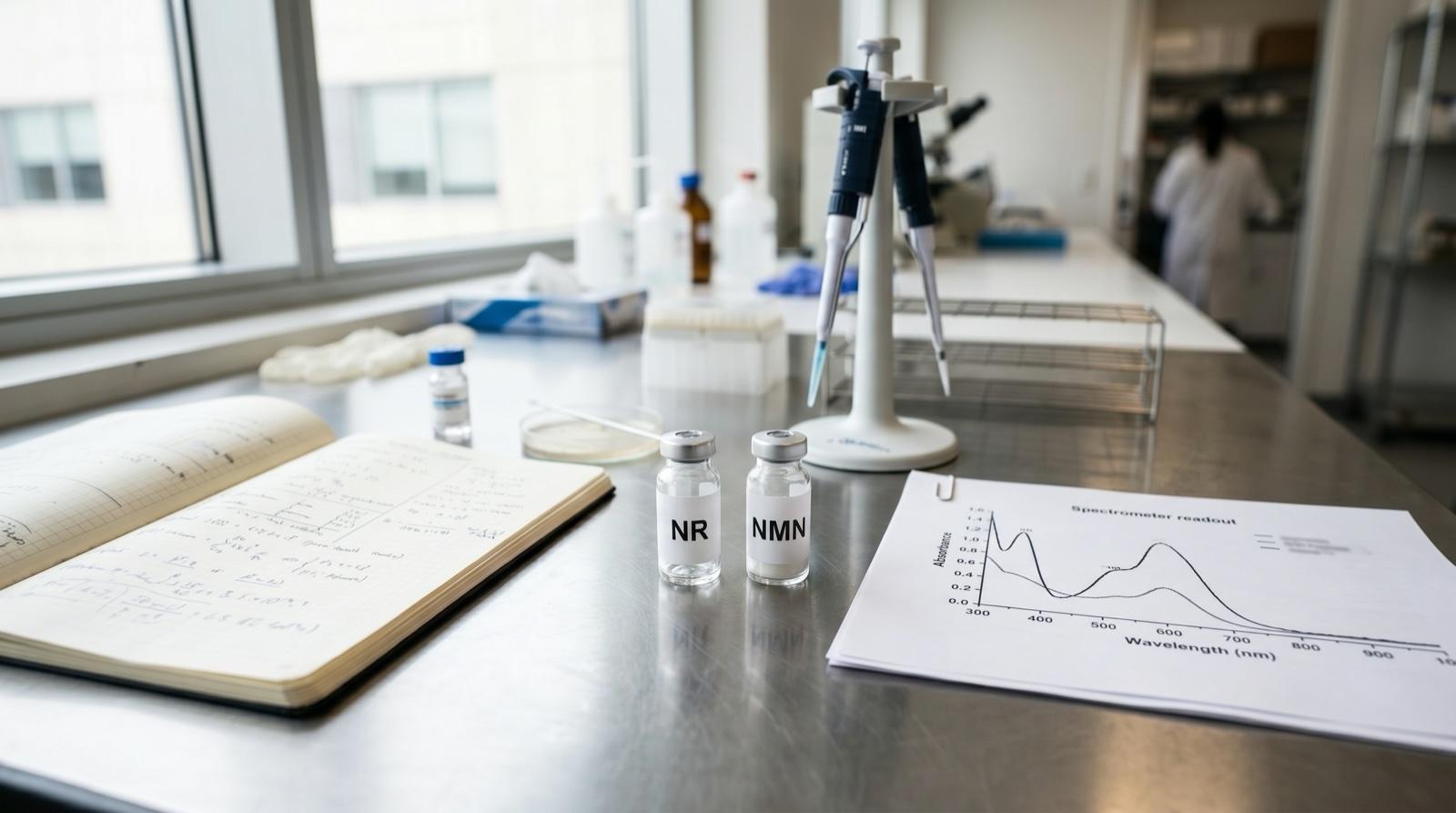
Nicotinamide (NAM) vs NR vs NMN: The Forgotten Third Precursor and Its Homocysteine Problem
A neutral comparison of nicotinamide vs NR vs NMN — pharmacokinetics, methylation burden, homocysteine signals, cost per mmol, and human trial evidence.
Nicotinamide (NAM, niacinamide), nicotinamide riboside (NR), and nicotinamide mononucleotide (NMN) all elevate NAD+ in humans, but they enter the salvage pathway at different points and carry different trade-offs. NAM is the cheapest by orders of magnitude, NR has the deepest tissue-level evidence, NMN has a clean metabolic-endpoint RCT, and only NAM has documented homocysteine signals at sustained high doses.
Why NAM gets skipped in the marketing conversation
Walk into any longevity-supplement comparison and you will see NR and NMN presented as the only serious precursors. Nicotinamide — the third precursor that has been on pharmacy shelves for over fifty years as a pellagra prevention agent and dermatology adjunct — is usually omitted or footnoted. The reason is commercial, not scientific.
NAM is a generic. It is sold by the kilogram for cents, has no patent protection, and supports no premium consumer brand. The peer-reviewed literature, by contrast, has studied NAM as an NAD+ precursor for decades — long before NR or NMN were commercially available — and the biochemistry is well-mapped (Sims et al. 2023, NAD+ pharmacokinetics review).
The honest framing is that NAM is the baseline against which NR and NMN must justify their price premium. Whether they do is an empirical question, and the answer depends on which endpoint you care about.
Three precursors, three entry points into the salvage pathway
NAM, NR, and NMN are not interchangeable substrates that converge at the same step. They enter the NAD+ salvage pathway at three distinct points, each with different enzymatic dependencies and different rate-limiting bottlenecks.
NAM is the substrate for NAMPT (nicotinamide phosphoribosyltransferase), which adds a phosphoribose group to produce NMN. NAMPT is the rate-limiting enzyme of the salvage pathway in most tissues, and its activity declines with age (Camacho-Pereira et al. 2016, PMID 27304511). Routing NAD+ replenishment through NAM means routing it through this declining bottleneck.
NR bypasses NAMPT entirely. The NRK1 and NRK2 kinases phosphorylate NR directly to NMN (Bieganowski and Brenner 2004, PMID 15137942). This is the mechanistic basis for the clinical interest in NR — it offers a salvage-pathway entry point that does not depend on the age-compromised enzyme.
NMN sits one step downstream of NR. Once inside the cell, NMN is adenylated by NMNAT1-3 directly to NAD+. The unresolved question is whether oral NMN crosses the gut wall intact (via the disputed Slc12a8 transporter — see our analysis at the Grozio 2019 paper) or is dephosphorylated to NR in the gut lumen and reassembled intracellularly. Our NR vs NMN deep-dive covers the Slc12a8 controversy in detail.
What does cost-per-mmol look like across the three?
The price gap between NAM and the patented precursors is not a small premium — it is roughly two to three orders of magnitude on a per-mmol basis at consumer pricing. This is the single largest practical differentiator in the comparison and is rarely surfaced honestly in consumer-facing content.
On a strict mmol-of-precursor-delivered basis, the gap is even wider: NAM's lower molecular weight (122 g/mol versus 255 g/mol for NR and 334 g/mol for NMN) means a gram of NAM delivers roughly twice the molar dose of NR and roughly 2.7 times the molar dose of NMN. The cost-per-mmol gap therefore exceeds the cost-per-gram gap.
This matters because the question “does NAM raise NAD+” has a different answer at different doses. At 500 mg/day NAM, you are delivering roughly 4 mmol — comparable in molar terms to 1 g/day NR or 1.3 g/day NMN. Whether that delivers comparable NAD+ elevation depends on the NAMPT bottleneck and on tissue-specific transporter expression.
How does NAD+ elevation compare across precursors?
Direct head-to-head NAD+ elevation data across all three precursors at equivalent molar doses in the same population does not exist. The comparison must be assembled from separate trials with different designs, populations, and assay methods (evidence grade: indirect — non-comparable studies, no head-to-head RCT).
The Trammell et al. (2016, Nature Communications, PMID 27721479) study showed roughly 2.7-fold whole-blood NAD+ elevation after a 1 g oral dose of NR. NMN at 250 mg/day in the Yoshino et al. (2021, Science, PMID 33888596) trial produced approximately 30 to 40% elevation in related metabolome markers in postmenopausal prediabetic women. Higher-dose NMN (Yamaguchi et al. 2022, up to 900 mg/day) reported larger elevations consistent with dose-response.
NAM's NAD+ elevation in healthy humans is documented in older literature and reviewed in Sims et al. (2023). The pharmacokinetic profile is reliable but the data resolution is lower than for NR — fewer recent placebo-controlled trials use NAM as the test compound, because commercial interest has shifted to patented precursors.
The methylation burden and the homocysteine problem
Every NAD+ precursor that ends in nicotinamide eventually generates free NAM as it cycles through the salvage pathway. Free NAM is either re-salvaged (via NAMPT) or excreted — and the dominant excretion route is methylation to N1-methylnicotinamide (MNA) by NNMT (nicotinamide N-methyltransferase), using S-adenosyl-methionine (SAM) as the methyl donor (Shats et al. 2020, NAD methylome study).
This is the methylation-burden argument: sustained high-dose NAM (or any precursor that bottoms out at NAM) draws on the SAM pool, which also supplies methyl groups for DNA methylation, neurotransmitter synthesis, phosphatidylcholine production, and homocysteine remethylation. Drain SAM faster than it regenerates and homocysteine rises.
Sun et al. (2012, Atherosclerosis) reported NAM at 1 g/day for one year in hemodialysis patients raised plasma homocysteine. The population is not generalizable — hemodialysis patients have impaired methyl-group handling at baseline — but the signal is real. The Bostom et al. (2018) niacin meta-analyses (a different precursor, but the same methylation-pathway endpoint) corroborate that high-dose B3 compounds can shift homocysteine.
NR and NMN trials at studied doses have not reported comparable homocysteine elevation. Conze et al. (2019, Sci Rep, PMID 31316207) documented NR up to 2,000 mg/day for eight weeks without significant homocysteine changes. The CHRONOS trial (Conze et al., extended NR safety) and Yoshino 2021 NMN data similarly show no elevation. This is consistent with — but does not prove — the hypothesis that upstream-entry precursors (NR, NMN) generate proportionally less free NAM for methylation than direct NAM dosing.
The methyl-donor-sparing argument
The pharmacological logic of choosing NR or NMN over NAM, beyond bypassing the NAMPT bottleneck, is that the higher per-mmol cost buys you a precursor that does not enter the methylation cycle until after cellular salvage has already taken its share. In theory, this preserves more SAM for non-NAD+ methylation reactions.
In practice, this argument has not been directly tested in a head-to-head trial measuring SAM, methyl-donor markers, and homocysteine across all three precursors at equimolar doses. It is a biochemically reasonable hypothesis, not a demonstrated clinical difference at typical supplement doses. Trimethylglycine (TMG) co-administration is sometimes added to NAM, NR, and NMN protocols on this premise but is not supported by strong human evidence.
Hepatic and metabolic considerations
Hwang et al. (2017) reported NAM-induced hepatic effects in animal models of fatty liver, raising flags about high-dose NAM in metabolically compromised populations. The mechanism appears related to altered NAD+/NADH ratio and one-carbon-metabolism stress in already steatotic livers. This is a preclinical signal, not human evidence, and dose-translation to human supplementation is not direct.
For metabolically healthy adults at moderate NAM doses (500 mg/day or less), no comparable hepatic signal has been documented in the peer-reviewed literature. The Chen et al. (2015) ONTRAC trial (PMID 26488693) used 500 mg twice daily NAM for 12 months in non-melanoma-skin-cancer-prone adults and reported no significant hepatic or renal safety signals — a relatively long-duration human dataset that informs the moderate-dose safety case.
NR's hepatic profile is also clean at studied doses (Conze 2019, Dollerup 2018 PMID 29992272). NMN's long-duration hepatic data is thinner. None of these data sets cover daily dosing across decades — the actual time horizon supplement users target.
The trade-off matrix, not a ranking
A neutral framing of the three-precursor comparison looks like a trade-off matrix, not a winner-and-losers list. The same property is a feature in one context and a cost in another.
- NAM — cheapest, longest commercial track record, decades of moderate-dose safety data, but routes through the age-declining NAMPT step and carries the documented methylation burden at sustained high doses.
- NR — bypasses NAMPT, deepest pharmacokinetic and tissue-level human evidence (Elhassan 2019 muscle biopsy data), no homocysteine signal at studied doses, FDA GRAS since 2015. Higher cost; patented; chemically less stable than NAM.
- NMN — one step further downstream, single high-quality mechanistic RCT for muscle insulin sensitivity (Yoshino 2021), unresolved Slc12a8 transporter question, US regulatory status under NDIN review since 2022. Highest cost; thinnest tissue-level data.
The choice between them is not which is “best” but which question you are trying to answer, in which population, at what budget, with what safety reserve. Our precursor comparison matrix lays the parameters side-by-side without rendering a verdict.
When NAM is the rational choice
- You want a low-cost baseline to test whether any NAD+ precursor produces a subjective effect for you before committing to the expensive ones.
- Your use case is dermatologic (Chen 2015 documented the chemoprevention effect at 500 mg twice daily) rather than longevity-mechanism-focused.
- You are willing to manage methyl-donor status with adequate folate, B12, choline, and (if indicated) TMG co-supplementation, and your baseline homocysteine is in range.
- You have no metabolic-liver-disease risk factors that would amplify the Hwang 2017 preclinical concerns.
When NR is the rational choice
- You want the deepest human evidence base for tissue-level NAD+ elevation (Elhassan 2019 skeletal-muscle biopsy result).
- You want to bypass the NAMPT bottleneck specifically — reasonable in older populations where NAMPT activity decline is the proposed mechanism of NAD+ loss.
- You want regulatory clarity (FDA GRAS, NDIN 822, established dietary-supplement classification) and a stable supply chain.
When NMN is the rational choice
- Your specific endpoint is muscle insulin sensitivity in a population resembling Yoshino 2021 (postmenopausal, prediabetic).
- You accept the unresolved Slc12a8 transporter question and the ongoing US regulatory uncertainty.
- You have access to verified third-party-tested NMN — counterfeit and underdosed product is more common in this category given fragmented manufacturing.
Long-term safety: the honest boundary
Long-term, multi-year, daily-dosing safety data does not exist for any of the three precursors at the doses common in longevity protocols (Imai 2023 review of NMN longevity research; Sims 2023 review of precursor pharmacokinetics). The Knip et al. (2000) ENDIT trial used 1.2 g/m2/day NAM in children at type 1 diabetes risk for five years without clear safety signals, which is the longest-duration high-dose NAM human dataset, but the population is not generalizable to adult longevity use.
For NR, the Conze CHRONOS extension trial and post-marketing surveillance support short-to-medium-term safety. For NMN, the longest published human trials are roughly 12 weeks. Multi-year daily-dosing data is genuinely absent for all three.
This is the honest boundary of the evidence. Anyone telling you with confidence that decades of daily NAM, NR, or NMN are safe is extrapolating beyond the published data. Our long-term NAD+ precursor safety overview covers what is and is not established.
The forgotten third precursor, revisited
NAM is “forgotten” in the longevity-supplement conversation because there is no commercial reason to remember it. Scientifically, it remains the baseline against which NR and NMN must justify their per-mmol premium, and it is the precursor with the longest moderate-dose human safety record (Chen 2015 ONTRAC, decades of pellagra-prevention dosing, dermatology adjunct use).
The homocysteine question is real — Sun 2012 documented it — but it is dose- and population-dependent. The methylation-burden argument is biochemically coherent but has not been head-to-head tested at equimolar doses across the three precursors in the same population.
The most honest takeaway for someone evaluating nicotinamide vs NR vs NMN is this: the published evidence supports all three as NAD+-elevating interventions in humans at studied doses. None has been demonstrated superior across all endpoints. The price gap is real and large. The methylation-burden difference is plausible but not directly tested. Long-term safety across decades is not established for any. The right choice depends on what you are trying to do, not on which molecule has the best marketing.
References
- Bieganowski P, Brenner C. Discoveries of nicotinamide riboside as a nutrient and conserved NRK genes establish a Preiss-Handler independent route to NAD+ in fungi and humans. Cell. 2004. PMID 15137942.
- Bostom AG et al. (2018) niacin homocysteine meta-analyses, related methylation-pathway endpoints in B3-class compounds.
- Camacho-Pereira J et al. CD38 dictates age-related NAD decline and mitochondrial dysfunction through an SIRT3-dependent mechanism. Cell Metabolism. 2016. PMID 27304511.
- Chen AC et al. A phase 3 randomized trial of nicotinamide for skin-cancer chemoprevention (ONTRAC). NEJM. 2015. PMID 26488693.
- Conze D et al. Safety and metabolism of long-term administration of NIAGEN (NR) in a randomized clinical trial. Sci Rep. 2019. PMID 31316207.
- Conze D et al. CHRONOS NR safety extension data — see the safety overview at /blog/safety-long-term.
- Dollerup OL et al. A randomized placebo-controlled clinical trial of nicotinamide riboside in obese men. AJCN. 2018. PMID 29992272.
- Elhassan YS et al. Nicotinamide riboside augments the aged human skeletal muscle NAD+ metabolome. Cell Reports. 2019. PMID 31412242.
- Grozio A et al. Slc12a8 is a nicotinamide mononucleotide transporter. Nat Metab. 2019.
- Hwang ES, Song SB. Nicotinamide is an inhibitor of SIRT1 in vitro, but can be a stimulator in cells; effects in fatty liver context. 2017.
- Imai S. NMN and NAD+ in longevity research — review and translational status. 2023.
- Knip M et al. Safety of high-dose nicotinamide: ENDIT trial. 2000.
- Martens CR et al. Chronic nicotinamide riboside supplementation is well-tolerated and elevates NAD+ in healthy middle-aged and older adults. Nat Commun. 2018. PMID 29599478.
- Shats I et al. Bacteria boost mammalian host NAD metabolism by engaging the deamidated biosynthesis pathway; methylome implications. 2020.
- Sims CA et al. NAD+ pharmacokinetics — review of precursor delivery in human trials. 2023.
- Sun CY et al. Nicotinamide and homocysteine elevation in hemodialysis patients. Atherosclerosis. 2012.
- Trammell SAJ et al. Nicotinamide riboside is uniquely and orally bioavailable in mice and humans. Nat Commun. 2016. PMID 27721479.
- Yamaguchi S et al. Safety and effects of NMN supplementation in healthy adults. 2022.
- Yoshino M et al. Nicotinamide mononucleotide increases muscle insulin sensitivity in prediabetic women. Science. 2021. PMID 33888596.
This article is editorial coverage and does not constitute medical advice. Dosing decisions for any NAD+ precursor — particularly in populations with kidney, liver, or methylation-cycle conditions — should be discussed with a qualified clinician. See our medical disclaimer and evidence-grading methodology for the framework behind these summaries.
Frequently asked questions
- Is nicotinamide the same as NR?
- No. Nicotinamide (NAM, also called niacinamide) is the simple amide form of vitamin B3 — molecular formula C6H6N2O. Nicotinamide riboside (NR) is NAM with a ribose sugar attached, formula C11H16N2O5. Inside cells they enter the salvage pathway at different points: NAM is processed by NAMPT (the rate-limiting enzyme), while NR is phosphorylated by NRK1/NRK2 directly to NMN, bypassing the NAMPT bottleneck (Bieganowski and Brenner 2004, PMID 15137942).
- Does nicotinamide raise NAD+ in humans?
- Yes. Oral NAM elevates whole-blood and tissue NAD+ in published human work, though peer-reviewed pharmacokinetic data on NAM is older and less granular than NR data. Sims et al. (2023) reviewed NAD+ precursor pharmacokinetics and noted NAM is well-absorbed across studied doses. The trade-off is methylation burden: every NAM molecule is eventually methylated and excreted, drawing on the SAM pool.
- Why is NAM cheaper than NMN?
- NAM is a commodity vitamin produced industrially by ammonolysis of nicotinic acid or hydrolysis of 3-cyanopyridine. It has been manufactured at scale for decades for pellagra prevention, animal feed, and cosmetic formulations. Bulk NAM costs roughly two to three orders of magnitude less per gram than pharmaceutical-grade NMN, which is produced by a more complex enzymatic or chemoenzymatic synthesis at lower volumes.
- Does niacinamide raise homocysteine?
- High-dose NAM can elevate homocysteine in some populations. Sun et al. (2012) reported NAM at 1 g/day for one year in hemodialysis patients raised plasma homocysteine. The mechanism is methyl-pool depletion: NAM is methylated to N1-methylnicotinamide by NNMT using SAM, and sustained high-dose intake can outpace methyl regeneration. Lower doses (under 500 mg/day) and adequate folate/B12/choline status appear to mitigate the signal, though this has not been rigorously tested in healthy adults.
- Is nicotinamide safe long term?
- Short-term safety at 500 to 1500 mg/day is documented in dermatology and chemoprevention trials (Chen et al. 2015, ONTRAC trial; PMID 26488693). Long-term high-dose safety is less established. Hwang et al. (2017) reported NAM-induced hepatic effects in animal models of fatty liver, raising flags for at-risk populations. Knip et al. (2000) ENDIT trial used 1.2 g/m2/day in children at type 1 diabetes risk for five years without clear safety signals. Long-term high-dose NAM in metabolically compromised adults remains under-studied.
- Which NAD precursor is best?
- No single precursor is established as superior across all endpoints in humans. NR has the deepest pharmacokinetic and tissue-level evidence base (Trammell 2016, PMID 27721479; Elhassan 2019). NMN has a single high-quality mechanistic RCT for muscle insulin sensitivity (Yoshino 2021). NAM has decades of safety data at moderate doses and is by far the cheapest, but carries methylation-burden questions at chronic high doses. The choice depends on the question, not a ranking.